


The iconic duo that anchors Eid celebrations across Bangladesh

I remember a passing exchange from over a decade ago, almost throwaway in its brevity, that lodged itself with curious permanence.
“Eid er din ki korben?” came the question. “Polao khabo,” the answer.

No elaboration, no flourish. Yet in that sparse reply lay an entire script of liturgy.
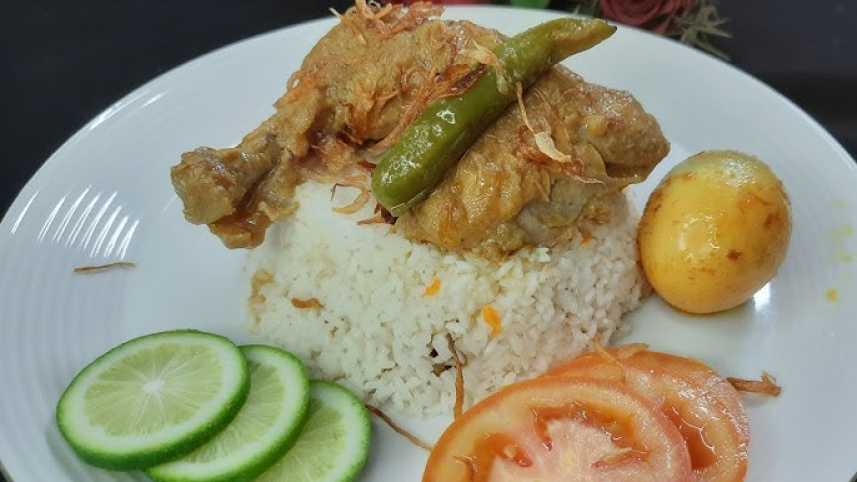
For Eid, in our subcontinent is not merely observed, it is also plated. And for Bangladeshis, at the heart of that plate, gleaming with ghee and gravitas, sits polao, attended faithfully by chicken roast, shami kabab, and a cooling glass of borhani or fizzy drink of your choice.
The menu, though, is less a choice than a cultural reflex, an inheritance rehearsed annually with near-liturgical devotion.
Gastronomic grammar
Eid-ul-Fitr arrives as a gastronomic crescendo after the ascetic diminuendo of Ramadan.
Polao and roast on Eid are not just celebratory food but also edible recompense.
The rice, each grain distinct and perfumed, glistens with ghee and whispers of cardamom and cinnamon. The roast, languorous in its creamy, faintly piquant gravy, offers a richness that feels both indulgent and deserved.
In the quotidian Bangladeshi kitchen, rice is a staple, humble and ubiquitous. But polao is rice elevated -- transfigured by aroma, texture, and technique into something almost ceremonial.
The choice of fragrant Kalijira rice is no accident; it is a deliberate invocation of refinement.
Similarly, roast is not simply chicken cooked through. It is chicken coaxed into opulence -- marinated, slow-cooked, and enrobed in a gravy that balances sweetness with a subtle tang.
Together, they articulate a culinary luxury that distinguishes Eid from the everyday.
The plate becomes a proclamation -- today is not ordinary.
Flavours that flowed down
The polao-roast pairing carries within it the echoes of empire and evolution.
Polao, etymologically and gastronomically linked to the Persian pilaf, travelled through Central Asian and Mughal corridors before finding a localised expression in Bengal. Here, it shed some of its imperial austerity and absorbed a sweeter, more aromatic identity, befitting the region’s palate.
Roast, particularly the creamy, mildly sweet Bengali chicken roast, is a later improvisation -- a syncretic creation shaped by Mughal techniques, colonial-era culinary exchanges and indigenous preferences. It is less fiery than its North Indian cousins, more nuanced, almost courtly in its restraint.
Together, polao and roast form a culinary palimpsest -- layers of history rewritten in each generation’s kitchen.
 For all latest news, follow The Daily Star's Google News channel.
 A culinary choreography
Eid meals in Bangladesh are rarely solitary affairs.
The kitchen expands, the table elongates, and the home becomes porous, welcoming a procession of relatives, neighbours and friends.
Polao and roast, in this context, function as social adhesives. They are prepared in generous quantities, designed to be shared, replenished, and admired.
The accompanying shami kabab adds a note of spiced depth, while borhani -- tart, herbed, and cooling -- cuts through the richness with refreshing precision. To serve this ensemble is to perform hospitality in its most articulate form.
It signals not merely abundance but attentiveness, a desire to honour the guest with something deemed worthy of the occasion.
What makes polao and roast enduring is not merely their taste, but their capacity to carry memory.
The aroma of ghee-laced rice can summon childhood Eids; the sight of a carefully arranged platter can evoke absent faces and older homes.
In that sense, the earlier overheard exchange was less about food and more about belonging. “Polao khabo” was shorthand for an entire experience.
Eid in Bangladesh is thus as much an act of remembrance as it is of celebration.
And polao with roast, in all their fragrant finery, remain its most eloquent expression -- a dish that feeds not only the body, but the collective memory of a people.
Comments