


Pure water crisis in Tanguar Haor
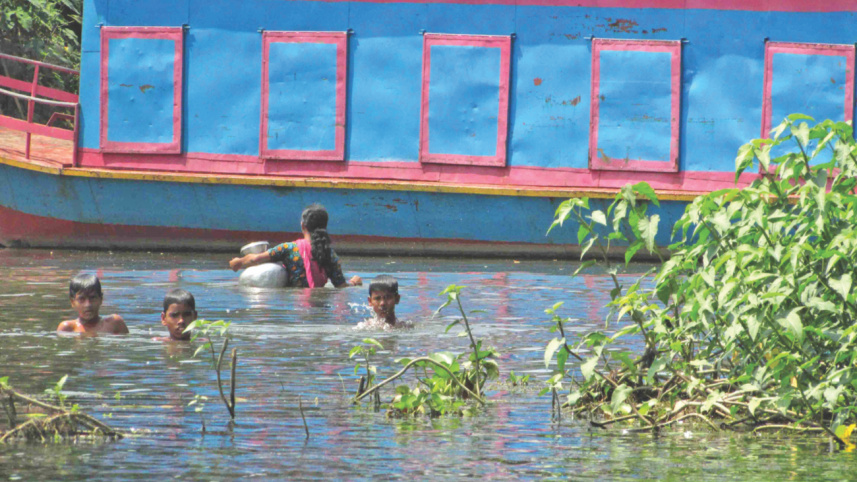
A tourist magnet, Tanguar Haor wetland in Taherpur upazila of Sunamganj is nothing if not beautiful. The about one lakh people who call the haor home likewise enjoy the idyllic scenery, as it changes with every season. But despite the fact that for at least half the year they live surrounded by water, many residents face a serious problem: a lack of reliable drinking water.
"People in this area, including the children, commonly contract water-borne diseases," says Morjina Begum, 38, a housewife from Gulabari village. "It's because they drink impure water."

"We collect water direct from the haor," says neighbour Sila Begum, 42. "We use haor water for drinking, cooking and other household work." In at least 88 fishing villages including Gulabari, there is an ongoing fresh water crisis.
The area has no lack of tube wells, which should offer a safer alternative; but underground water supplies in the haor area are tainted by high levels of arsenic and iron, making tube well water unfit for consumption.
"We have no alternative but to drink the haor water," says Husna Begum 45, another local housewife, "even though it can give us dysentery and diarrhoea."
Villager Sefhola Das, 45, says that with his younger brother he tried to find a solution to the drinking water crisis for their family. They constructed a 1,000-foot deep tube well. "But the tube well water was full of arsenic," he says.
Housewife Sabina Akhter, 38, also notes the unsafe condition of tube well water. "The tube well water is polluted by arsenic and iron: the reason I collect drinking water from the haor instead."
Neighbour Tomij Miah adds that when children and family members are ill from drinking the haor water, many families cannot even afford basic medicines to treat them. "Many of us live hand-to-mouth," he says. "We want government intervention, with a master plan to solve our water crisis."
Saikat Roy, a sub-assistant engineer with the department of public health engineering notes that the international acceptable standard per litre for arsenic is 0.01 milligrams, and in Bangladesh it is 0.05 milligrams per litre. But in the Tanguar Haor area deep tube wells record levels of 0.07 milligrams of arsenic per litre.
Although he says iron offers less of a health risk, iron levels in the area's underground supply are astronomical. "The standard in Bangladesh is 0.01 – 0.02 milligrams per litre," he says, "but in Tanguar Haor area deep tube well water contains 2 milligrams of iron per litre."
"We can't forbid people to draw water from the wells," he says, "because they use it for household chores; but if consumed the arsenic in particular will damage their kidneys, skin and liver. It causes cancer, stroke and diabetes. We promote awareness of the dangers and advise people to drink boiled surface water and rainwater."
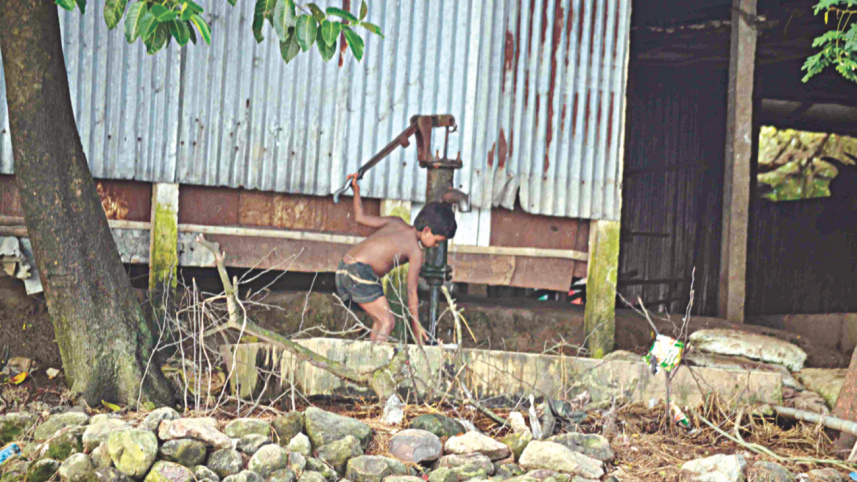
Taherpur upazila chairman Kamruzzaman Kamrul acknowledges that around one lakh people in Tanguar Haor area face an acute drinking water crisis. He says he has requested the administration to make a master plan to ensure safe supplies.
"The haor is painted by the three main seasons of winter, summer and monsoon," contemplates Amirul Islam, a fisher from Gulabari village. "Each season has its own beauty. To look across the water to the horizon in the monsoon makes me realise how tiny we are in this grand universe. The haor has diverse people and wildlife; the area is mesmerising. But nobody thinks about us."
 For all latest news, follow The Daily Star's Google News channel.
Comments