


‘Fake News Funeral’ event highlights digital violence risks among youth in Dhaka
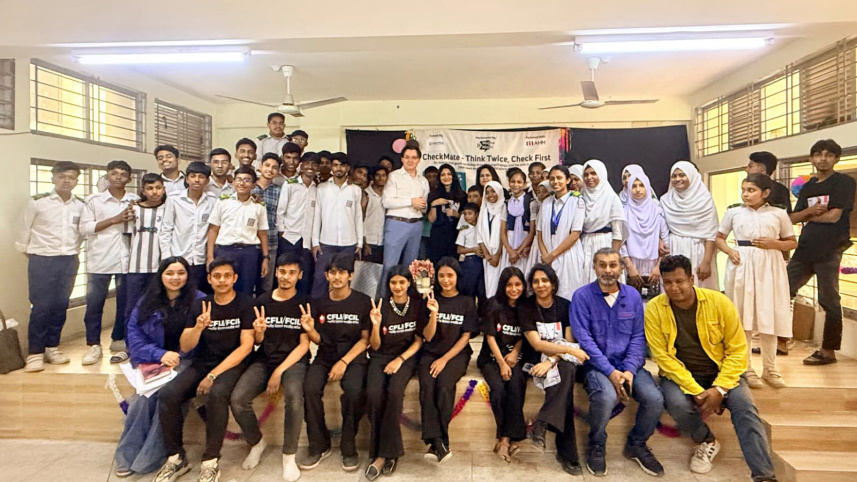
An awareness event on digital violence and misinformation was held at Banani Model School in Dhaka, aiming to educate students on online safety and the real-life consequences of fake news.
The programme, titled “Fakenews Funeral (Bhuya Khobor-er Din Shesh)”, was organised by MajhaMajhi under its Checkmate – Think Twice, Check First project to promote critical thinking, digital wellbeing and proactive safety education among young people, says a press release.

The event began with an interactive art performance and a participatory stage play, followed by a panel discussion involving experts from diplomacy, psychology, law and lived experience.
Marcus Davies, political counsellor at the High Commission of Canada to Bangladesh, opened his session with an interactive activity to engage students and reduce stress. He said, “It is crucial to protect the digital space so that it can protect you. That is why Canada prioritizes digital safety.”
Syed Tanvir, associate professor at the Department of Psychology of Dhaka University, spoke on the psychological impact of online abuse. He said, “When you face digital violence, you are not just facing something virtual; it causes real physical and emotional harm, often leading to Post-Traumatic Stress Disorder (PTSD).” He also urged parents to monitor their children’s internet use.
Priya Ahsan Chowdhury, barrister and advocate of the Supreme Court of Bangladesh and adviser on cyber support for women and children at Bangladesh Legal Aid and Services Trust, highlighted legal protections against online abuse. She said, “There are numerous new laws in Bangladesh to protect and support women and children in the digital space,” and advised filing a general diary immediately in cases of digital violence.
Md Arif, a survivor of digital fraud, shared his personal experience of losing more than Tk 30,000 to online scammers. He cautioned students, saying, “Don’t make the mistake I did. If an unknown number or anyone tries to be your friend and, in return, asks you to share your OTP, don’t share it.”
Supported by the Canada Fund for Local Initiatives and the High Commission of Canada to Bangladesh, the event was attended by policymakers, educators and activists. It featured student-led storytelling, short stage performances, dance and art installations highlighting the psychological and social consequences of digital violence.
MajhaMajhi said the initiative underlines the need for stronger education on mental health, digital literacy and online verification, particularly for young people from marginalised communities. The programme also guided students on how to identify fake news and how to support friends who become victims of digital harm.
 For all latest news, follow The Daily Star's Google News channel.
Comments