


Post-LDG export loss may create new poor


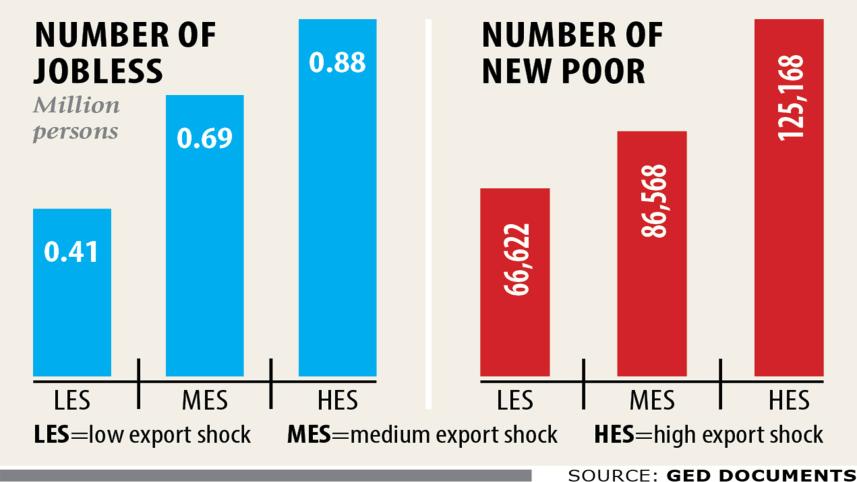
At least 66,622 people would fall below the poverty line due to the decline in exports following Bangladesh's graduation to a developing nation from the group of least-developed countries, according to a government analysis.
The number of poor is likely to increase from 24.09 million to 24.16 million, according to the "Impact Assessment and Coping up Strategies of Graduation from LDC Status for Bangladesh" of the General Economics Division of the planning ministry.

However, 86,568 new people may turn poor under the medium export shock scenario, implying a head count poverty rate of 13.18 per cent.
The poverty rate may jump to 13.24 per cent under the high export shock scenario as the number of new poor will be 125,168, the document said.
With more than 8.5 per cent economic growth, the head count poverty is projected to drop to 13.1 per cent in 2027 under the business as usual scenario. However, economic contraction due to LDC graduation may to cause the poverty level to rise, the report said.
The head count poverty rate declined to 24.3 per cent in 2016 from 31.5 per cent in 2010, aided by higher economic growth, job creation, and robust flow of remittance.
"However, gains in poverty reduction remain highly precarious as most households that escaped poverty did so by only a small margin," the document said.
Speaking about the GED observation, Ahsan H Mansur, executive director of the Policy Research Institute of Bangladesh, said the real impacts of graduation could be understood after 2024, the year when the country will start facing the graduation challenges.
"New people may fall into poverty because of graduation as market access for Bangladesh will get squeezed."
However, if Bangladesh can obtain the generalised system of preferences (GSP) Plus status in the European Union, the poverty rate might not increase as higher exports will generate jobs, Mansur said.
There is a possibility of gaining the status as Bangladesh is a major exporter to the bloc, he said.
If Bangladesh can meet EU conditions, which include ratifying 27 international conventions in the areas of governance, environment, labour and human rights, the EU may offer the country the GSP Plus status.
"Offering the GSP Plus status to any country is a political decision of the EU," said Mansur, adding that Bangladesh needs to lobby with the EU. The former official of the International Monetary Fund suggested the government initiate talks with Germany and France to gain the status after 2024.
If the GSP Plus status is not granted, Bangladesh should continue lobbying with the EU to strike a trade agreement bilaterally to continue the existing trade privilege after the graduation, Mansur said.
The EU accounts for nearly 60 per cent of exports and 64 per cent of garment shipment from Bangladesh.
The reduction in garment shipment, which makes up more than 80 per cent of exports, would likely to lead to a national income loss, the analysis said.
The major loser from the drop in garment exports to the EU will be the labour factor. Labour returns may decline about 5.5 per cent under the export loss simulation over the business as usual scenario.
The impacts on the returns to the capital factor have been found significantly smaller than the impacts on the labour factor. If LDC graduation is not handled properly, it may lead to a rise in income inequality, the GED analysis said.
It said the implications of the graduation may have deleterious impacts on the economy and social welfare if not planned appropriately.
The analysis projected an export loss of 4.9 per cent to the EU in 2027 in the low export shock scenario. The drop will be 9.8 per cent in the medium export shock scenario and 14.7 per cent in the high export shock scenario.
 For all latest news, follow The Daily Star's Google News channel.
 Depending on the extent of the erosion of garment exports to the bloc, the cost of LDC graduation may not be small, the GED said, calling on the government to adopt proper strategies to offset the loss.
The strategies may include prudent macroeconomic management, including flexible management of the exchange rate, trade reforms to promote export diversification, finding new markets for export items based on bilateral and regional free trade agreements, and boosting competitiveness.
The country should attract foreign direct investment by reducing the cost of doing business and improving infrastructure and human capital.
Furthermore, trade policy capacity must be strengthened to prepare Bangladesh to comply with the provisions of the World Trade Organisation following the expiry of the special treatment as an LDC.
Zahid Hussain, a former lead economist of the World Bank's Dhaka office, said the pandemic severely affected businesses, workers, migrants, and their households.
The export sector faced major setbacks as international orders were suspended, affecting around four million workers, mainly female in the garment industry alone.
Vulnerable workers in the agriculture and urban informal sectors also lost earnings. All surveys done since the onset of the pandemic suggest large increase in the number of poor, Hussain said.
There is a pressing need to protect the livelihoods of both formal and informal workers, he said.
"Beyond the crisis, the government needs to move structural reforms forward to strengthen social protection, including the establishment of a comprehensive national pension system as envisioned in the National Social Security Strategy adopted in 2015."
"It will be important to make sure the assistance is speedily and efficiently delivered to the targeted microenterprises."
Comments