
UK economy picks up but slowdown looms before Brexit
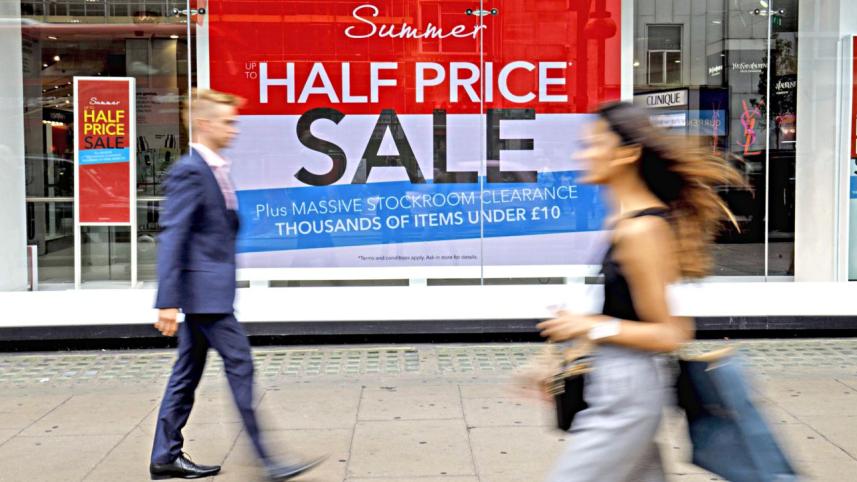
Britain's economy has grown at the fastest pace in nearly two years as strong exports and solid household spending offset slumping business investment, data showed Friday awaiting a Brexit deal.
Gross domestic product climbed 0.6 percent in the third quarter, in line with analysts' expectations and up on growth of 0.4 percent in the second quarter, the Office for National Statistics (ONS) said in an initial estimate.
 For all latest news, follow The Daily Star's Google News channel.
 At 0.6 percent growth for July-September, GDP was the strongest reading since the fourth quarter of 2016. Analysts meanwhile expect the economy to cool ahead of Britain's departure from the European Union in March.
"It seems unlikely that the economy will be able to keep up this pace with Brexit uncertainty hanging over it," noted Thomas Pugh, UK economist at Capital Economics research group.
The ONS also revealed Friday that growth had already turned flat in August and September, after July registered solid expansion.
"Taken together, we think UK growth has clearly lost some momentum," concluded HSBC economist Chris Hare. "The summer spending spree is over, global tailwinds have waned and Brexit uncertainty continues to bite."
Nevertheless, the ONS said third-quarter growth was driven by an expansion of 0.3 percent in July, "which stemmed from strong retail sales boosted by warm weather and the World Cup, as well as a low base reflecting the weaker start to the year".
It added: "The recent subdued business investment environment is consistent with external surveys of investment intentions, which attribute much of the weakness to Brexit-related economic and political uncertainty."
Business investment slid 1.2 percent in the third quarter, while exports jumped 2.7 percent and household spending increased 0.5 percent.
"The export growth... reflects an increase in both goods and services exports, with goods exports to non-EU countries growing more robustly than to the EU," the ONS noted.
Britain could be about to finally seal an all-important deal to smooth its departure from the European Union, although reports this week of an imminent announcement have cooled somewhat heading into the weekend.
And despite stronger growth for the UK economy in the third quarter overall, the Bank of England last week trimmed its own GDP forecasts as Brexit approaches.
The BoE predicted that Britain's economy would grow by 1.7 percent in 2019, down from a forecast of 1.8 percent.
The new estimate is based on the assumption of a smooth transition period, but there is unease on markets about a chaotic no-deal Brexit.
And before then, "growth in the fourth quarter is expected to be limited by more restrained consumer spending..., while business investment is expected to be curbed by heightened Brexit uncertainties", said Howard Archer, chief economic advisor to the EY ITEM Club.
Friday's GDP update came as British Prime Minister Theresa May drew the fury of her crucial Northern Irish allies after seemingly accepting an EU-backed Brexit solution they fervently oppose.
Comments