


What happens when reform is managed, not delivered

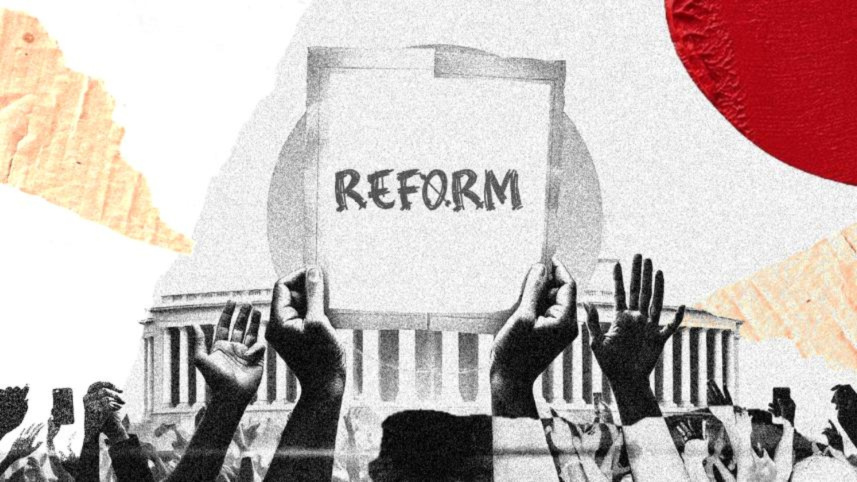
At first glance, the interim administration appears to be doing what transitional governments are expected to do. The ground has been steadied. An election date has been announced and is nearing. Charters and ordinances have been drafted. The language of restoration circulates freely, carrying the reassurance that the rupture of July is being responsibly managed.
However, beneath this surface calm, something feels unresolved. Not because politics is loud—if anything, it has grown quieter compared to past election cycles—but the space in which politics is meant to unfold feels narrower than the promise of reform would suggest.

Power does not always govern through force or repression. Often, it governs through mundane procedure—timelines, expert bodies, administrative sequencing, the framing of choices as technical necessities rather than political decisions. And this is experienced not as coercion but as delay, deferral, and the gradual closing of options: through notices, legal ambiguity, and the repeated assurance that reform will follow. The talk of reforms becomes a way of managing uncertainty.
Following the 2024 uprising, reform was presented as both a moral obligation and a political promise. The near-dozen reform commissions and their recommendations, the consensus-building exercises, and finally the adoption of a national charter all pointed towards a reimagining of the state and its power structure. The language was ambitious, suggesting not merely a transition between governments but also a recalibration of how power would be exercised and contested.
But ambition alone does not transform institutions. What matters is where reform is placed in the political timeline and how it is sequenced, controlled, and insulated from political contestation. In Bangladesh’s case, many of the major reform measures proposed have been procedurally deferred, their fate and likely impact all but suspended in a future that may or may not arrive.
Since August 2024, the interim government has announced reforms across nearly every major institution of the state. Constitutional amendments were promised through the July National Charter. Electoral, judicial, anti-corruption, police, and public administration reforms were placed under review. Yet few of the reforms have crossed the threshold from proposal to enactment. The constitutional changes remain tied to future decisions, while many of the police and anti-corruption reforms remain at nascent stages. Meanwhile, electoral reform has focused largely on administration rather than political inclusion.
This pattern has a measurable outcome: reform largely as architecture, not action.
In fact, Iftekharuzzaman, executive director of Transparency International Bangladesh, remarked not long ago that the interim government effectively “surrendered” to bureaucratic power, with many reform targets largely missed. His critique was not that reform ideas were not substantive, but that resistance within the administrative machinery was never meaningfully confronted while pursuing them. Powerful interests embedded in the bureaucracy diluted or excluded key provisions, including those aimed at strengthening the Anti-Corruption Commission. Despite early expectations, proposals to meaningfully reinforce ACC’s independence, particularly its appointment and oversight mechanisms, have yet to materialise. Reform, when it arrived, lost its momentum; authority continued to circulate through familiar, entrenched channels.
This pattern—reform on paper, power elsewhere—is not incidental. It mirrors a familiar failure in change management: systems are redesigned on paper, processes are updated, but the underlying power structures and practices that sustain the old order are left undisturbed.
Nowhere is this perhaps more visible than in the design of the election itself. The interim government has delivered many of the administrative components expected of it. Timelines are in place. Preparations are underway. From a logistical standpoint, order prevails. Campaigning remains cautious, alliances tentative, and political speech unusually restrained for a moment meant to invite contestation.
But elections are not merely administrative events. They are reconstitutive moments, occasions when political space is reopened, legitimacy renegotiated, and participation meaningfully expanded. It is here that the reform promise has thinned most visibly. Take, for instance, the nomination of women candidates contesting in the election—a mere four percent.
In the reform project, legitimacy was meant to be restored by opening up political space; instead, procedures have closed off participation, constrained whose voices matter, and regulated how political competition is allowed. Simply prosecuting the past regime’s political actors or barring them from returning to politics, on its own, does not amount to political reform.
By treating the election as a procedural exercise rather than a reconstitutive moment, the interim government has narrowed reform precisely when political possibility was meant to expand. The result is an election that may function smoothly but yet struggle to carry the burden of expectations placed upon it.
Other areas of reform reveal similar tensions between promise and practice. As the Human Rights Watch noted in late July 2025, while some of the most visible abuses associated with the previous regime have eased, systemic reforms to protect civil liberties and human rights remain incomplete. Arbitrary detention, politically motivated prosecutions, and threats to journalists and vulnerable groups have persisted.
Economist Debapriya Bhattacharya has made a similar point recently, but from another angle, arguing that reforms remain superficial when they rely on institutional blueprints without strengthening the social forces that sustain democratic norms. His observation matters because it exposes a deeper contradiction at the heart of our reform project. Reform was expected to be inclusive, to draw legitimacy from public participation. Instead, it has largely remained insulated: managed at a distance from the society it claims to renew. In this disconnect, the purpose of reform risks defeating itself.
For many citizens, the question is no longer whether reform will be completed, but whether it will ever touch daily political life at all. If reform is to mean more than reassurance, the logic must shift.
Electoral credibility must be treated as a matter of political architecture, not merely administrative efficiency. Transitional moments require mechanisms that widen participation, protect contestation, and prevent dissent from being neutralised as a technical inconvenience. Reform cannot be deferred to post-election promises alone. Within their limited window of authority, interim governments must establish irreversible guardrails—on administrative neutrality, prosecutorial restraint, freedom of expression, and bureaucratic accountability—that shape the way forward.
Resistance to reform must also be confronted. Bureaucratic inertia does not dissolve on its own, and reform fails mostly when power is allowed to hide behind complexity. Institutional change must be socially anchored. Minority representation must be mandated when reforms are being planned. None of this requires dramatic confrontation. But it does require a willingness to treat reform not as a sequence to be managed, but as a political space to be protected.
True, the interim government has restored a degree of calm. The harder task now is to ensure that calm does not harden into closure.
Power does not always close doors outright. Sometimes it keeps people waiting at the threshold, through the routine of procedures, reviews, and assurances. The measure of reform will not be found in the calm of election day, but in whether politics is eventually allowed to cross that threshold, long after the moment of transition has passed.
 For all latest news, follow The Daily Star's Google News channel.
 Tasneem Tayeb is a columnist for The Daily Star. Her X handle is @tasneem_tayeb.
Views expressed in this article are the author's own.
Follow The Daily Star Opinion on Facebook for the latest opinions, commentaries, and analyses by experts and professionals. To contribute your article or letter to The Daily Star Opinion, see our guidelines for submission.
Comments