


Trade bodies demand urgent fix to Ctg port deadlock
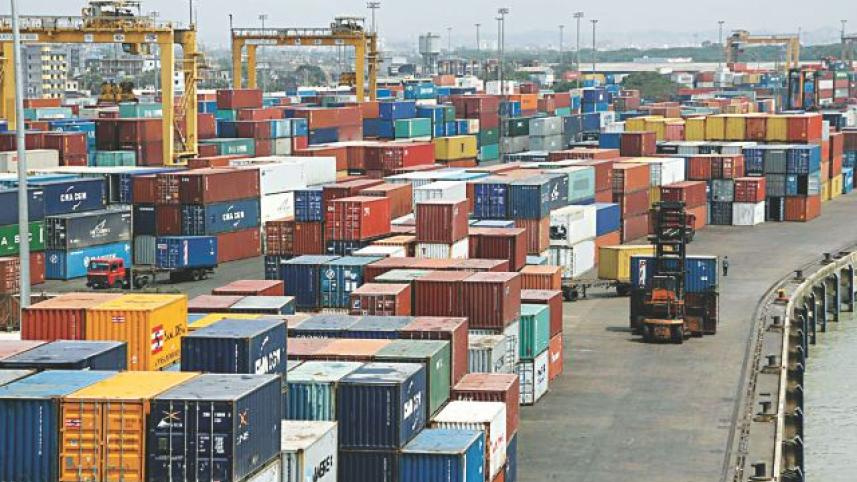
Leaders of ten major trade bodies have demanded immediate government intervention to resolve the ongoing deadlock at Chattogram port, which handles over 90 percent of the country’s maritime trade, terming it a “great disaster”.
This is the first time in the country’s history that all vessels have remained at a standstill at the port, they claimed in a joint statement at a press conference at the Gulshan office of the Bangladesh Textile Mills Association (BTMA) in Dhaka yesterday.

“This is not a normal strike; it is equivalent to destroying the country’s heart of business and trade by creating a deadlock at Chattogram port,” the statement said.
The economy suffers losses of several thousand crores of taka even from a single day’s deadlock at the port, they added.
Operations at the port came to a halt after workers and employees of the seaport enforced indefinite work abstention from February 3, opposing the move by the interim government to hand over the operation of the New Mooring Container Terminal (NCT) at the port to UAE-based firm DP World.
Goods from export and import vessels have not been loaded or unloaded for nearly a week.
The joint statement was issued by top trade bodies, including the Bangladesh Garment Manufacturers and Exporters Association (BGMEA), Bangladesh Knitwear Manufacturers and Exporters Association (BKMEA), Bangladesh Textile Mills Association (BTMA), Metropolitan Chamber of Commerce and Industry (MCCI), Dhaka Chamber of Commerce and Industry (DCCI), and Bangladesh Employers’ Federation (BEF).
The Bangladesh Chamber of Industries, Bangladesh Garment Buying House Association, Bangladesh Garments Accessories & Packaging Manufacturers & Exporters Association (BGAPMEA) and Bangladesh Terry Towel & Linen Manufacturers & Exporters Association (BTTLMEA) also signed the statement.
The country’s external trade, including the main export earner garments, has been facing irrecoverable losses due to the situation, they noted.
Operations at the port came to a halt after workers and employees of the seaport enforced indefinite work abstention from February 3
Exportable goods cannot be shipped, and imported goods cannot be released from vessels, which will make it difficult to meet strict delivery deadlines for international buyers.
The business leaders warned that Bangladesh risks losing work orders if the crisis continues, as international buyers may shift to alternative sourcing countries.
They also noted that export and industrial production are already under pressure due to falling demand, geopolitical crises, and rising production costs.
In such a situation, port demurrage charges, port fees, and storage costs are increasing, directly affecting production costs. Consequently, export prices will rise, negatively impacting international trade.
Additional costs on imported goods may also affect the prices of essential commodities meant for Ramadan sales. Any delay in releasing imported goods could disrupt the timely supply to consumers and raise price levels if the stalemate is not resolved quickly.
An unstable situation has also been created in obtaining bank loans and opening Letters of Credit (LCs) for importing goods.
The business leaders urged the government to resolve the port crisis immediately, considering the greater interest of the country and the economy.
In the statement, the business leaders urged the union leaders to call off the strike. They also suggested that the issue of renting the NCT can be postponed, and the union leaders can have the chance to discuss it with the next elected government.
“It is our firm belief that the government will sit with the labour leaders soon and solve the crisis immediately,” the statement reads.
In a separate statement, the DCCI urged the immediate restoration of normal operations at Chattogram port.
 For all latest news, follow The Daily Star's Google News channel.
 “Approximately 54,000 containers of goods have been stranded at the port so far,” it said.
Due to this delay in clearance, businesspeople are incurring additional costs of Tk 10,000 to Tk 15,000 per day. This ongoing shutdown is having a severe impact on the country’s export sector in particular.
“Moreover, if the situation continues, it will adversely affect the national economy. There is also a growing concern of cancellation or diversion of purchase orders to competitor countries, as we are unable to process shipment of goods in time,” it added.
In addition, this unexpected deadlock in cargo handling is likely to increase operational costs across trade and investment activities, creating an extra burden on both businesses and consumers.
The statement called for urgent government intervention to resolve the problem as soon as possible through discussions with all stakeholders concerned with Chattogram port.
The chamber also stressed the need for collective efforts involving the business community, the Chittagong Port Authority and all relevant stakeholders.
Comments