


Mobile phones: A perfect platform for self-learning
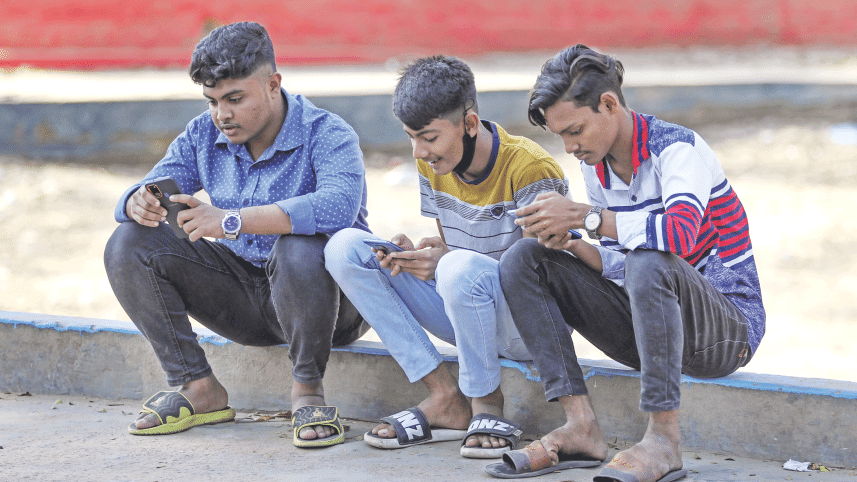
The diverse functionality of mobile phones is enabling people in Bangladesh to access information from various virtual platforms and thereby educate themselves on just about any topic, reducing illiteracy rates in the process.
The transformative impact of mobile phones is evinced by how a 20-year-old homemaker in Pabna used her device to learn the craft of tailoring traditional women's clothing, according to Mohammad GN Mozumder, a research fellow at the Bangladesh Institute of Development Studies (BIDS).

Mozumder made this comment while presenting a recent study, styled "Mobile Phone: Skill, Communication & Sociation", which found that many people use their mobile phones for self-learning.
The paper was presented during a seminar at the BIDS office in Dhaka yesterday.
The study examines how disadvantaged segments of the population, namely those with little or no formal education and a poor socio-economic background, use mobile phones in their everyday life.
Learning through mobile phones is self-propelled, albeit sometimes aided by kin and friends.
So, it is a self-driven evolution, as many people are upskilling and reskilling themselves using mobile phones, which enable custom creations channelling online ingenuity, the study shows.
With this backdrop, Mozumder said mobile phones create opportunities for self-advancement by providing much-needed support that helps realise a user's untapped potential.
For example, many women who never had any formal education are generating income by learning marketable skills through mobile phones.
It does not stop there though as some are even using their devices to learn new languages, such as English, Tamil, Hindi, Arabic and Urdu.
Besides, mobile phones facilitate payments for utility bills, insurance premiums, data packages and more while also allowing users to receive remittance through apps like bKash, Nagad, Rocket and MyCash.
Khorshed Alam, an associate professor of the mass communication and journalism department at the University of Dhaka, said the connection among youths, mobile phones and informal sector should be explored through research.
He noted the importance of further studies on Bangladeshi youths and the use of mobile technology.
Alam pointed out that the focus on mobile device research is predominantly centred on negative issues.
"Globally, studies on mobile devices mostly focus on the aspect of health hazards, mental health, addiction and other negative impacts. So, the dominant discourse in analysing mobile device usage is from a negative side," he said.
"But while it is true that mobile phone usage has many drawbacks, as shown by many studies in this regard, it is also crucial to unearth innovative and diverse uses for such devices," added Alam, who is also an instructor at the department of writing and rhetoric at the University of Mississippi in the US.
Syed Almas Kabir, president of the Bangladesh-Malaysia Chamber of Commerce and Industry, said mobile phones can no longer be classified as a simple "phone" as they are now a digital device.
"It [my phone] works as a watch, laptop, radio and television," he said.
"The dream of a smart nation is feasible and we will soon become its citizens. The activities of e-governance initially started with computers but it has now transferred to mobile phones," Kabir added.
He also said there are billion-dollar businesses -- such as Uber -- that solely depend on mobile devices.
 For all latest news, follow The Daily Star's Google News channel.
 Binayak Sen, director general of BIDS, also spoke at the event.
Comments