


Food grain imports surge 42% in first half of FY26
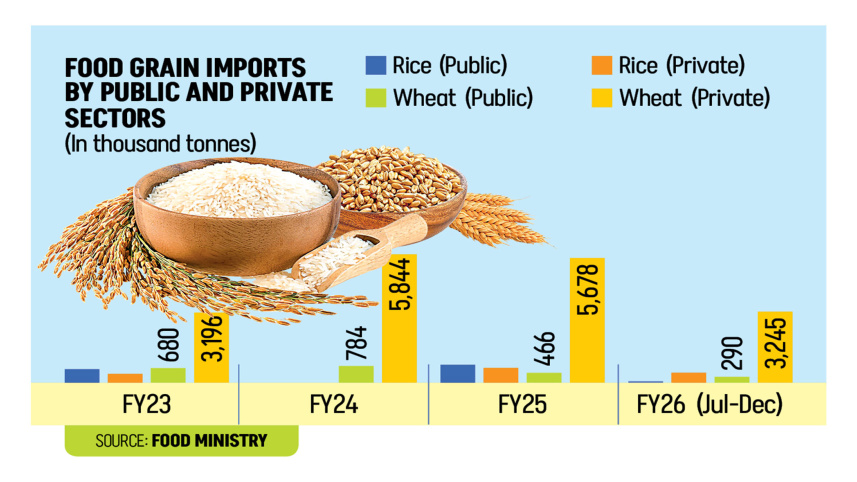
Bangladesh’s food grain imports surged 42 percent year-on-year to 42 lakh tonnes in the first half of the current fiscal year (FY) owing to higher imports, particularly by the private sector.
Of the amount, 84 percent or 35 lakh tonnes were wheat, and the rest were rice brought in by the public and private sectors, according to data from the food ministry.
 For all latest news, follow The Daily Star's Google News channel.
 During the period, wheat imports by the private sector surged 31 percent year-on-year to 32.45 lakh tonnes, up from 24.69 lakh tonnes a year earlier.

Meanwhile, imports by the government dropped marginally.
Taslim Shahriar, senior assistant general manager at Meghna Group of Industries (MGI), said a decline in wheat prices in the international market has encouraged imports.
“High prices of rice also buoyed demand for wheat, as it is a substitute. Demand for wheat-based foods is growing, too. This is because people’s consumption behaviour has changed,” he said.
Market price data compiled by the Food and Agriculture Organization (FAO) showed that the national average retail price of wheat flour stayed below the rates of coarse rice between November 2024 and September 2025.
Later, prices of rice declined due to higher supply from increased domestic production and imports. At the same time, retail prices of wheat flour exceeded the prices of coarse rice.
In October 2025, the national average retail price of wheat flour was Tk 54.28 per kilogramme, and the rice price was Tk 52.20 per kilogramme.
Food ministry data showed that rice imports by both the public and private sectors shot up to 6.65 lakh tonnes in the July-December period of FY2025-26 from 1.75 lakh tonnes a year ago.
The food ministry, in its latest Bangladesh Food Situation Report, said the government undertook initiatives to import 15 lakh tonnes of food grains, including 7 lakh tonnes of rice and 8 lakh tonnes of wheat.
This import aimed to strengthen buffer stocks, mitigate market volatility, and safeguard national food security amid global uncertainties.
The government had imported 1 lakh tonnes of rice and 3 lakh tonnes of wheat, while the remaining quantities were in the import pipeline, the report added.
To stabilise domestic supply and prices, rice import duties were reduced, and the private sector was authorised to import 6 lakh tonnes of rice. Under this approval, the private sector imported nearly 4.9 lakh tonnes by November 2025, close to the scheduled target.
Recently, the government granted permission for the private sector to import an additional 2 lakh tonnes of rice.
The food ministry report projected that Bangladesh’s total rice import during FY26 would be more than 14 lakh tonnes, almost equal to the volume of imports in the previous year.
Wheat imports, which meet over 85 percent of the country’s demand, will rise to 71.75 lakh tonnes in the current FY26, registering a 17 percent year-on-year increase.
The MGI official Shahriar said the amount of wheat may be close to the projection of the food ministry.
Comments