


Dairy farmers hit by turmoil

It was simply out of hobby that Abdul Gafur, from Jhikargacha upazila of Jessore, started rearing cows in 1991.
But soon, his herd of four started expanding, which is when he decided to take up farming seriously. Today, his herd size is 46 -- and 22 of them are milking cows that produce more than 100 litres of milk a day.

Instead of feeling grateful for such volumes of milk production, he is now losing sleep over it.
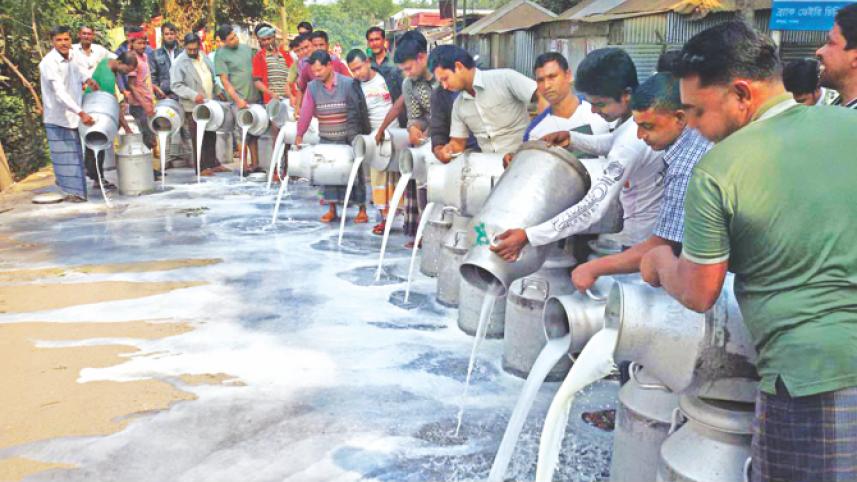
Due to shutdowns and non-stop blockade since January 6, processors, fearing attacks on the milk transportation vehicles, have cut back on their purchases from dairy farmers from the country's southwest districts, leaving them to the devices of the informal market to clear their produce.
“Our sufferings begun on January 5,” said the 43-year-old, adding that he has to depend on the local sweetmeat shops and villagers to get rid of his produce, and they pay whatever price they like.
While Brac is continuing to procure milk regularly albeit at a lower volume, Pran's collections have become largely irregular.
In January, Gafur sold 2,183 kilograms of milk to processing firms via milk collectors, down 45 percent from the previous month. And in February, he managed to sell a little over 1,200 kilograms of milk to processors.
Furthermore, the milk processors have slashed the procurement prices of milk from farm gates.
“As a result, we have to cut the prices at which we purchase milk from farmers,” said Ashok Ghosh, who supplies milk to the collection centres of Brac Dairy at Jhikargacha.
He said milk collectors now offer Tk 28 each kilogram of milk to farmers, down from Tk 33 for the same before the blockade.
Md Murad Ali, senior officer-in-charge of milk procurement of Brac Dairy, admitted that the firm has reduced its purchase prices in line with the lower retail price of milk. The price of milk has been reduced at the consumers' end to boost demand, he said.
To compound the dairy farmers' woes, the prices of some key ingredients of feed have increased due to the soaring transport costs.
The costs of production have gone up to Tk 26-27 each kilogram -- an amount not possible to recoup in the current market condition.
“We are just victims of vindictive politics. I do not have any peace of mind right now,” said Gafur, adding that it will take a long time for him to bounce back from this.
To survive, many farmers like Shachin Ghosh have cut back on their spending on feeds for cows.
“Whenever the companies reduce prices, we are providing less feed to cows. As a result, milk production is falling,” said Feroz Shah Alam, a dairy farmer at Debhata of Satkhira.
However, Gafur is yet to cut feeding. Instead, he sold seven calves since the beginning of the turmoil to get by.
“It was not my intention to sell. But I had to, to ensure feeds and pay wages to my farm workers.”
Aggrieved, Gafur said the government should extend support to the dairy farmers to withstand the current crisis.
If it does, many farms will survive. It will contribute to increasing milk production, facilitating poverty reduction, employment generation and increasing soil fertility, he added.
 For all latest news, follow The Daily Star's Google News channel.
 Meanwhile, Ali said the country has huge potential to raise milk production through farming.
The government should look to develop the sector to reduce import dependence, he said, adding that local production now meets 20 percent of the annual domestic demand.
In fiscal 2013-14, Tk 1,984 crore was spent to import milk and milk products, up 16.12 percent year-on-year, according to data from Bangladesh Bank.
Ali went on to urge the government to provide feed subsidy so that the farmers can keep their production costs down.
Comments