


Bringing light to visually impaired

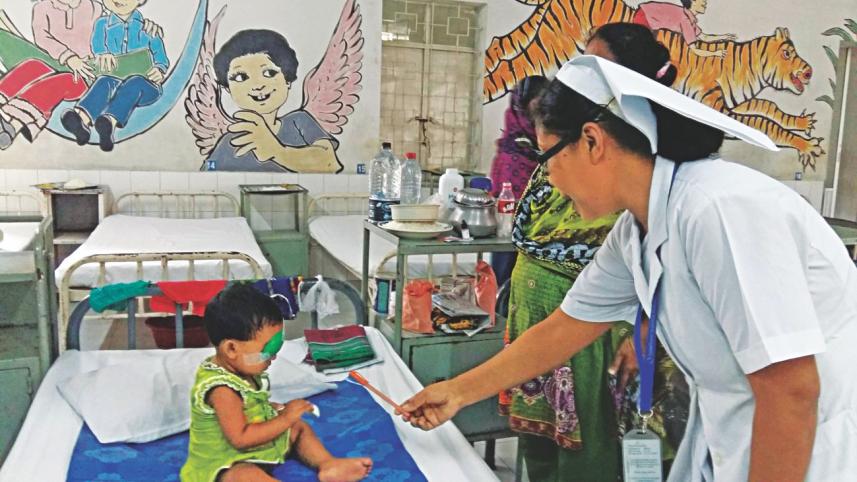
MD Sanwar Hossain and Selina Begum's family has got a new lease of life. After remaining visually impaired for eight years, their eldest daughter Mithila Akhter is fully cured now, thanks to a surgery at Ispahani Islamia Eye Institute and Hospital.
Impressed with their daughter's procedure, they brought their second daughter Tanzilla Akhter to the hospital as well for a cataract operation last month.

"We are really happy. Mithila can now read and attend school regularly," said Hossain, sitting next to Tanzilla at the children's ward of the hospital after her surgery.
Colourful wall paintings of animals, birds, children and even Meena cartoon liven up the mood at the children's ward that was upgraded by Standard Chartered Bank (SCB).
SCB extended a hand to develop the ward under its largest corporate social responsibility initiative -- Seeing is Believing -- which began here at the Ispahani hospital and is now being replicated in 71 countries with the aim of giving back eyesight to the visually impaired.
Around 7.5 lakh people suffer from blindness in Bangladesh. Of them, 80 percent is due to cataracts, according to the National Eye Care Plan, framed by the government. The number of individuals suffering from low vision is three times that number.
In addition, about 40,000 children are blind and over 12,000 of them are blind due to un-operated cataracts.
Ophthalmologists and eye care service providers say cataract and low vision are curable. However, the dearth of ophthalmologists and other service providers remains a big problem.
Every year, almost 150,000 people go blind due to cataracts, but only half of them can be handled, according to Sightsavers, a UK-based charity.
SCB partnered with Ispahani in 2003 and supported the hospital to improve and expand its operation theatre. The bank also provides its maintenance costs, according to SCB.
The bank, however, did not disclose the amount of money it spent on the non-profit private hospital for development of its operation theatre and the children's ward.
Initially, with the bank's support, the hospital had also conducted 1,800 free cataract surgeries.
Zahida Ispahani, adviser to the hospital, said such a high volume of cataract surgeries has helped increase the confidence of the doctors.
The doctors are good here, but they did not get the opportunity to use their skills much in the past, she said. "Now they have showed their talents and we have not looked back since then."
Following support from SCB and other partners, the hospital registered gradual growth of outpatients in the last 15 years. In 2014, the hospital served 6.62 lakh outpatients, up from 1.52 lakh in 2003, when SCB joined hands with it.
"The volume of operations had been low before the bank's engagement with us," she said.
Zahida said 300-400 children come for treatment a day, but the hospital can serve only 200 a day.
In addition to financial assistance, SCB's support and the physical engagement of its employees allowed the hospital to develop its human resources and IT capacity, she said.
"Today, we have a computerised system that has been possible for Standard Chartered. We have developed an HR manual with the help of the bank's HR team. The bank has done so much for us," said Zahida.
"It is easy to put your hand into your pocket and give money. To be physically involved in a project is the challenge."
 For all latest news, follow The Daily Star's Google News channel.
 SCB encourages its employees to help their local communities to develop, as part of its overall sustainability strategy. Under the scheme, it gives permanent employees three days a year in addition to their annual leave to volunteer in the community.
Bitopi Das Chowdhury, head of corporate affairs of SCB in Bangladesh, said there is a lot of scope to work on eye health care.
The bank took up the CSR initiative with an objective to improve its brand image and do something good for the community where it operates, she added.
"Our aim is to do something that has a positive impact on the community. We came to know that there had been a lack in the treatment of avoidable blindness. So, we decided to join the journey to help people get back their eyesight by developing infrastructure of eye-care units and training of eye-care personnel."
"It has a life changing impact," said Bitopi.
She said the SCB team in Bangladesh feels proud that the initiative that was taken in 2003 at the Ispahani hospital has become a global project of the bank today.
The bank aims to raise $100 million for the Seeing is Believing project between 2003 and 2020, with the bank matching every dollar. The bank raised $79.4 million as of December 2014, according to the bank.
"We will build a new paediatric ophthalmology outpatient building at Ispahani hospital," Bitopi said.
Comments