


Memories of war scar
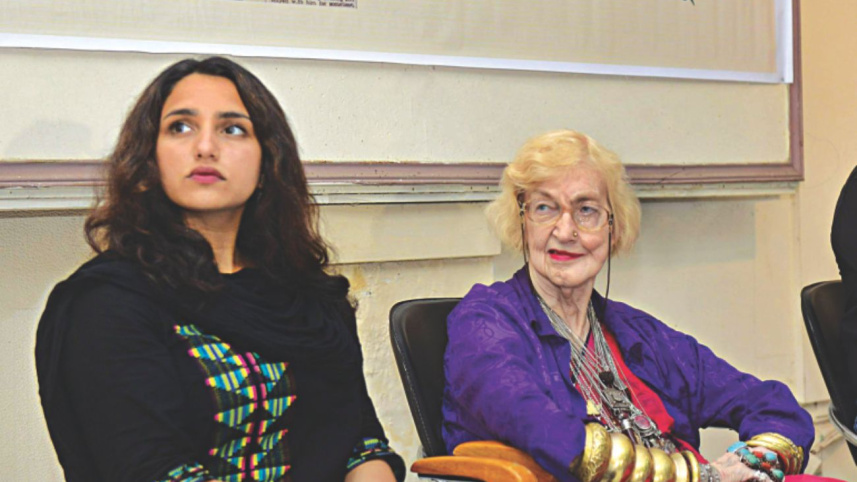
She came, she cried and she made the audience cry.
Forty-four years ago, Katrina Cappuccino's grandmother had been raped by the Pakistani occupation army during the Liberation War. Her mother was born a few months after the country's independence but denied by the society.
 For all latest news, follow The Daily Star's Google News channel.
 At that time, there arrived an angel in human form in Bangladesh, from a land thousands of miles away, and adopted Katrina's mother when she was three months old. That angel, Bonnie Cappuccino, not only took the feeble war baby to Canada but also gave the baby her surname and brought her up with love and affection.
Yesterday, both Bonnie and Katrina shared their experience in front of a small gathering at the Liberation War Museum in the capital's Segunbagicha. The programme was organised by the museum authorities.
Many in the audience were moved to tears by Katrina's story.
Katrina said her mother had not yet got the chance to visit Bangladesh.
“I'm here today and trying to really soak everything all in for her so that she [her mother] feels she's with me on this trip,” Katrina said.
“I only arrived in Bangladesh yesterday [Thursday] evening but I'm completely overwhelmed with the amount of love and support and generosity I've already seen.”
“She [her mother] feels it's important for me to know my roots,” Katrina said while explaining her visit to Bangladesh.
“... [I'm] thankful that the Bangladesh government at that time allowed four Canadians to adopt the war babies. Otherwise, I wouldn't be where I am today,” said Katrina who graduated from a Canadian university recently and got a government job there.
According to historical documents, between 2,00,000 and 4,00,000 Bangladeshi women and girls were raped by Pakistani occupation army and its auxiliary forces in 1971.
They spared no one, from elderly widows to schoolgirls not yet in their teens.
After the independence of Bangladesh, the government made abortion legal for a certain period so that the unfortunate women, who got pregnant, could have a choice about the war babies they were carrying.
Having read about the Liberation War of Bangladesh and its aftermaths in newspapers, the Cappuccino couple decided to try to save war babies, who were unwanted here given the social context of the newly emerged country.
In mid 1972, Bonnie accompanied 15 war babies on a special Air India flight from Dhaka's Tejgaon (old) airport to Canada. One of them was Katrina's mother. The rest 14 were adopted by other Canadian families.
“My mom, as you know, was adopted and grew up in a very loving household,” said Katrina.
“She asked me to kiss the ground upon arrival [in Bangladesh],” she said.
Katrina followed her mother's instruction.
The 21-year-old expressed her gratitude to grandmother Bonnie who sat was sitting beside her at the Museum yesterday.
“My husband and I were overwhelmed that the government of Bangladesh, which was so very new at that time, was very supportive. They [war babies] did not have passports but they [Bangladesh government] let them leave the country,” said Bonnie, now 80.
“We will always love Bangladesh for that reason,” she added.
The Cappuccino couple founded Child Haven International in Toronto in 1985.
Child Haven opened a shelter home -- Shishu Shorgo -- for destitute children in Chittagong in 2002. Bonnie said she used to visit the child home three or four times a year.
Mofidul Hoque, a co-founder and one of the eight trustees of the Liberation War Museum, said Shishu Shorgo needs a permanent shelter home.
“We hope that the authorities in Chittagong will extend their hands so that Shishu Shorgo gets a permanent establishment,” he said.
Comments