


Can buying arms from Russia help India make peace?
Last week India signed a pact with Russia to produce more than 600,000 Kalashnikov AK203 rifles in the northern Indian state of Uttar Pradesh. The $675m deal may be relatively insignificant in dollar terms compared to the standard of complex missiles and submarines that are typical of defence deals. But it is the latest iteration of the strategic value that the country gets with its defence orders, say analysts.
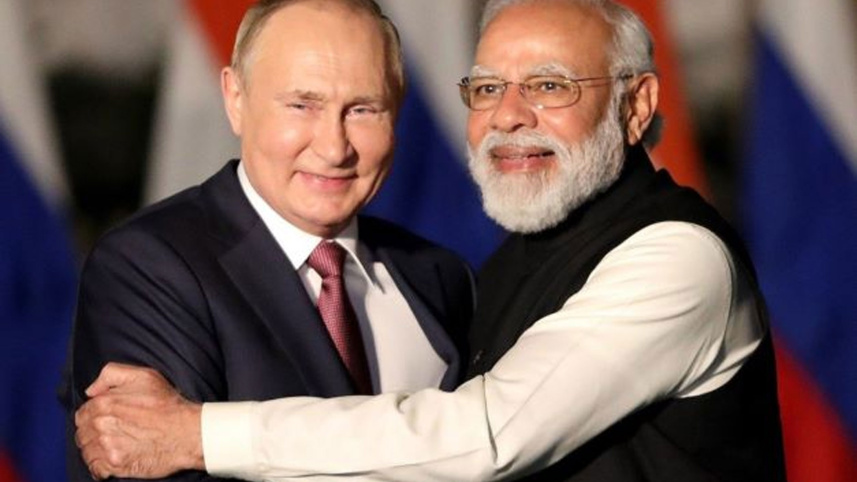
The deal was signed during Russian President Vladimir Putin's visit to New Delhi for the 21st India-Russia Annual Summit, only the second time he went abroad this year, after his meeting with US President Joe Biden in Geneva.

That Russia and India also agreed to renew their ten-year military cooperation agreement at the time is a sign of the strategic balancing act Delhi is striking between Russia and the US while keeping China's growing influence in check by keeping Moscow close to Delhi.
India's defence purchases from Russia and the US serve different purposes, said Angad Singh, project coordinator at New Delhi think-tank Observer Research Foundation's Strategic Studies Programme.
"Fundamentally all defence purchases are aimed at maintaining the balance of power against adversaries, but I think India understands that defence ties with Russia and the US are serving different purposes beyond basic capability-based arithmetic," Singh told Al Jazeera. "The US is an Indo-Pacific power with skin in the game against China. Russia is able to share sensitive strategic technologies. Both work to India's advantage in different ways."
Sure enough, both Russia and the US operated from behind the curtains as border tensions with China moved towards today's uneasy peace.
"A country like Russia with ties in Delhi and Beijing is well placed to facilitate talks," said ORF's Singh.
"But equally, between Russia straddling the fence and the kind of military access and capabilities provided by the US — for example during the Doklam crisis in 2017 — I think policymakers in Delhi know the US is no less important."
But apart from business, there is a more strategic imperative here as well for India and Russia to be "clinging" to each other to slow, if not altogether halt, what they see as "the other's strategic drift", Arzan Tarapore, South Asia Research Scholar at Stanford University, told Al Jazeera.
New Delhi is keen to ensure that Russia does not slip further into China's orbit just as Moscow is no doubt concerned by India's steadily deepening alignment with the US, he said.
Such arms deals, he noted, offer a way for India and Russia to maintain a diversified portfolio of security partners, and keep each other from drifting too far into US and China-dominated camps.
The US appears to have less of a choice in this respect and so far, at least, it has not activated the Countering America's Adversaries Through Sanctions Act (CAATSA) against India, a law that empowers it to impose sanctions against officials and countries doing, among other things, big-ticket defence deals with Russia.
 For all latest news, follow The Daily Star's Google News channel.
Comments