


Election stakes, coalition battles, and the Awami League question

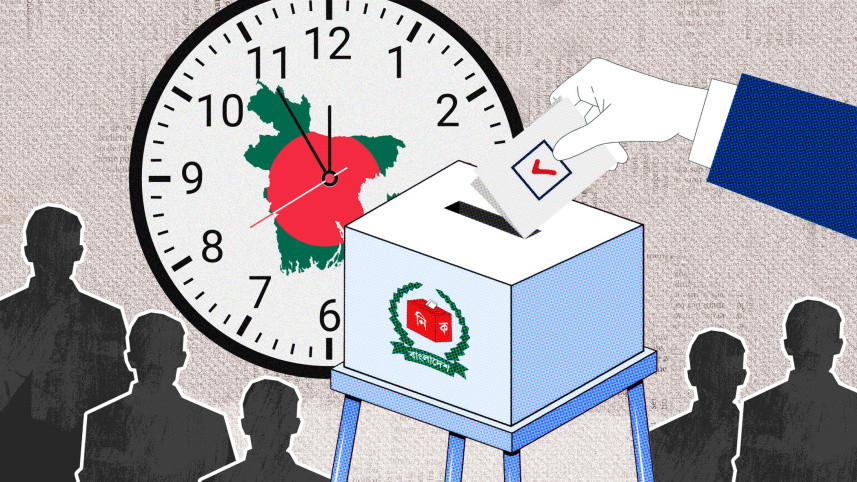
Bangladesh is heading into one of the most consequential elections in its history, not only because it follows the dramatic fall of Sheikh Hasina’s government but also because it marks a decisive break from a long-entrenched political order. The February 12 election, therefore, will be more than about choosing a new government; it will be about redrawing the country’s political map.
With the Awami League’s political activities suspended and its leadership in disarray, millions of AL-leaning voters have been left politically orphaned. For decades, their loyalty was anchored in party identity, local patronage networks, and the memory of the liberation legacy. Now that this anchor is gone, these voters are unlikely to move as a single block. Instead, their behaviour will fragment across constituencies.

In many districts, tactical voting will dominate. AL supporters will likely back the strongest local candidate capable of winning—often a BNP nominee, sometimes a powerful independent, and in a few cases another coalition-aligned figure. The logic will not be ideological so much as practical. Politics in Bangladesh has always been intensely local, and personal networks still matter more than party labels.
In some constituencies, a section of former AL voters may even vote for Jamaat. Where Jamaat candidates have deep community roots or are perceived as strong challengers to BNP dominance, voters may choose influence over ideology. Others are likely to stay home. Alienation, anger, and a sense of political dispossession may push many into abstention or protest voting.
The net effect is that AL voters will not disappear from the election. They will help decide it—seat by seat, district by district—as a floating, unreliable force.
For Tarique Rahman and the BNP, this election represents a historic opening. But it is also a defining test of leadership. After years in exile and political uncertainty, Tarique seems to be standing at the threshold of power. How he frames his campaign and manages his party will help shape not only BNP’s victory prospects but also possibly the legitimacy of the next political order.
His first strategic option is a broad stability-and-inclusion narrative. After years of repression, economic stress, and political upheaval in the country, voters want calm and order. They want a functioning state. BNP’s most powerful message is not revenge, but reassurance: that politics will return to institutions, that disputes will be resolved in courts and parliament, not on the streets, and that corruption will not be tolerated.
His second option is winning over orphaned or disgruntled AL voters without embracing the Awami League itself. BNP needs to make it clear that it is not rehabilitating the old order but offering a new political home for ordinary supporters who want stability, jobs, and security. The message should be simple: we want your vote, not your old rivalry.
The third and perhaps most delicate challenge is managing the Islamist question. With Jamaat openly positioning itself for influence on that front, BNP faces a strategic dilemma. Cooperation may help in seat arithmetic, but dependence risks alienating liberals, minorities, women voters, and international partners. The next government will need global legitimacy, foreign investment, and diplomatic credibility. That requires clear red lines on rights, the rule of law, and pluralism.
This election’s success will be measured not only by who wins but also by how many people vote. Turnout on February 12 will be a direct test of security and trust. The key question is not whether Bangladeshis want change—they have already demonstrated that. The question is whether they feel safe or encouraged enough to participate in the process.
Rising violence and fears of intimidation, if not properly addressed, could suppress turnout in sensitive districts or create uneven participation across the country. In politically contested areas, fear can be as decisive as persuasion. There are also concerns around election administration, including controversies surrounding expatriate postal voting and perceived administrative bias. In an election this charged and consequential, perception matters almost as much as reality.
Perhaps the most striking development of this election cycle is the return of Jamaat-e-Islami as a central political actor. Once marginalised, Jamaat is now positioning itself as a major power broker and has publicly signalled its openness to a post-election unity or coalition arrangement.
This realignment is most visible on campuses. For more than a decade, Bangladesh Chhatra League, the Awami League’s student wing, dominated universities through administrative backing and coercive politics. After the 2024 uprising and the collapse of the AL government, that structure disintegrated. In its place, Islami Chhatra Shibir has emerged as the most organised student force, winning all five recent student union elections at public universities. For years, Shibir operated underground and, according to media reports and student testimonies, embedded many of its cadres inside BCL units to survive political repression. After the uprising, that hidden network surfaced openly under the Shibir banner.
Jamaat’s growth is less about slogans and more about leverage. If it emerges as the second force or coalition pivot, it will shape the character of the next government.
As I indicated earlier, this election is not merely about replacing one party with another. It is about redefining power after the collapse of a long-entrenched authoritarian regime. The Awami League may be politically sidelined, but its voters will impact the outcome. Tarique Rahman may be on the verge of victory, as some suggest, and Jamaat may not win outright. But nothing is written in stone. And whoever wins or loses will be judged not just by the result but also by how responsibly power is claimed, contested, and exercised in the moment that follows.
So, February 12 is more than just an election day. The question of whether Bangladesh can change course is being put to a vote on that day.
Zillur Rahman is a political analyst and president of the Centre for Governance Studies (CGS). He is the host of Tritiyo Matra on Channel i. His X handle is @zillur.
Views expressed in this article are the author's own.
Follow The Daily Star Opinion on Facebook for the latest opinions, commentaries, and analyses by experts and professionals. To contribute your article or letter to The Daily Star Opinion, see our guidelines for submission.
 For all latest news, follow The Daily Star's Google News channel.
Comments