


Spain remains intact, for now
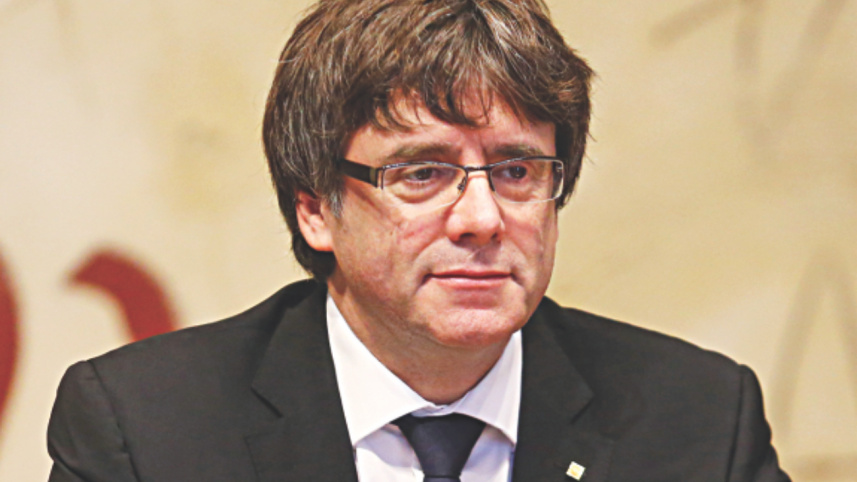
Catalan leader Carles Puigdemont yesterday said he had accepted the "mandate of the people" for his region's independence from Spain but suspended the declaration to allow more time for talks with Madrid.
In a speech to regional lawmakers in Barcelona, Puigdemont stopped short of declaring an outright split but left the door to secession open, leaving some political rivals scratching their heads.

"I assume the mandate of the people for Catalonia to become an independent republic," he said. But the 54-year-old asked the Catalan parliament to "suspend the effects of the independence declaration to initiate dialogue in the coming weeks."
The central government fired back, with a spokesman rejecting what Madrid termed Catalonia's "tacit" independence declaration.
Political leaders in Catalonia, Spain and Europe have come out against an independence declaration, concerned over the country's biggest upheaval since its transition to democracy in the 1970s.
EU nations are watching developments closely amid concern that Catalan independence could put further pressure on the bloc still dealing with the fallout from Britain's shock decision to leave.
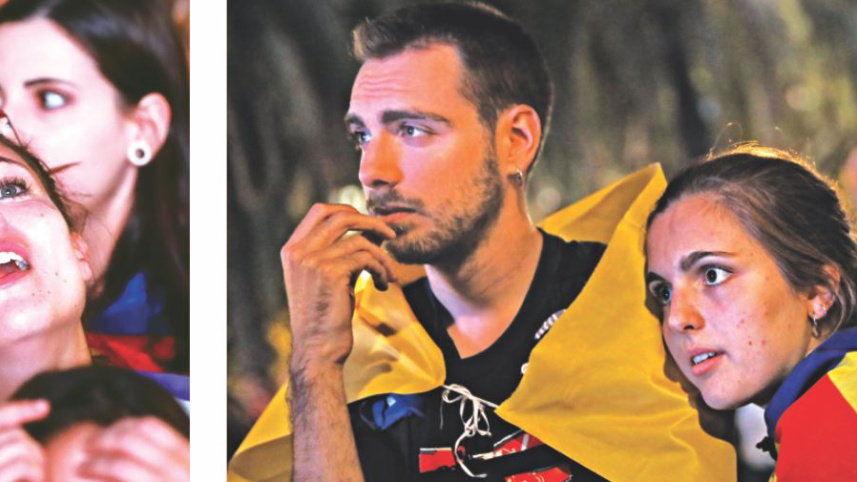
Police deployed en masse around the regional parliament, blocking public access to a park that houses the building as crowds watched the session on giant screens, waving Catalan flags and some brandishing signs reading "democracy."
Reaction among those who had hoped to witness a historic moment for a region deeply-divided over independence was mixed.
"In essence we're happy but I was expecting more," said 66-year-old Pere Valldeneu.
Madrid has repeatedly said it would not negotiate on Catalonia's independence.
Pro-unity and pro-independence supporters have staged mass rallies in Barcelona over the past week, highlighting divisions in Catalonia.
At stake is the future of a region of 7.5 million people deeply divided over independence, one of Spain's economic powerhouses whose drive to break away has raised concern for stability in the European Union.
Prime Minister Mariano Rajoy has vowed to use everything in his power to prevent independence and has even refused to rule out imposing direct rule over the semi-autonomous region -- an unprecedented move many fear could lead to unrest.
EU President Donald Tusk also urged Puigdemont against making a decision that would make "dialogue impossible".
Demands for independence in Catalonia, which has its own language and cultural traditions, date back centuries.
But a 2010 move by Spain's Constitutional Court to water down a statute that gave Catalonia additional powers, combined with a deep economic meltdown in Spain, sparked a surge in support for independence.
 For all latest news, follow The Daily Star's Google News channel.
Comments