


The Man Who Unearths the Past for the Future
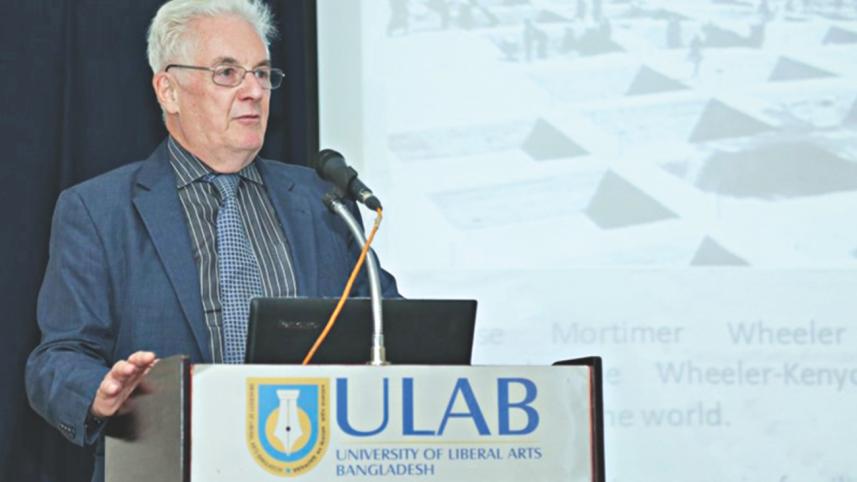
Photo: courtesy
Working on various projects in Bangladesh for 20 years now, veteran archeologist David Michelmore is no alien to the illustrious history and heritage of the country. Boasting thousands of years' worth of history, Bangladesh hides invaluable relics of the past beneath her which could enlighten us about our deepest ancestral roots. Current methods of archeological excavation followed here, however, runs a risk of damaging or even destroying significant potential discoveries.

The seasoned expert voiced concern over the matter in a lecture titled 'Archaeology in Bangladesh: opportunities for upgrading and future development' at the University of Liberal Arts Bangladesh (ULAB). The Department of Archeology in Bangladesh, although has a rich heritage and a firm institutional establishment, still follows methods long outdated and often improper for unearthing structures predominantly made of mud hundreds, sometimes even thousands of years old.
David Michelmore also outlined modern methods of excavation by means of advanced archeological geophysics that could be adopted in Bangladesh to get better results. He highlighted certain barriers in the system like institutional lethargy, encouraging the acceptance of status quo, and an unwillingness to embrace change, and lack of enforcement of legislation that are preventing the upgrade.
Any form transition can be a daunting task. The upgrades in the archeological practices in Bangladesh are no different. However, Michelmore prescribes a smooth means. There are highly experienced and skilled international experts in archeology who, along with having extensive international experience, also boast a deep understanding of our region. Establishing relationships with these specialists on an individual or institutional level would catalyze the transition process to a great extent, and could prove to be a much better alternative to starting from scratch. Michelmore points out Durham University and Professor Robin Coningham as prominent examples.
Shockingly, Bangladesh, with all her glorious history, currently has only 448 protected heritage sites. Lack of legislative enforcement and insufficient active engagement with the local by the authority is threatening proper preservation of these proud monuments as well. It is not that the local people are unaware of the cultural heritage in their respective areas, but they are unaware of its true value. It is time they are effectively communicated with, and made to realize that they should also be very proud of the remains of history in their respective localities. Only then, these people will play an active role in preserving the heritage sites in these areas.
Michelmore emphasizes that the archeological heritage sites are much more than simple structures. The locations of discovery could be transformed into tourist sites, and local people could be trained to become guides, adding value to the local economy.
On a personal level, David Michelmore says it is the more imaginative projects that attract him rather than the more expensive ones. A graduate from University of Exeter and earning a Master of Philosophy from University of Leeds for a thesis on the Monastery of Fountains (now a UNESCO World Heritage Site, he has so far worked in 40 countries around the world, including as UNESCO International Technical Adviser, based in the Department of Archaeology in Kathmandu, as well as in the UNESCO Principal Office for Asia and the Pacific in Bangkok. He has worked on numerous international projects funded by UNESCO, the Asian Development Bank, the World Bank, the European Investment Bank and the European Union.
In 1992, he founded the Consultancy for Conservation and Development and increasingly concentrated on heritage management and the conservation of heritage sites. David Michelmore looks forward to working in more projects in Bangladesh and in other countries where he is currently working to unravel new discoveries, because it is 'the process of studying and scholarship of finding things out' that he finds a 'fascinating, and enjoyable'. Before arriving in Bangladesh last October, he had been working in Georgia, before which he was working in Iraq. The man shows no sign of tiring any time soon.
 For all latest news, follow The Daily Star's Google News channel.
Comments