


Quirky Science

Plastic Litter in the Arctic
In a new study, researchers from the Alfred Wegener Institute, Helmholtz Centre for Polar and Marine Research (AWI) show for the first time that marine litter can even be found at the sea surface of Arctic waters. Though it remains unclear how the litter made it so far north, it is likely to pose new problems for local marine life, the authors report on the online portal of the scientific journal Polar Biology. Plastic has already been reported from stomachs of resident seabirds and Greenland sharks.

Plastic waste finds its way into the ocean, and from there to the farthest reaches of the planet – even as far as the Arctic. This was confirmed in one of the first litter surveys conducted north of the Arctic Circle, carried out by an international research team from the Alfred Wegener Institute, Helmholtz Centre for Polar and Marine Research (AWI) and Belgium's Laboratory for Polar Ecology. The researchers presented their results in an article released on the online portal of the journal Polar Biology.
In order to gauge the level of pollution, the researchers took advantage of an expedition that brought the research icebreaker Polarstern to the Fram Strait, the area between East Greenland and Svalbard. In July 2012, AWI biologist Dr Melanie Bergmann and her team searched for litter floating on the sea surface from the ship's bridge and by helicopter, maintaining a "litter watch" for a combined distance of 5,600 kilometres. "We found a total of 31 pieces of litter," reports Bergmann.
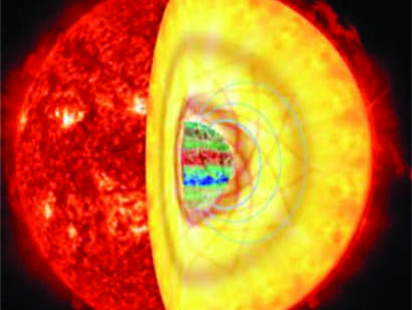
MAGNETS IN STARS
Astronomers have for the first time probed the magnetic fields in the mysterious inner regions of stars, finding they are strongly magnetised.
Using a technique called asteroseismology, the scientists were able to calculate the magnetic field strengths in the fusion-powered hearts of dozens of red giants, stars that are evolved versions of our sun.
"In the same way medical ultrasound uses sound waves to image the interior of the human body, asteroseismology uses sound waves generated by turbulence on the surface of stars to probe their inner properties," says Caltech postdoctoral researcher Jim Fuller, who co-led a new study detailing the research.
The findings, published in the October 23 issue of Science, will help astronomers better understand the life and death of stars. Magnetic fields likely determine the interior rotation rates of stars; such rates have dramatic effects on how the stars evolve.
Until now, astronomers have been able to study the magnetic fields of stars only on their surfaces, and have had to use supercomputer models to simulate the fields near the cores, where the nuclear-fusion process takes place. "We still don't know what the center of our own sun looks like," Fuller says.
Red giants have a different physical makeup from so-called main-sequence stars such as our sun – one that makes them ideal for asteroseismology (a field that was born at Caltech in 1962, when the late physicist and astronomer Robert Leighton discovered the solar oscillations using the solar telescopes at Mount Wilson).
Source: Sciencedaily.com
 For all latest news, follow The Daily Star's Google News channel.
Comments