


Learning from History

In ancient Rome, there was a king called Sextus Turquinus. The all powerful, self indulgent king fell in love with the beautiful wife of one of his courtiers. However, the beautiful woman named Lucretia refused Sextus. The king, enraged by the rejection, raped Lucretia for revenge. Being raped and seeing no hope of justice, Lucretia committed suicide.
A nephew of Sextus revealed the actual reason behind Lucretia's death to the public. Agitated Romans took to the street in thousands and organised a full scale revolt against the decadent King. Thus the kingdom of Rome, where the King was worshipped like God, was ousted and the Roman republic was established. This epic incident of how the common people of ancient Rome sought justice for Lucretia and finally established their own rule over the Roman Empire by expelling unjust authority has been portrayed in Shakespeare's classic poem “The Rape of Lucrece”.

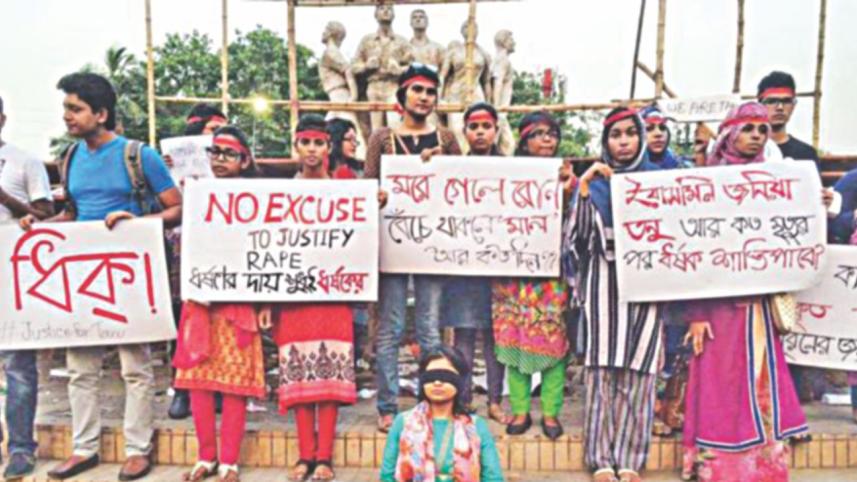
After several millennia and thousands of miles away from Rome, Bangladesh is burning with the same agitation. On March 20, 19-year-old Sohagi Jahan Tonu was raped and killed. Her lifeless, mutilated body was found in the Mainamati cantonment area. The tragic death of Tonu, a bright student of Comilla Victoria Government College and a cultural activist, infuriated the whole nation.
While people's upheaval demanding justice for Tonu was gaining strength, some curious incidents have pushed this case into further darkness. According to a report of The Daily Star dated March 21, the first autopsy of Tonu was performed on the day after Tonu was murdered. However, the findings of the first autopsy was published on April 4 only to say that no evidence of rape was found on Tonu's body and the cause of death could not be identified.
Nonetheless the court ordered to exhume Tonu's body and to perform a second autopsy only seven days after the first autopsy was performed. Then Tonu's body was exhumed and was sent to the morgue of Comilla Medical College for the second autopsy. However, the report of the second autopsy has not been published yet (till April 4, 2016).
Why did the investigators feel that a second autopsy was needed at the time when the report of the first autopsy was not even published, what were the lapses of the first autopsy, who made those mistakes and why – these questions need to be answered for a transparent and successful investigation.
Meanwhile curious things happened at the site where Tonu's body was found. After his visit to the spot, chairman of National Human Rights Commission Professor Dr Mizanur Rahman said that the place where Tonu's body was found has been cleared. He added that in the first photo of the place – he saw grass and bushes. However, when he visited the area on March 31, 2016 he saw the place was cleared completely (The Daily Prothom Alo, March 31, 2016). While these mysterious incidents are taking place, investigators have not made any headway in their probe and not a single suspect has been arrested even after thirteen days of the murder.
Now justice for Tonu is a popular demand. After days of countrywide protest by students and common people, different political organisations have also come forward to join the movement. But some of them portray different tones. While people were demanding justice and arrest of the perpetrators, some organisations such as Gonojagoron Moncho, which joined the protest two days after the countrywide procession, have explicitly blamed Bangladesh army for this crime during its gathering at the Shaheed Minar on April 1, 2016.
During Moncho's protest in the capital's Shahbagh area, its workers also blocked the car of a high ranking officials of the Bangladesh army and glued protest posters to the vehicle. If these activists of Gonojagoron Moncho have any strong evidence regarding this heinous crime, they should produce it before the nation and also before the investigators. However, if their claim is just based on suspicion, they should keep in mind that popularising such random blame can also affect the course of investigation and proper trial of the crime.
Although there are clear symptoms that some vested quarters are trying to manipulate the course of the investigation and justice, Bangladeshis like the ancient Romans, have got their message. People en masse have become united and have come forward with only one demand; try and punish the criminals, whoever they are, and put an end to such violence and social injustice against women.
Prevention of crime and ensuring justice to the victim is the state's most basic obligation. If the state fails to ensure justice, it is a matter of time that the outraged and oppressed people will find their own alternative ways of establishing rights which often comes at the cost of peace, progress and normalcy.
 For all latest news, follow The Daily Star's Google News channel.
Comments