


The Mahmudullah question
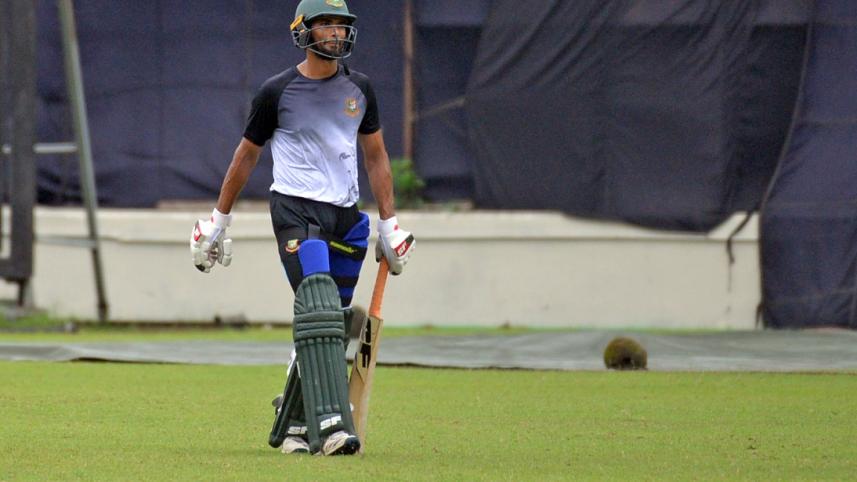
On Saturday, Mahmudullah Riyad's inclusion into the Test side for the upcoming Zimbabwe tour was widely seen as a "surprise inclusion".
It perhaps was a surprise because it had become widely accepted that Mahmudullah was not cut out for Tests. There were even suggestions that he may not have been as interested in playing Tests as he was to play limited-overs cricket, though the cricketer himself has said that he wants to play cricket's oldest format.

His inclusion, after 16 months out of the Test team, comes not because of his credentials as a Test batsman -- and his credentials are noteworthy, as we shall see later -- but as a last-minute back-up for the injured Mushfiqur Rahim.
However, the question is whether Bangladesh – a team that has not had the best of times since the 2019 World Cup – have the luxury to overlook a player like Mahmudullah in any format.
During that period, there were Test losses at home against Test newcomers Afghanistan and most recently West Indies -- the hosts were expected to beat the former confidently and had been bossing the latter at home recently. The gaping need for a revaluation of our approach to Test matches has perhaps never been more apparent.
While many avenues of the current cricket structure - especially perhaps larger emphasis being placed on first-class cricket - can be examined in hopes of improving Bangladesh's Test match prospects, it should also be asked whether the country can continue ignoring Mahmudullah.
To begin with, Bangladesh simply does not get the opportunity to play as many Test matches as some of its more accomplished counterparts. To put things into perspective, Joe Root recently played his 100th Test match after debuting in 2012, whereas the last match against the West Indies was only Shakib Al Hasan's 57th, having debuted five years earlier.
When it comes to the formidable Test playing nations, it makes sense for them to rotate their key players across the three formats: they capitalise on the wide range of skills and talent on offer while also ensuring that each international player gets adequate exposure in the respective departments. These situations do not apply for Bangladesh. There is not an abundance of players who can lay claim to being specialists in Test matches nor are there enough matches played for top talent to sit out.
Mahmudullah Riyad, since making his Test debut in 2009 has played in 49 matches and scored 2,764 runs at an average of 31.77. While that average may not stand out, unfortunately not many Bangladeshi batsmen average higher than 30 in the current lineup. It would be different if players like Soumya Sarkar, Liton Das and Mohammad Mithun were setting the world alight with their exploits.
When the odds are already stacked against Bangladesh, it is confusing to see the lack of importance given to the few strengths in its repertoire.
To further emphasise the value brought to the team by Mahmudullah, his average of 59.44 as a Test captain is nearly twice his regular average. Some people buckle under pressure while others thrive and rise to the challenge. Given that Bangladesh has not found a dependable and consistently performing Test captain, Mahmudullah Riyad's records prove him to be worthy of consideration for the role.
Test match cricket is said to be the most important form of the game. In this regard, Mahmudullah agrees, "It is the ultimate format to truly display a cricketer's potential, abilities and mindset." When asked if he would like to see himself in the longer format, he says, "Why not? I believe I am quite fit and I have a lot to give to my nation."
If the role played by Mahmudullah in the ODI team is considered, he repeatedly finds himself in pressure situations with only tailenders to support him. It is perhaps the most difficult spot in the entire lineup for a batsman to prove his mettle. Yet, Mahmudullah has established himself as one of the most dependable batsmen who is also credited with steering his side to victories from nail-biting situations.
Although the pressures under which Test matches are played and the mentality required are quite different, one would assume that there is still a lot to be gained from a player with experience as extensive as Mahmudullah's.
While Mahmudullah went through a few dry patches in Tests, from 2018 to 2020, he has been the third-most successful Test batsman ahead of Shakib Al Hasan and Tamim Iqbal, with 833 runs in 14 matches. In that period, he scored three of his four Test centuries in the space of six matches -- one each at home against Zimbabwe and West Indies, and another in the more challenging conditions in New Zealand.
Since the New Zealand series, Bangladesh has played only nine Test matches, the last five of which Mahmudullah has missed. It seems that his second coming as a Test batsman has been cut short just when it was beginning.
In his Test career, Mahmudullah has also picked up 43 wickets. While not a genuine all-rounder, he can often fulfil the role of a third spinner, and that lends valuable balance to the side, especially as the country cannot be sure of Shakib's participation in the longer forms.
Given how few Test matches Bangladesh plays, the fact that our Test captain Mominul Haque only plays Tests is also a matter of concern, which has been highlighted in the defeats to a Windies missing many of their key performers. Mominul's record as captain does not inspire confidence – six losses, one draw and one win in eight Tests.
All things considered, the need for Mahmudullah's presence in the Tigers' Test squad has only deepened since his axing, and the team management now has to debate whether that need can be fulfilled in a back-up capacity, or as someone playing a more central role.
 For all latest news, follow The Daily Star's Google News channel.
Comments