


Voting without access: How the national election failed voters with disabilities

For the first time in years, voters across Bangladesh felt they had taken part in a national election without fear. That sense of relief was extended to many voters with disabilities. Yet beneath the optimism, a different picture emerged. A significant number of voters with disabilities reported misbehaviour, harassment, or practical barriers that prevented them from casting their ballots.
In August 2025, the Bangladesh Election Commission, with UNDP, organised a consultation titled “National Consultation on the Inclusion of Persons with Disabilities in the Electoral Process”. Officials noted that more than three million registered voters in Bangladesh are persons with disabilities, but only about 10 per cent have historically been able to vote. The promise was clear. The outcome, according to many voters and observers, was uneven.
Student elections at several public universities revealed that many visually impaired students were unable to cast their votes because polling centres lacked basic accessibility. Similar concerns resurfaced during the national election. Despite assurances that arrangements would be in place, most centres relied solely on human assistance. There were no Braille ballots, tactile templates, or assistive devices.
Ayesha Ahmed Liza, a polling official in Dhaka-4, said, “We received training from the Election Commission before the election, including specific guidance on how to assist persons with disabilities in casting their votes. In my booth, two such voters came to cast their ballots, and there were designated people to support them. However, there were no accessibility machines at the voting station.”
For some voters, simply reaching the booth was the first hurdle. Rifat Pasha, a policy officer at the Institute of Wellbeing Bangladesh who is blind, voted in a national election for the first time since becoming eligible in 2009. This year, he finally received his voting slip. “My wife was with me as my voting assistant. I was lucky my voting station was closer to my home and the room was on the ground floor, so I didn’t have to climb two or three floors.” But his arrival was unsettling. “What was shocking at first was that security saw me and said, ‘Why are you here?’ When I said I was a voter, he eased off but again probed why there was another person with me.” After he explained, they allowed him in, yet “the first experience left a bad impression on me.”
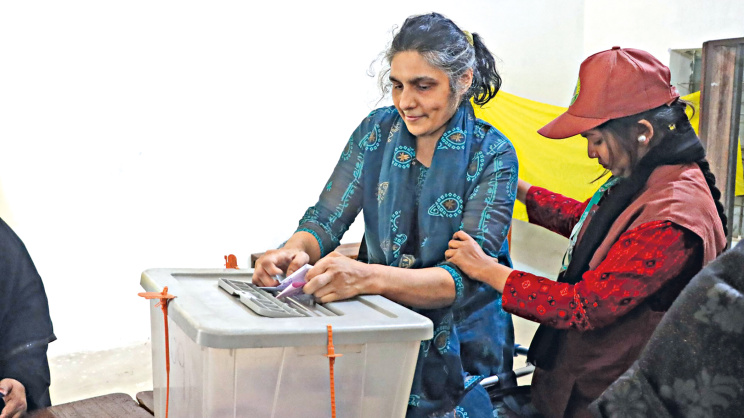
Photo: Titu Das
Ajmeri Nishat, a voter with low vision, also cast her ballot for the first time this year. Her polling centre, a three-storey school in Mirpur, had her booth on the second floor. “Since I went with my mother, she was with me from start to finish. She took me to the second floor.” Inside, officials allowed her mother to accompany her after she explained her eye condition. “They held the pen for me at the right spot, and I signed the two pads.”
However, the ballot itself presented challenges. “I told them it wasn’t possible for me to stamp the ballot on my own because of the layout; I needed an assistant.” She ultimately voted with her mother’s help. Yet she stressed that her experience depended heavily on family support and familiar officials. “If I hadn’t taken my mother and had gone alone, I would have needed support from start to finish.”
She added, “For a visually impaired person, a three-storey building with only stairs is not accessible. There were no ramps or lift systems.” Nor were there any Braille or tactile ballots.
“No, it was just a plain piece of paper.” Looking ahead, she said, “polling centres must be accessible, and the ballot paper needs to change.”
Jahangir Alam, Senior Coordinator at the CDD (Centre for Disability in Development), said he was able to vote without much difficulty, though others were less fortunate. “I went with a guide and cast my vote without much trouble.” However, two totally blind voters who accompanied him faced rude behaviour before officials eventually apologised. “I believe the root cause is a lack of awareness,” he said.
He cited reports of guides being stopped at polling stations and polling agents attempting to stamp ballots on voters’ behalf. “This raises serious concerns about the privacy and dignity of voters.” In one constituency, wheelchair users found that booths were located on upper floors without ramps. “We do not want these so-called ‘favours’ or charity from the state; we want our rights and our dignity. Voting is meant to be secret.”
Salma Mahbub, Executive Director of B-SCAN, a women-led organisation of persons with disabilities (OPD), said this was the first time organisations working with persons with disabilities had formally observed a national election. Despite meetings with the Election Commission and discussions about making 100 centres accessible, “when we went for observation, we did not see anything of that sort.” Although officials were instructed to prioritise voters with disabilities, she said, “they were not told how to support them.”
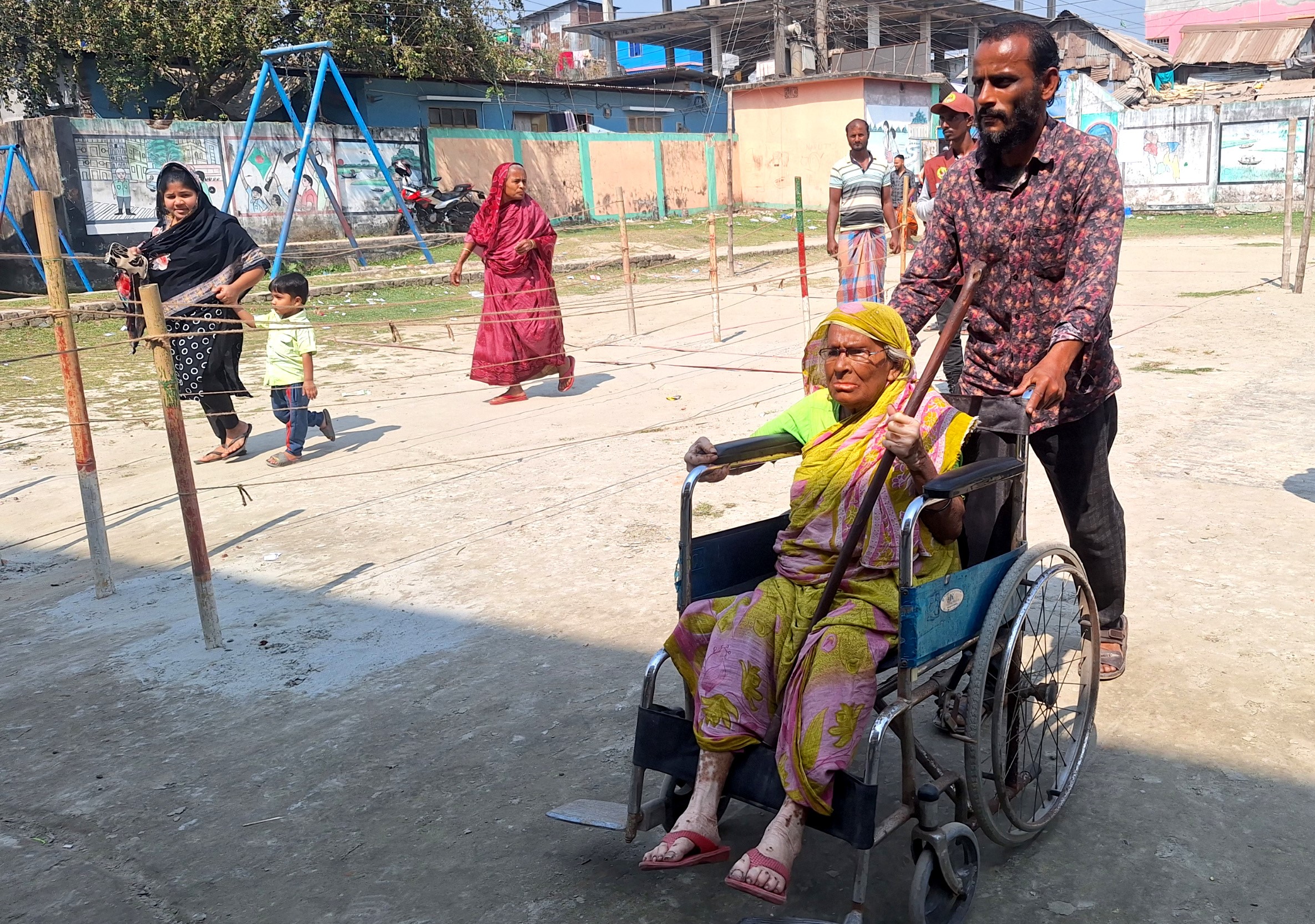
Wheelchair users assigned to upper floors were often carried upstairs. “In those cases, the secrecy of the vote was not maintained.” While some officials were cooperative, others were not. “People with mobility impairments did not receive the support they were supposed to get.” There were no Braille ballots and no clear signage for voters with hearing impairments.
She believes a simple circular mandating voting booths on the ground floor could have addressed many of these issues. “It requires a mindset that truly wants all citizens to vote.”
According to earlier surveys, Bangladesh has an estimated 3.3 million voters with disabilities, though no participation data is available. That, she said, is a question she would put directly to the Election Commission.
Ruhul Amin Mollik, Director of Public Relations at the Election Commission, said trainers were instructed to ensure voters with disabilities could cast their ballots with ease. If booths were located upstairs, “arrangements should be made to assist the person upstairs, if possible.” Where that was not feasible, officials were told to come downstairs. He noted that many newer school buildings have ramps, although older ones may not. On voter participation figures, he acknowledged, “we don’t have a number. We do not collect or conduct surveys specifically for voters with disabilities.”
Both Jahangir Alam of CDD and Salma Mahbub of B-SCAN called for structural reform. “We wanted persons with disabilities and the elderly to be allowed to vote by postal ballot. The Election Commission introduced the system, but only for expatriates, not for citizens with disabilities. If postal ballots had been available, participation would likely have been higher.”
Ultimately, the experience of voters with disabilities in the recent national election reveals a gap between intention and reality. While the absence of widespread violence and the presence of some supportive officials offered reassurance, these alone cannot substitute for structural preparedness. Inclusion cannot depend on personal goodwill, family assistance, or improvisation at polling centres. For participation to be meaningful, accessibility must be built into the electoral process as a matter of right, not exception. Clear legal safeguards, consistent training, accessible polling infrastructure, and enforceable standards are essential if future elections are to ensure that voters with disabilities can exercise their franchise with dignity, privacy, and independence.
Ystiaque Ahmed is a journalist at The daily Star.
Send your articles for Slow Reads to slowreads@thedailystar.net. Check out our submission guidelines for details.