


At Karl Marx’s grave on his death anniversary

14 March of this year marked the 143rd death anniversary of Karl Marx, a revolutionary philosopher whom I do not need to introduce to my readers. Having known that he was buried in Highgate Cemetery, one of the earliest cemeteries of the Victorian era, I had been looking for an opportunity to travel from Durham to visit it.
I took the morning train at around 7 o’clock, and there was no sign of the sun. It was the middle of March, a time of seasonal transition from the cold winter to the flowery spring. But the weather in the UK is always unpredictable. The temperature was 3 degrees, and my fingers, without gloves, were freezing. After buying a coffee from the station, I immediately found comfort once I got on the train. Three hours passed in the blink of an eye, accompanied by coffee and Julian Barnes’ novel Flaubert’s Parrot. Through the windows, lush green fields, sheep farms, and wild daffodils pleased my eyes.
At around 10 o’clock, I found myself at King’s Cross, one of the busiest railway stations in London, where my friend from my Dhaka University days, Sharif, was waiting to accompany me. Sharif, who has been living here as a tax and payroll accountant since 2012 after completing his higher studies, knows London like the palm of his hand.
We took the underground train, popularly called the ‘Tube’, from King’s Cross and headed towards Archway station. My previous experiences on the Tube in cities like London and Paris reminded me of local buses in Dhaka, where passengers stand shoulder to shoulder, as if everyone is glued together. But one of the nicest things that I enjoy about the underground train in London is watching how many people, even while standing, spend time reading books, either physical copies or on a Kindle. Our travel day was a Saturday, so the Tube in the morning was not crowded at all. After only three stations and about fifteen minutes, we got off at Archway station.
I then opened Google Maps, which showed that we needed to walk for around twenty minutes to reach Highgate Cemetery. During our walk, I began telling Sharif about the struggling life of Karl Marx in London since 1849. The sky was perfectly sunny but very cold. We had to walk up a small hill along the main road. Seeing me panting while climbing the hill and continuously lecturing at the same time, Sharif told me to shut my mouth and simply walk.
We crossed a church and then took a left turn according to Google Maps. Soon, we stepped into Waterlow Park. I took a picture of the park’s billboard at the entrance, and beside it there was a placard written in red ink: “No BBQs,” meaning that barbecuing is strictly forbidden there. I again looked at Google Maps and found that the cemetery was located at the far end, on the other side of the park.
Under a clear sky, the grass looked incredibly green and fresh, giving the park a peaceful sense of life. I saw a few children playing with dogs while their parents kept a watchful eye on them. In some parts of the park, yellow daffodils looked mesmerising. We crossed two small ponds where some waterfowl were playing joyfully.
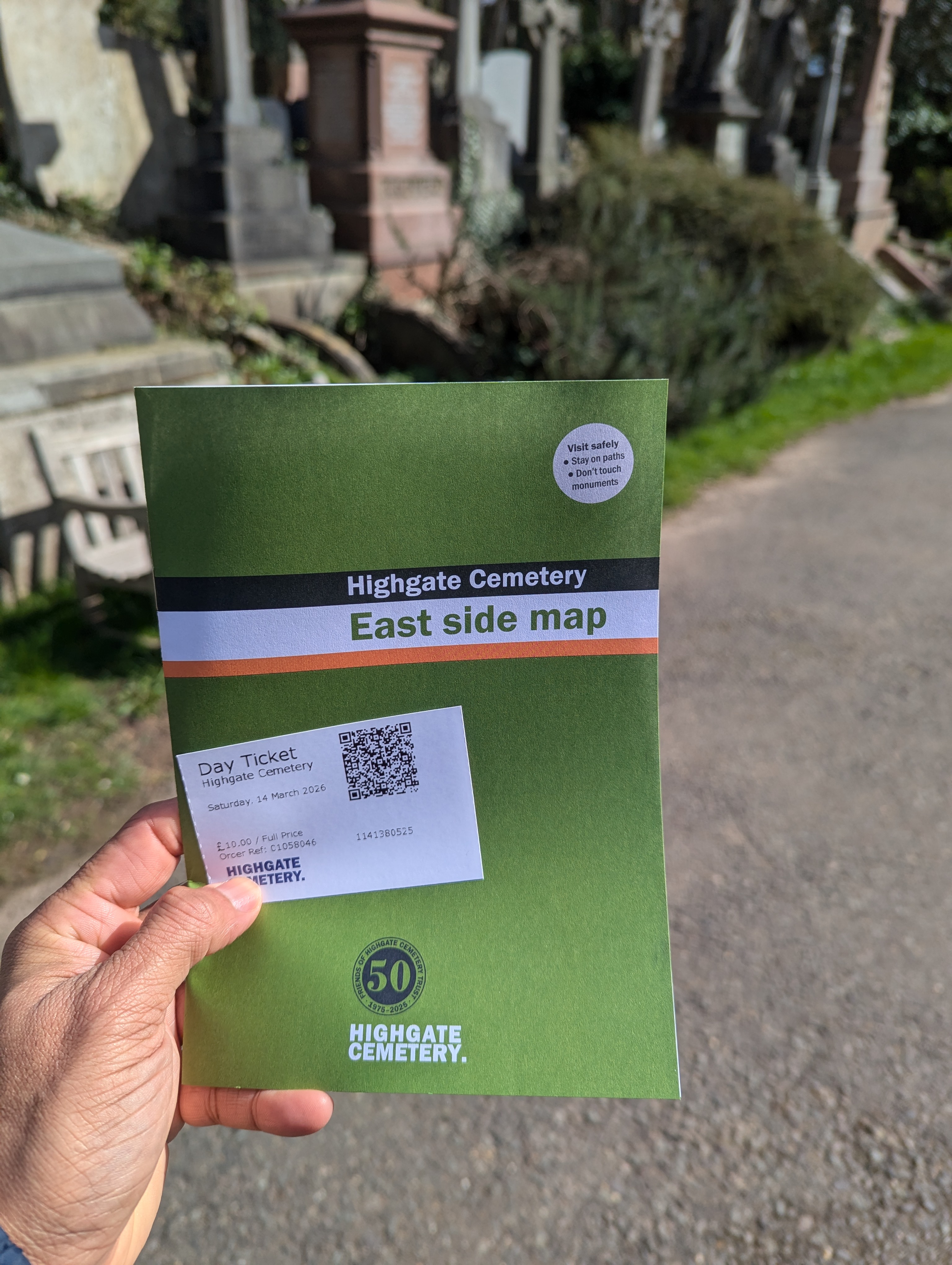
Finally, we reached the end of the park, went through the gate, and stood in front of Highgate Cemetery. The cemetery was divided into East and West wings. Before deciding which part we should explore, Sharif noticed a small placard on the gate of the East side. I was literally shocked to see that we had to pay 10 pounds for a day ticket to visit the grave of Karl Marx. I thought to myself, ‘What! People need to pay money to see Marx’s grave, who fought his whole life against capitalism and commodification! What an irony it is!’ Though both of us were terribly disappointed, we paid the money, and the lady at the counter handed over the tickets along with a map of the cemetery. She opened the first page of the map and pointed to where Marx’s grave was located. On the printed map, only Marx’s name was written in bold red letters. I became excited when I noticed on the map that the grave of the famous British Marxist historian Eric Hobsbawm was just opposite Marx’s grave.
The walking paths through the cemetery are divided into right and left. If we took the left path, we could reach Marx’s grave very quickly. But Sharif decided not to follow the map inside the cemetery. Instead, we took the right path, wandering a little around the cemetery before reaching Marx’s tomb. There were thousands of graves there, stretching across the cemetery in every direction in a planned layout so that visitors could reach them on foot. A few cherry trees in blossom stood beside older trees. These trees seemed to shade the departed souls from the sun, snow, and rain. What I liked most about the tombs was not the stone structures or the names and dates engraved on them, but the beautiful words that the loved ones of the deceased had left in their memory.
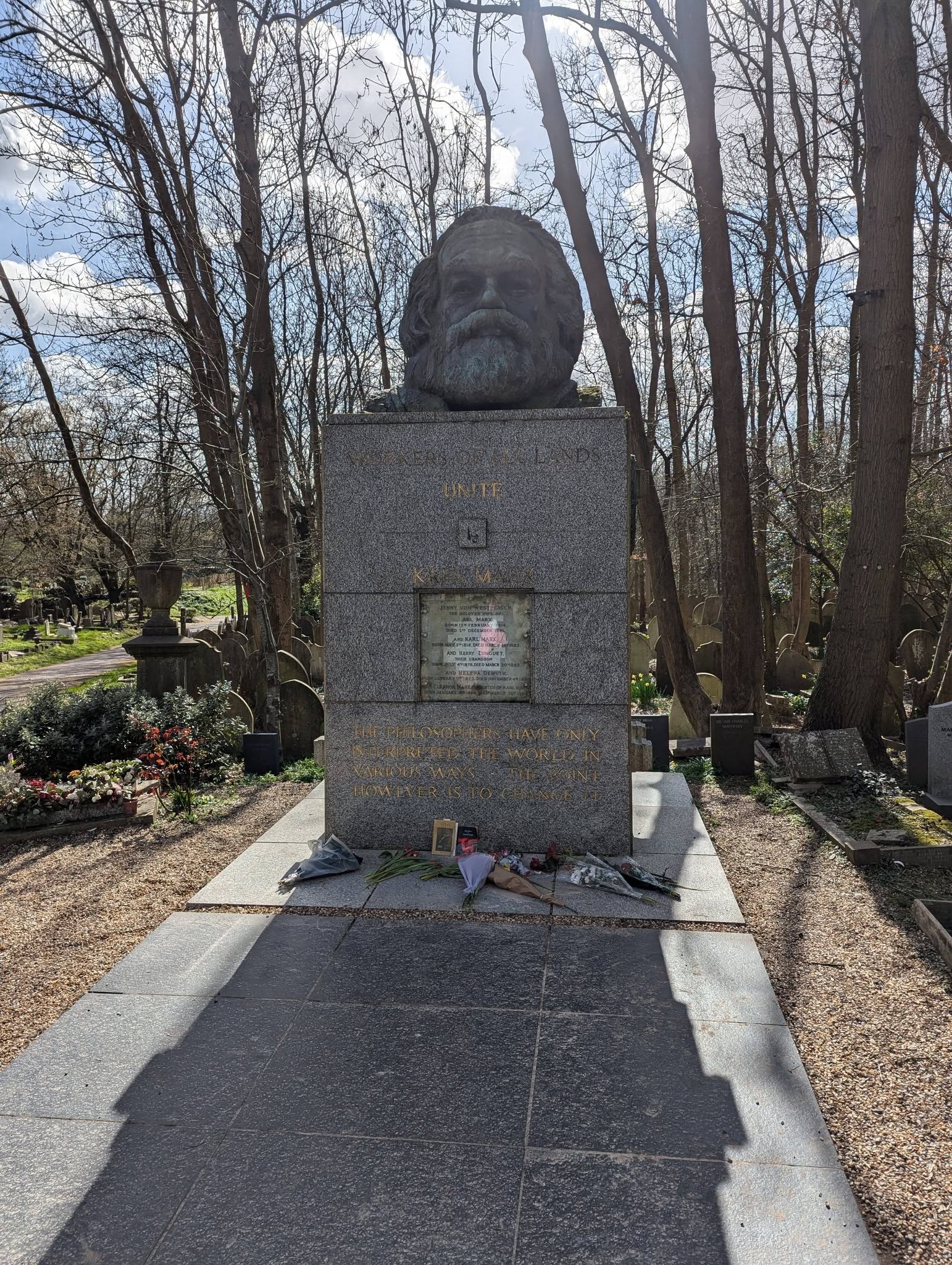
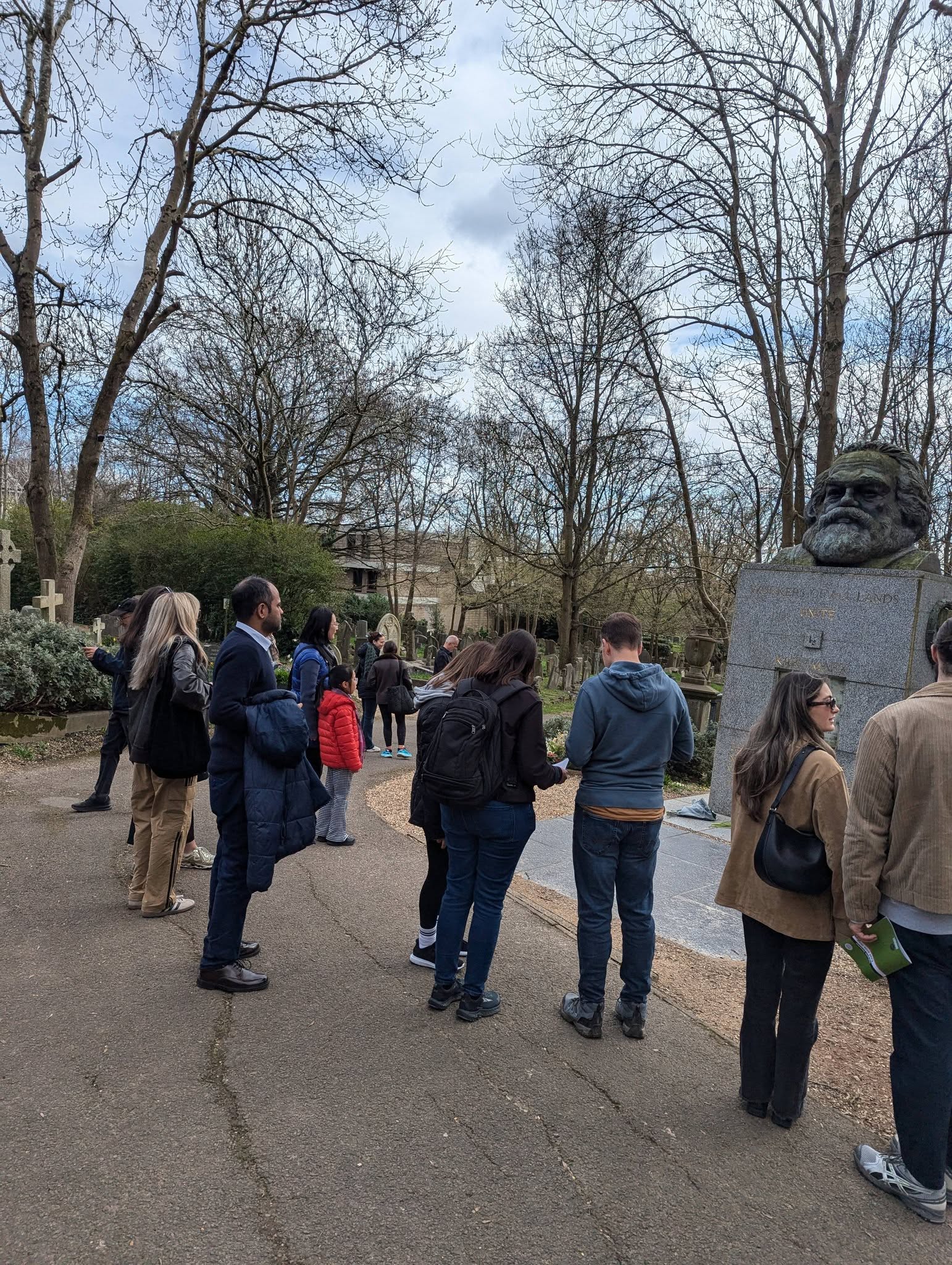
Finally, we arrived at Marx’s tomb. A large monument crowned with a bronze bust immediately drew my attention from afar. ‘Workers of all lands, unite!’ and the Eleventh Thesis on Feuerbach — ‘The philosophers have only interpreted the world in various ways; the point, however, is to change it’ — were inscribed above and below the names of those buried in the grave: Karl, his wife Jenny, their grandson Longuet, and their housekeeper Helene Demuth. In fact, Marx was originally buried a few hundred yards from the current spot in 1883, in the same cemetery. In 1954, the bodies of Marx, Jenny, Longuet, and Demuth were reburied at the current site. Two years later, in 1956, with funding from the British Communist Party, a new large monument for Marx was unveiled in a short ceremony. In 2019, the tomb was vandalised in an organised attack at night, which damaged a marble plaque taken from Marx’s original 1883 gravestone and incorporated into the 1954 monument.
After taking some pictures of the monument, I took off my jacket. Standing behind the small crowd, I began to imagine how it must have been when people gathered here to bury Marx on 17 March 1883, three days after his death. On the day of the funeral, the crowd was small as well: some family members and a handful of friends — a total of eleven people gathered for the funeral. Marx’s wife, Jenny, had already died 15 months earlier, and Marx was buried beside her. At the ceremony, Friedrich Engels read aloud a short eulogy in English, introducing Marx as ‘the greatest living thinker’ and ending his speech with: ‘His name will endure through the ages, and so also will his work’. Unfortunately, after a week, the family gathered again at the same cemetery to bury Marx and Jenny’s young grandson, Longuet.
I spent almost two hours near Marx’s grave and saw around twenty to thirty visitors coming and going during that time. At the beginning, I noticed middle-aged and older people arriving, but later I saw some young people from China, probably students studying in the UK. I tried to strike up a conversation with them to understand what they thought of Marx and his legacy. While most of them were too shy to speak, one of them joked about the irony of having to buy tickets for £10 to see Marx’s grave.
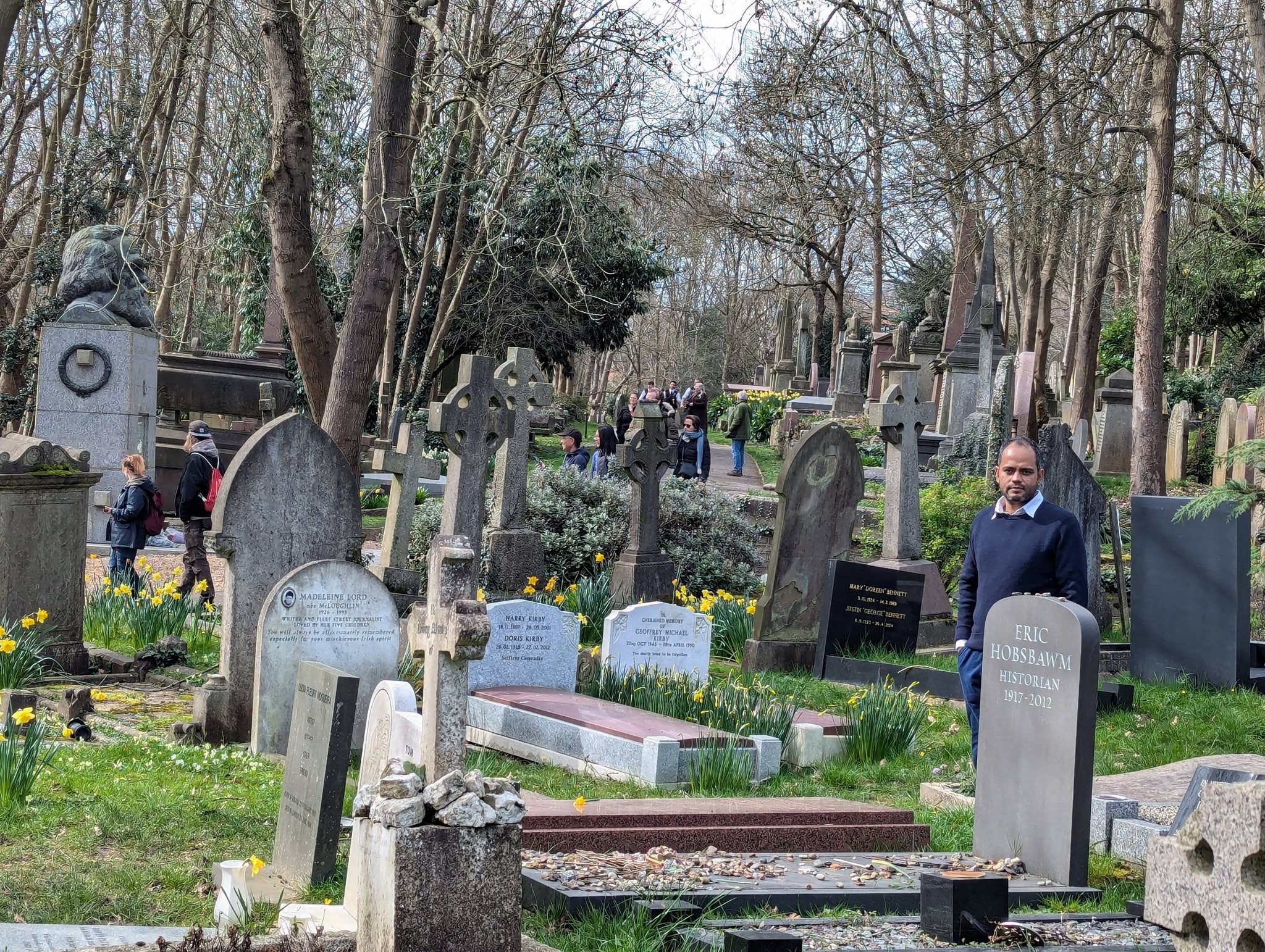
In the meantime, Sharif tried to look for the grave of Hobsbawm, who died in 2012 at the age of 95. Hobsbawm is considered one of the greatest historians of the modern world, and few history books rival his famous Age series (The Age of Revolution, The Age of Capital, The Age of Empire, and The Age of Extremes). The map showed that his tomb was close to Marx’s, but it was difficult to pinpoint the location on the ground. When Sharif returned to me with a despairing look, I showed the map to a young British couple. The man pointed out the direction after looking at the map, and when I went closer to the spot, I found a relatively new tombstone inscribed: ERIC HOBSBAWM, Historian, 1917–2012. I went up to Hobsbawm’s tomb and stood in such a way that a single picture could capture both Marx’s and Hobsbawm’s graves. It might be a coincidence to find such proximity between Marx and a Marxist’s grave in the same cemetery.
After taking some final pictures, I went back to Marx’s grave. I noticed three policemen talking among themselves near the small crowd by the tomb. It might have been either a routine patrol or the possibility of a VIP visiting from a foreign embassy. We had spent almost two hours in the cemetery, and the sun suddenly vanished behind the clouds. The cold wind began piercing through my thick jumper again. Sharif opened the weather app and warned of a possible short spell of rain. Before we walked away from the tomb, when I looked at Marx’s bronze bust one last time, I felt as if he was looking at us in a way that suggested we had disappointed him greatly.
We slowly walked towards the main gate of Highgate Cemetery, where we had bought our entry tickets. Near the entrance, there was a small shop, and I stepped inside to look for a souvenir to remember the visit. Several books were displayed on the shelves, a few of them related to Marx. Among them, I picked up a copy of The Communist Manifesto, republished by Verso Books in 1998. When I looked through the contents, I noticed that the historian Eric Hobsbawm had written a long introduction to the book. There was also a preface written by Marx and Friedrich Engels for the English translation of the Manifesto, which added historical context to the text. Holding the book in my hands, I felt that it was a meaningful souvenir from a place so closely connected with Marx’s memory.
Fahmid Al Zaid is Associate Professor in the Department of Anthropology, University of Dhaka, and a PhD candidate at Durham University, UK. He can be reached at fahmidshaon@du.ac.bd.
Send your articles for Slow Reads to slowreads@thedailystar.net. Check out our submission guidelines for details.