


Shrimp over rice and the quiet erosion of our food security
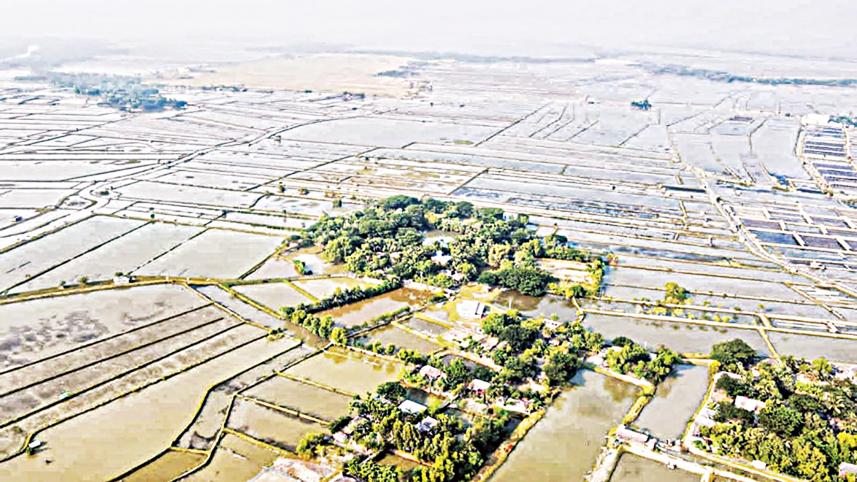
Recent reports on the southern coast describe an alarming breakdown in dry-season farming. In Chitalmari, Fakirhat, Rampal and Mollahat, land was ploughed and prepared for Boro paddy as it has been for decades, but irrigation pumps could not supply freshwater. Salinity had crept into canals that once sustained winter cultivation, leaving seedlings to dry on nursery beds. With no cyclone damage or embankment breach to blame, farmers faced a quieter failure: irrigation systems rendered useless by brackish water. Some abandoned planting altogether; others shifted to cultivating Bagda shrimp as the only viable way to salvage the season.
When salinity rises, the soil creates a condition agronomists call physiological drought: salt increases osmotic pressure around plant roots, preventing crops from absorbing moisture even when fields appear wet. Seedlings stand surrounded by water they cannot drink. The failure is invisible to the eye, but fatal to the crop.

In recent years, coastal districts have lost nearly 50,000 hectares of cultivable land to salinity. Salt does not announce itself through catastrophe. It enters quietly—an inch of tide here, a dry monsoon there, a river slightly less generous than before—until the soil forgets how to hold rice. Farmers rarely meet this with protest; they adapt by turning to shrimp.
Shrimp aquaculture generates income where paddy fades. In one season alone, shrimp exports from a single district exceeded Tk 700 crore—attractive in economic terms. Yet profitability cannot disguise a deeper exchange: shrimp contributes to export earnings, while rice secures nourishment. When one replaces the other, income may continue, but food security shifts. Soil that converts to shrimp ponds rarely returns to rice; salinity lingers.
This quiet transformation is not local or isolated. Salinity is already redrawing coastlines and harvest patterns worldwide. The Mekong Delta has begun losing rice for the same reason, with tides pushing upriver millimetres by millimetres. The Nile Delta is gradually surrendering to the Mediterranean, and in the Indus Basin, salinity has challenged yields for decades. The UN estimates that over 1.4 billion hectares of farmland globally are now salt-affected—nearly 10 percent of the world's cultivated base. Hunger arrives slowly, not through famine but erosion.
Even the world's most engineered agricultural economies face similar pressures. In the Netherlands, where one-third of the country sits below sea level, food security is implemented through water governance—dikes, polders, saline-tolerant breeding programmes—designed to prevent losing ground. Australia treats salinity as an economic threat; more than two million hectares remain affected despite decades of investment, mapping, and recovery programmes. In California's Central Valley, groundwater depletion has triggered a salinity shift, forcing farmers from almonds towards pistachios and other drought-tolerant grains. Across the Organisation for Economic Co-operation and Development (OECD), governments have responded to signs of salinity stress with research funding, soil restoration, crop insurance, and irrigation reform.
These comparisons matter because they shift the discussion from misfortune to management. If high-capacity nations treat soil salinity as a strategic threat, coastal agriculture in Bangladesh cannot afford to treat it as a slow inconvenience.
There are still paths forward for Bangladesh. Along the western coast of India, farmers have cultivated Pokkali rice—a salt-tolerant indigenous variety—for over three thousand years. During lower-salinity months, they grow rice; when the tide turns brackish, they shift to prawn cultivation by opening and closing sluice gates with the tide and moon. They do not abandon paddy for shrimp. They alternate them, preventing soil from choosing one future permanently.
Research in Bangladesh has also produced resources worth using. Bangladesh Rice Research Institute (BRRI) has developed multiple salinity-tolerant rice varieties. Their potential remains mostly theoretical until seeds reach farmers' hands at scale—innovation is not measured by laboratory success, but by germination in real soil.
The danger ahead is not only environmental; it is generational. If rice cultivation no longer sustains dignity or income, the children of farmers will not remain farmers. Land may stay fertile on paper, yet unused in practice. Soil security depends not only on water and seeds, but on the faith that farming still has a future.
Meanwhile, urban progress speaks loudly through structures that reach into the sky—flyovers, expressways, power plants, megaprojects—and each ribbon-cutting is celebrated as an achievement. But concrete does not feed families. A functioning irrigation channel receives no ceremony, though without it every new expressway ultimately leads to a place where nothing grows. Economic growth may continue for a time even as agriculture declines, but eventually the imbalance reveals itself at the dinner table rather than in budget documents.
The steps we need to overcome and manage the problem are neither mysterious nor unreachable. Irrigation infrastructure must be funded, maintained, and governed with the same seriousness applied to the power or transport sector. Shrimp expansion needs zoning rather than market momentum. Salinity-tolerant rice seeds should be distributed widely, supported by services that help farmers manage new methods, not left isolated in trial plots. River dredging must be ongoing rather than intermittent, recognising that rivers are agricultural arteries. Crop insurance, procurement pricing, and credit support must sustain the farmers who hold the food system in their hands.
A half-century ago, the threat was famine, and agriculture recovered through research, extension, cooperation, and resilience. Flood, cyclone, and the pressure of population did not break food security then. But, salinity may, if allowed to proceed unchallenged. It does not uproot houses or break embankments; it waits, season after season, until fields go quiet.
A nation may grow economically while allowing cultivable land to slip into export ponds, but it becomes dependent. Food security is not achieved through ports, highways, or megaprojects; it is achieved when water reaches the fields and seed meets soil. No country retains full strength if it cannot feed itself, and whether that foundation is protected or allowed to erode will determine not just the next harvest but the country's long-term resilience.
Dr Abdullah A Dewan is professor emeritus of economics at Eastern Michigan University in the US, and a former physicist and nuclear engineer of Bangladesh Atomic Energy Commission. He can be reached at aadeone@gmail.com.
Views expressed in this article are the author's own.
Follow The Daily Star Opinion on Facebook for the latest opinions, commentaries, and analyses by experts and professionals. To contribute your article or letter to The Daily Star Opinion, see our guidelines for submission.
 For all latest news, follow The Daily Star's Google News channel.
Comments