


How multispecies justice supports social justice

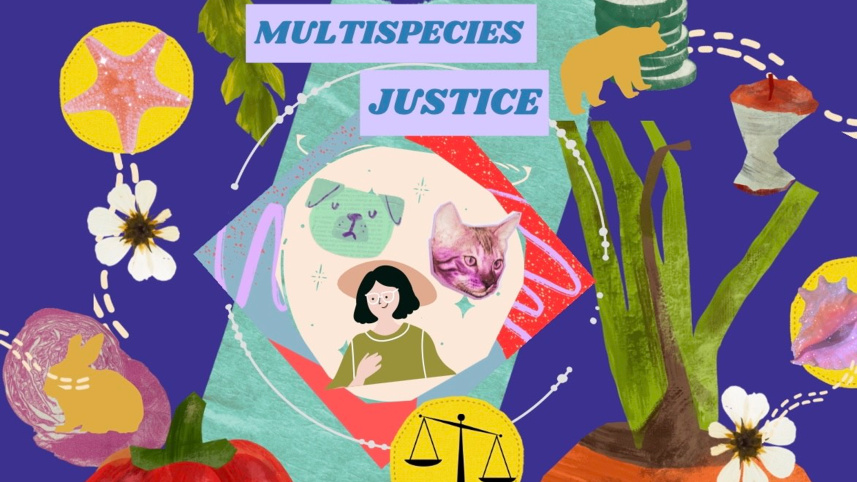
“Multispecies justice”—quite a mouthful, I know. I remember the first time I heard about it: I was freezing, sitting in my 19th-century classroom, which always managed to maintain a subzero temperature no matter the season. When this phrase reached my ears, I was instantly fascinated. Having my higher education broadly focus on human justice, the fact that justice could transcend beyond humans still wasn’t something I was deeply aware of. And ever since that class, I have carried around the idea of multispecies justice quite closely. So, what exactly does “multispecies justice” mean, and how does it relate to social justice?
Multispecies justice is a concept that rejects human exceptionalism and recognises the interconnectedness of human and nonhuman lives. It challenges the historical and contemporary idea of justice that has largely been reserved for humans. It is an emerging idea in the field of social and ecological justice that can be best understood by taking the polycrisis of the 21st century into account and by rejecting the notion that humans are at the top of the non-existent social and ecological pyramid; by actively moving away from anthropomorphism that evaluates nonhumans through a purely human-centric lens; and by acknowledging that injustice, even across species, often follows a core logic rooted in exploitation and indifference.

In layman’s terms, multispecies justice is a lens that enables us to see ourselves as part of the wider natural world and to realise that all networks of violence and destruction might have their roots in extraction-focused, profit-oriented ideas pushed by colonialism and capitalism. And by shedding light on that very problem, it offers us a way out: by rethinking how we engage with the world around us and by demanding an inclusive, thoughtful, and kinder approach in our everyday interactions with life that’s all around us; and that’s exactly where its goals align with those of social justice.
Social justice is about ensuring humans, regardless of gender, class, or sexual orientation, have fair and equitable access to rights, resources, and opportunities that allow them to have dignity and unobstructed participation in social, economic, and political life. Now, when we normalise harm committed against nonhumans, it has a way of affecting humans too, especially those living on the peripheries of society. For example, as we approach summer, we are increasingly dreading the unforgiving sun and the inevitable sweaty, sticky inconvenience it will turn us into. While the heat affects everyone, people working in informal sectors–day labourers, rickshaw-pullers, street vendors–whose livelihoods depends on being outside and who cannot retreat indoors the way more privileged people can, suffer disproportionately more.
When streets are waterlogged, or monsoon floods arrive, the most affected are those who live on the streets without shelter–both humans and our nonhuman neighbours. When industrialisation takes over habitats, it deprives animals of their homes, and they are often forced to relocate to heavily urban areas where conflict between humans and nonhumans ensues. And, even when affluent human neighbourhoods can afford to drive those they deem “others” away, marginalised neighbourhoods are often left to grapple with a conflict not of their choosing. Even our most shared resource, the air, is heavy with pollution and refuses to acknowledge class boundaries, as we see increasing headlines of an ever-deteriorating, hazardous quality of air, children with asthma, and adults with persistent respiratory diseases.
When all this translates into headlines of increasing mental health issues, suicide rates, and crimes, one argument that becomes difficult to ignore is this: if we had just built our cities to be inclusive of more than just one species, could we have been slightly better off?
Imagine a city with more trees to provide us essential shade that supports biodiversity, unencroached water bodies to protect us from floods, and buildings built following proper codes that allow airflow and reduce disaster risks. Imagine open spaces and bluer skies, and room to take a nature walk with those we love, a city with limited light, noise, and air pollution where birds don’t have their routines disturbed by impatient horns and rampant fireworks, where trees are allowed to live out their full, uninterrupted lives, where crows don’t disappear, and where policymaking begins with kindness and understanding. So, maybe, if cities were built for more-than-human needs in mind, we wouldn’t have to be trapped in an urban jungle in a constant state of crisis, trying to masquerade everything as “normal”.
Multispecies justice, then, is not abstract but a very practical way of achieving many of the outcomes promised by social justice: a society with fairer distribution of resources, safety, liveability, and dignity. And Dhaka is the perfect playground to test this inclusive approach as a dense, diverse, and young city constantly improvising to survive, care, and perhaps even thrive. And at a moment when our democratic rights and scope for accountability are back on the table, and a younger generation of lawmakers signals the possibility of different priorities, it is worth redefining our idea of what justice includes and whom it is for.
Marzana Tasnim is a member of the Editorial team at The Daily Star.
Views expressed in this article are the author's own.
Follow The Daily Star Opinion on Facebook for the latest opinions, commentaries, and analyses by experts and professionals. To contribute your article or letter to The Daily Star Opinion, see our guidelines for submission.
 For all latest news, follow The Daily Star's Google News channel.
Comments