


Will this election pass the minority protection test?

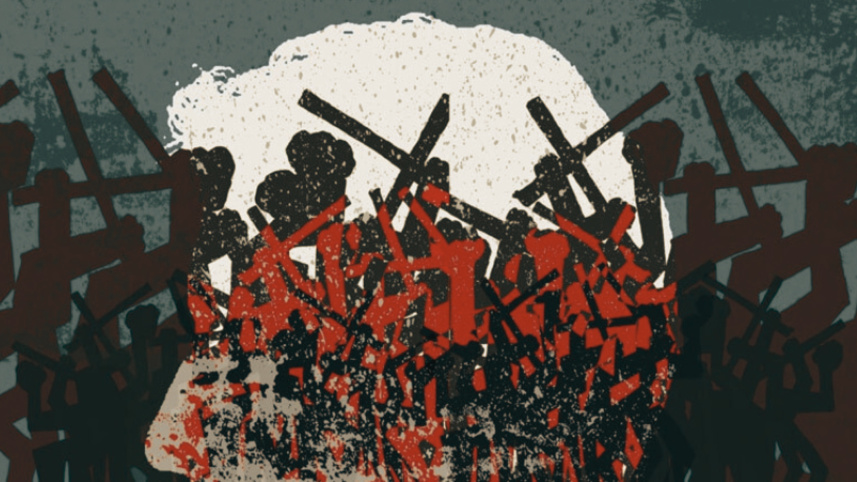
In late December, several houses of minority communities in Raozan and Rangunia upazilas of Chattogram were padlocked from outside and set on fire, forcing families to cut their way out to safety. A citizen delegation that inspected the Raozan site on February 1 said the attack was meant to create fear among religious minorities ahead of the election. The visiting team leader also underscored a deeper question: “When elections come around, we talk about a level playing field for candidates [equal opportunity for all]. But we don’t talk about a level playing field for voters. Can all voters exercise their right to vote by going to polling centres without fear?”
In other words, can the minority voters go to the polls without fear or intimidation, like everyone else? For many, such attacks are not just isolated crimes. They serve as a signal. After all, elections in this country have a way of reigniting unpalatable memories. Long before the first ballot is cast, fear begins to circulate: not as rumour, but as recognition of times past. For religious minorities, election cycles have historically coincided with heightened vulnerability—threats, intimidation, attacks on homes and places of worship, and the cautious calculation of when to stay indoors. It has been repeated enough to become part of how elections are anticipated, not just experienced.

That anticipation matters politically, because fear that is predictable is rarely irrational.
Civil society organisations have often attempted to document this vulnerability, though not without controversy. Recently, the Bangladesh Hindu Bouddha Christian Oikya Parishad reported 42 incidents of communal violence in January alone, including attacks on homes, land, and places of worship. Such reporting, especially the characterisation of crimes, should be treated with caution, but the recurrence of these incidents during election periods is not new.
The government, for its part, rejects claims of widespread communal violence. According to official numbers, 645 incidents were recorded in 2025 involving members of minority communities. Of these, officials say only 71 contained what they called “communal elements,” while the rest were categorised as general criminal acts. The state argues that these numbers demonstrate the importance of distinguishing religiously motivated violence from broader law-and-order challenges.
This distinction deserves to be acknowledged. Accuracy matters in public debate, and conflating all crimes involving minorities with communal violence risks distortion. However, it does not resolve the deeper democratic question. Even a single incident rooted in communal targeting is not acceptable in a democracy that claims equal citizenship. Violence and intimidation tend to cluster when political stakes are high and accountability is diffuse, usually before votes are cast, and sometimes after results are declared.
This is not so much an aberration of democratic life as a pattern that institutions have learned to manage rather than dismantle. Their response thus feels almost routine: condemnations are issued, assurances are offered, and additional security is deployed around polling stations and other sensitive sites.
These measures are not meaningless, but they are temporary. They address the visibility of risk, not its persistence. Protection intensifies when legitimacy is publicly at stake, then recedes once attention moves on, while accountability—thorough investigations, consistent prosecutions, visible consequences—remains elusive. The harder question is not whether the state can anticipate risk, but why minority insecurity remains so foreseeable and yet so episodic in its protection.
Political theory offers a useful perspective here. Political scientist Guillermo O’Donnell once warned that electoral democracy can coexist with what he described as “low-intensity citizenship”—systems in which rights do exist but the state’s protective reach is uneven. Some citizens experience the state as continuous; others encounter it intermittently. Seen through this lens, the election-linked insecurity of minority communities is not evidence of democratic absence. It is evidence of democratic incompleteness.
Authorities anticipate risk. Security forces are deployed around polling stations, religious sites, and sensitive localities. This anticipation itself is an admission that vulnerability is known in advance, even if protection is seldom guaranteed. Minorities do not need to be entirely excluded to be politically marginalised. They only need to calculate risk differently. The anticipation of harm, whether or not it materialises, reshapes participation. A vote cast under such conditions may still be counted, but it is not cast on equal footing.
If minority security is to be taken seriously, it cannot be treated as an election-management exercise. Protection must be anticipatory rather than reactive, accountability must extend beyond moments of public attention, and investigations must proceed with the same urgency once political incentives have faded. These are not exceptional demands. They are the minimum conditions of equal citizenship in a functioning democracy.
The period after elections is often the most revealing. It is then that political attention shifts, security deployments thin, and cases stall. Communities are left to wonder what the state’s silence or inaction means. The message they get is that protection was temporary, extended when political legitimacy was visible, and withdrawn when it was no longer urgent. So, if the upcoming election is to be understood as a democratic reset, it cannot be judged solely by the calm of polling day; it must be assessed by what follows.
A democracy is not measured only by how it administers choice but also by how it distributes security. Bangladesh is not alone in confronting this tension. But election periods do sharpen the contradiction. The incidents of recent months should therefore be acknowledged not as aberrations, but as ground realities, and these are part of a legacy pattern that must be dismantled. But for that, acceptance of the risk is the first step. After all, democracies mature not by denying their fault lines, but by confronting them institutionally. The standard expected here is the predictability of protection. Citizens, including minorities, must be able to assume that their safety does not depend on electoral attention, media coverage, or political convenience.
This election arrives with a set of expectations that have been absent in recent years. It is being framed, domestically and internationally, as more competitive, more open, and more credible than the last three national polls. But this also raises the threshold by which democratic performance will be judged. A democracy that secures its minorities only when it is being watched has not yet resolved the question of equal citizenship.
Tasneem Tayeb is a columnist for The Daily Star. Her X handle is @tasneem_tayeb.
Views expressed in this article are the author's own.
Follow The Daily Star Opinion on Facebook for the latest opinions, commentaries, and analyses by experts and professionals. To contribute your article or letter to The Daily Star Opinion, see our guidelines for submission.
 For all latest news, follow The Daily Star's Google News channel.
Comments