


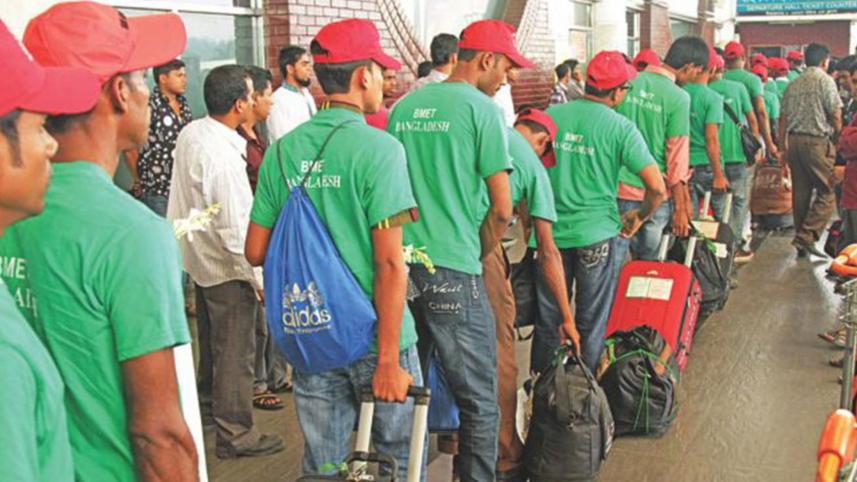
Migrants are anxiously waiting. Let us not fail them.
The Covid-19 pandemic has thrown a grave challenge to the policymakers. The government of Bangladesh is engaged in an uphill task to contain the contagion through enforcing lockdowns and raising public awareness, shoring up testing and treatment facilities and framing incentive packages so that damage to the national economy is minimised. A declared priority of the government is to lessen the hardship of workers engaged in various sectors.
In the past, during periods of national crisis (cyclone or floods), migrants remitted higher than the regular amounts to help households tide over the emergency. This time, however, the global scale of the crisis—triggering a sudden contraction in the flow of remittance—has exposed a big section of their left behind families to severe vulnerability. In addition, voluntary return and forced deportation of tens of thousands of workers have further compounded the crisis. Many returned empty-handed.

Reports that migrants from the Gulf states and Europe were not abiding by quarantine rules created an anti-migrant psyche. Households in which migrants returned faced resentment of the locals. They were subjected to harassment, physical assaults, extortion and discrimination in accessing medical care. Without valid evidence, returnee migrant workers were identified as the source for the spread of the infection. The class element of such labelling is evident. There was hardly any stigmatisation of other returnees (business people, students, visitors and other professionals) who failed to adhere to the quarantine rules. Marginalised migrants were the convenient villain.
In this challenging situation, RMMRU proposes several immediate and mid-term measures pertaining to the labour migration sector for consideration of the government.
Immediate Measures
Allocation of fund targeting migrant households: The Ministry of Expatriates' Welfare and Overseas Employment's allocation of resources for emergency support to the migrants in destination countries and its plan to extend reintegration loan from the Wage Earners' Welfare Fund (WEWF) are important steps. Unfortunately, a much larger amount is needed than what can be mobilised from this Fund. Instead of relying on the WEWF, which is generated from the migrant workers' own subscription, such fund should be sourced from the government's own exchequer. This will send a positive signal of the government's commitment to the migrants.
There is a need to extend financial support to the migrant families who are in distress and the returnees who came back empty-handed. The government should consider allocation of a large amount of resources, perhaps to the tune of thousands of crores of taka, to provide cash grants to the vulnerable migrant households so that they can stave off hunger and malnutrition. Civil society organisations can be effective partners of the civil administration at the grassroots in identifying the deserving households.
Concerns in destination countries: Taking advantage of the Covid-19 outbreak, some destination countries have taken measures to deport migrants in irregular status. Instead of adhering to international law to protect all migrants during a situation of global crisis, exerting pressure on the countries of origin to take back their nationals with the threat of blacklisting is egregious. The government should urge the concerned states to keep the matter in abeyance until the situation normalises. It is important to note that, in many instances, workers who now find themselves in irregular status migrated through the regular channel with valid visa and work permit, meeting the administrative requirements of both countries of origin and destination. On arrival in the countries of employment, they became victims of the machinations of unscrupulous rent-seeking Kafeels (sponsors) or recruiting agencies at that end.
Many migrant workers who lost their jobs due to the coronavirus crisis either returned voluntarily or were deported; they have not been able to secure their due wages and other benefits. The government should make sure that those affected can claim back such dues as soon as the situation permits.
In some destination countries, migrants cannot access free test and treatment and are thus unable to secure those services. The fear of detention precludes those in irregular status from undergoing tests. The government should urge the concerned countries not to make any distinction between citizens and migrants as it would only jeopardise the health of their own population.
In most instances, migrant workers live in cramped, unhygienic condition. The fear is, if one is infected it will spread like wildfire. The government needs to engage with the authorities of destination countries so that appropriate measures are taken to minimise the risk. Current efforts of Bangladesh missions to disseminate information about safety in Bangla should be a continuous endeavour.
The impact of Covid-19 pandemic will differ significantly on the basis of gender. The Bangladesh missions should work out modalities with the authorities of destination countries to maintain unhindered communication with the female migrants working at home to ensure they remain safe and are provided with healthcare, should the need arise. Concerns of safety of the women working in other sectors should also receive equal attention.
To keep its foreign exchange reserve buoyant, the government should consider giving additional financial incentives to the remittance senders. In some areas of destination countries, remittance transfer houses are not operating and migrants are unable to send remittances. The government should urge those countries to keep such facilities open so that migrants who still have earnings can send remittances.
Responsibility of the BAIRA: The Bangladesh Association of International Recruiting Agencies (BAIRA) should create an emergency fund through the contributions of its members, particularly those who are wealthy. It should immediately instruct the members to submit a list of migrants whom they have charged money to facilitate their migration. The Ministry of Expatriates' Welfare and Overseas Employment should demand such a list from the BAIRA.
BAIRA should also instruct its members to return money to workers in cases where the recruiting agencies have not started processing the documents. From the emergency fund, BAIRA should provide assistance to those migrant families whose papers were processed but could not secure flights due to the sudden outbreak of the pandemic. The government should ensure that the latter group of workers is given priority in deployment without having to pay any additional sum when labour migration resumes.
Mid-term measures
Guideline for serving migrants during emergency situations: There is no established guideline about how labour migrants should be dealt with in emergency situations. This crisis has created an opportunity to frame such a guideline that can be incorporated in the Overseas Employment Policy, 2016. Resources have to be allocated for emergency situations under the Guideline. Likewise, the Communicable Diseases (Prevention, Control and Eradication) Act, 2018 needs to incorporate the migrant issue with due importance.
Database of returnee migrants: Using the arrival data of civil aviation and immigration departments, the Ministry of Health has done an important work in identifying migrants who returned after the outbreak of Covid-19. This has created an opportunity for generation of a database of all returnee migrants through the coordination and collaboration of various ministries of the government, including home affairs, civil aviation and MEWOE.
 For all latest news, follow The Daily Star's Google News channel.
 Irregular migration and trafficking: In the aftermath of the pandemic, the scope and opportunity for migration through formal channels will substantially reduce. This will create conditions for the trafficking and human smuggling syndicates to prey on the aspirant migrants. The government should remain vigilant and take stern action against the kingpins, not merely the ground-level operatives of such nefarious trade; and in partnership with the civil society organisations, it should take measures to create awareness against irregular migration.
Responsibility of regional and international processes: In the post-pandemic phase, the member-states of Colombo Process, Abu Dhabi Dialogue and the Global Forum on Migration and Development should, taking lessons from the crisis, develop appropriate short and long-term strategies for protection of migrants during emergency. As the leading state of the much-celebrated Global Compact on Migration, Bangladesh should initiate discussions in these forums at the opportune moment.
Migrants are the lifeline of Bangladesh. All along during crisis situations, they stood by the country. At this critical time, we as a nation should do our best to support the vulnerable migrants and members of the left behind families. Such support to the migrants should be no less than what has been extended to others: business, formal-sector workers and agriculture. Migrant workers are eagerly waiting for an announcement to this effect.
RMMRU researchers Dr Tasneem Siddiqui and Dr Syeda Rozana Rashid of Dhaka University, Dr Mohammad Jalal Uddin Sikder of Daffodil International University, Sayed Nurullah Azad and C R Abrar contributed to this piece.
Comments