


When waste becomes threat, not nuisance
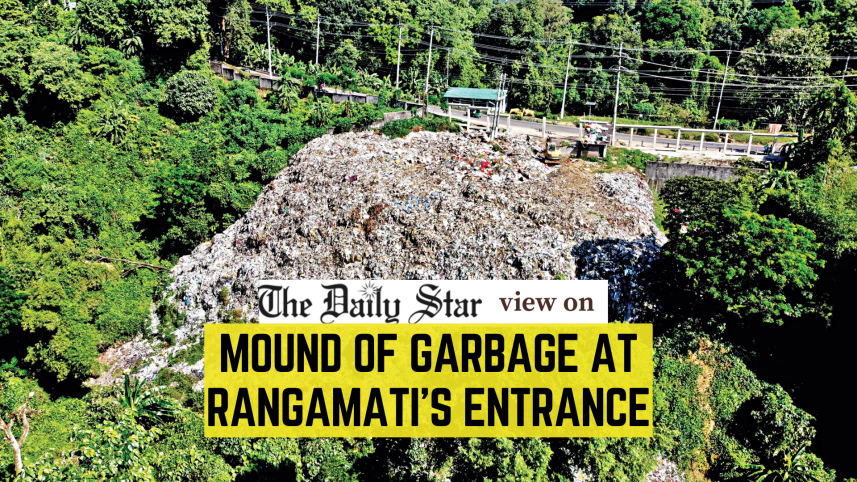
Bangladesh's waste crisis has long ceased to be a mere civic inconvenience; it has become a serious environmental and public health emergency. Across cities and towns, waste generation continues to outpace both the capacity and the commitment of authorities to manage it sustainably. That failure is laid bare in Thursday's front-page photograph of this daily: a vast mound of garbage dumped along the roadside at the entrance to Rangamati town. Local authorities admit that around 30 to 40 tonnes of waste from the town are discarded daily in this open space, sliding down hillsides and polluting nearby streams and ultimately Kaptai Lake.
Over the years, media reports have repeatedly shown how municipal and tourism-related waste is dumped on hill slopes and along lake banks, despite official assurances of proper disposal. During the monsoon, this waste contaminates vital water sources, triggering waterborne diseases such as diarrhoea and cholera, as confirmed by local health officials. Now, the gateway to one of the country's most scenic tourist destinations has become an indicator of administrative neglect.

Sadly, across the country, the dominant approach to handling waste remains dumping rather than treatment, with little attention paid to reduction, segregation, recycling or recovery. Dhaka, for instance, generates nearly 7,000 tonnes of waste every day and only about 37 percent of waste is collected regularly. The rest clogs drains, contaminates water bodies, burns in open air or accumulates in landfills already close to collapse. Besides, landfills such as Aminbazar and Matuail are dominated by mixed waste and lack proper leachate and gas management systems. Medical and industrial waste are frequently disposed of alongside household refuse, significantly increasing the risks of toxic exposure and disease. Despite spending around Tk 3,323 crore on waste management over the last seven years, hundreds of uncontrolled dumping sites continue to operate across the capital. Financial allocations, in the absence of systemic reform, have delivered little meaningful improvement. This situation does not stem from a lack of awareness, but from chronic deficiencies in planning, enforcement and political priority.
The way forward requires a decisive shift away from the linear "take-make-dump" model towards a circular and sustainable system. Waste reduction must be prioritised, segregation made mandatory, organic waste composted, recycling industries strengthened, and hazardous materials treated safely. Without urgent, coordinated and accountable action, waste will continue to degrade our landscapes and water bodies, while steadily eroding public trust in governance. Also, we cannot allow the scenic terrains and tourist sites of the country to drown in heaps of waste.
 For all latest news, follow The Daily Star's Google News channel.
Comments