


Crisis at Chattogram port must end
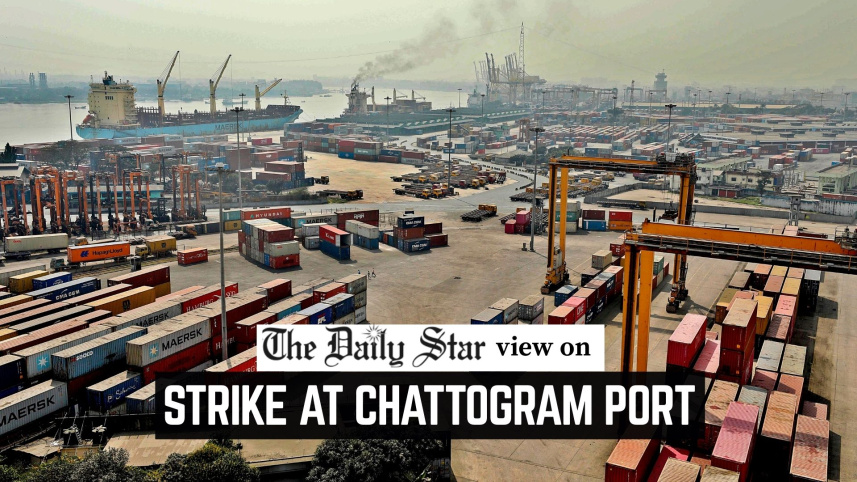
We cannot emphasise enough the punitive impact of the stalemate at Chattogram port, with protesting employees announcing an indefinite resumption of their strike from Sunday after a two-day break. The strike, which began on February 3, was triggered by the interim government’s decision to hand over the port’s management to DP World, paralysing export and import activities. Losses to traders are expected to run into millions.
The RMG sector being the most vulnerable, businesspeople are justifiably worried. Bangladesh competes with Vietnam and India in this sector and without a functional port, we lose our competitive edge. Besides, continued stalemate will also lead to higher consumer prices due to import bottlenecks. As things stand, the lack of transparency surrounding the deal with DP World, a hardline stance towards workers, and delayed negotiations have brought operations at one of the country’s most vital economic hubs to a complete halt.

During the first 28 hours of the strike, cargo delivery from yards, vessel movement to and from the port, and loading and unloading at the jetties remained suspended. Workers had earlier postponed their strike after assurances from the shipping adviser that their demands would be addressed. Later, instead of easing tensions through dialogue, the government moved to clamp down on employees, seeking travel bans and asset probes against protest leaders. This only worsened the situation, leading to the declaration of an indefinite strike at the time of writing this column.
Leasing a terminal is standard global practice and does not amount to selling the country. However, a deal of this magnitude must be transparent and concluded after consulting stakeholders. That this apparently did not occur has led to a predictable crisis. The Supreme Court has observed that the government cannot proceed with signing the contract until an appeal against the High Court verdict is filed. A coordinator representing the striking employees has also alleged that senior government officials “forcefully” obtained signatures from port officials who are members of the contract negotiation committee.
The shipping adviser has assured that no jobs will be lost and that recruitment will be done locally, with no foreign workers brought in. This only strengthens the case for making the contract public to allay workers’ fears. The adviser has also stated that, contrary to prevailing perceptions, the deal was not rushed and was based on a project dating back to 2022. Negotiations, he said, had been ongoing for the past three months and were interrupted midway due to a High Court case. A Supreme Court hearing on the deal is scheduled for February 9.
With the election only days away and mounting losses from the strike, prudence demands that the government leave the decision to the next elected administration. The deadlock at Chattogram port must be resolved.
 For all latest news, follow The Daily Star's Google News channel.
Comments