


Women, work and the demography of development

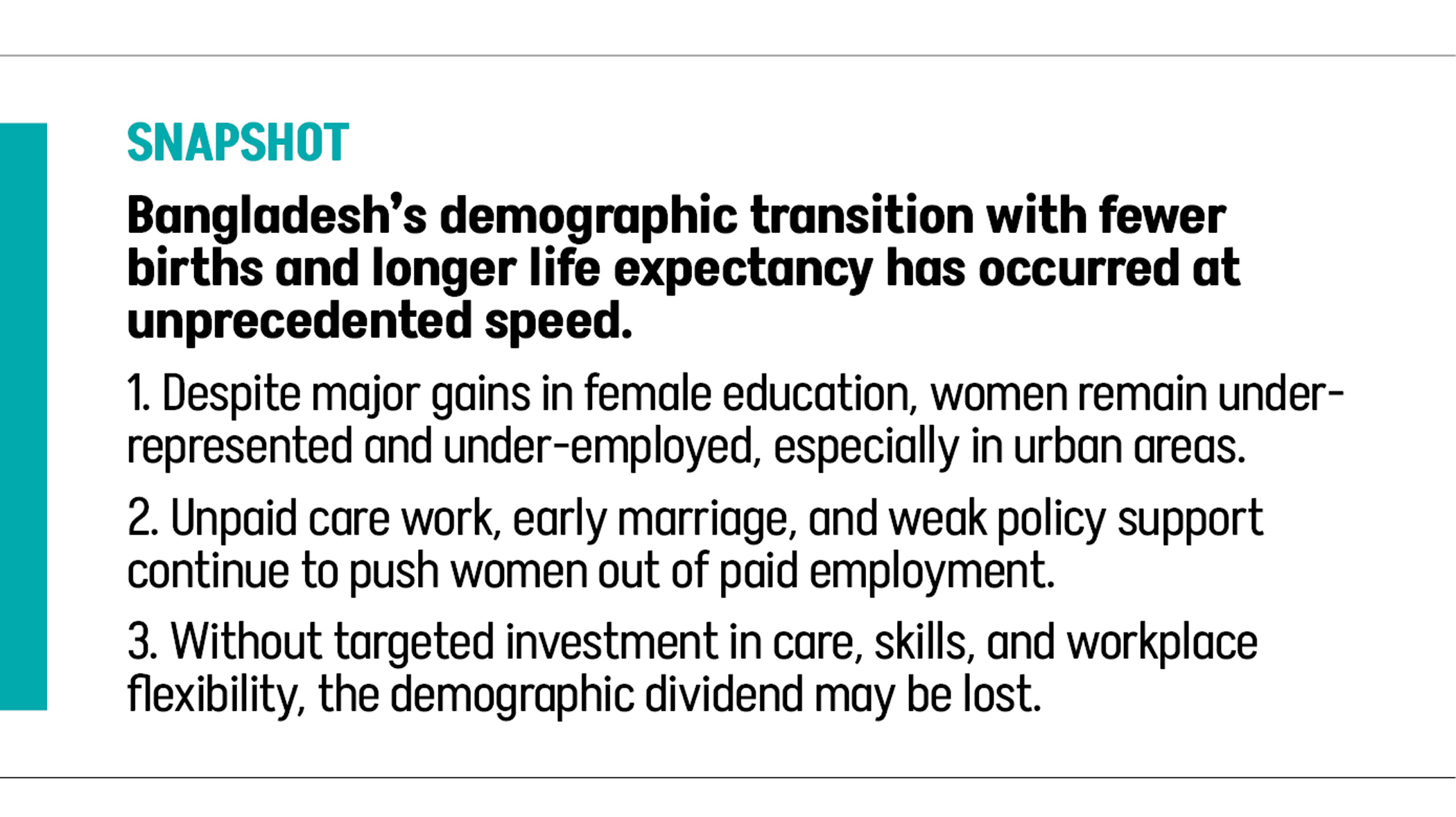
Bangladesh is at a crossroads of several major social and demographic trends. Women are at the centre of these trends. Falling birthand death rates are generation-defining trends in Bangladesh today. In the years since the birth of Bangladesh, expected length of life has increased by over 25 years on average and more so for women. Life expectancy rose from 50 in 1972 to over 75 today. Until the 1990s men and women had about the same lifespan –females born now can expect to live up to 76 years while males will live up to 73 years. In approximately this same timeframe, birth rates declined from over 6 children per woman in the 1970s to just over 2 births per woman on average. In historical perspective demographic transition in Bangladesh happened at great speed—in Europe similar change took 150 to 200 years. Understandably, cultural change has not kept pace.
A Rapid Demographic Shift

Fewer births and longer life can have promising implications for development but only if the right investments are made. These trends create favourable conditions for economic growth, for a limited period of time, when the working age population has relatively few dependents. When birth rates decline the ratio of child to adults is low. Bangladesh is now enjoying a window of opportunity of low dependency ratios when it can benefit from a relatively large workforce. However, this is only a potential dividend that depends crucially on the right investments. East Asian economies that reaped the benefits of demographic dividend to catapult themselves out of low levels of development made crucial investments in education and work opportunities for women.
The Promise and Fragility of the Demographic Dividend
Bangladesh has made great strides in improving female education but these have not translated into expected trends in the workforce. Women constitute half the population but represent only a third of the workforce. Even that does not show the full extent of women’s under-employment. Most women work part-time. While women’s labour force participation has improved in rural areas it has declined in urban Bangladesh. Some part of this declining trend is in the garment sector but that is not the full story. The changing nature of garment production, in knitwear and other less labour-intensive sectors, is likely the cause of decreases in feminisation of the workforce—in the initial years of the introduction of garment manufacturing for export the workforce predominantly female with some estimates suggesting 90 per cent were women and girls. Recent surveys show women constitute only 54 per cent of the workforce in the garments industry.

Why Education Has Not Translated into Work
There are other much more foundational barriers to entry for women, in terms of acquiring requisite skills and cultural expectations around early marriage and child-bearing as well as exclusive responsibilities of providing care to children and elderly, and household chores. These constitute hurdles at individual, household and societal levels, that if not overcome, will present formidable challenges to development at all of these levels. Analyses of national labour surveys that routinely collect time use data show that on average women spend 3 to 4 times more time in child care, elderly care and domestic work compared men who spend less than an hour of average. Women are also more likely to leave the workforce when they marry, whereas men are more likely to join the workforce in order to marry. Even now, nearly 50 per cent of all women are married before the legal age of marriage of 18 years. Choices about childbearing and childrearing further entrench these differences, setting men and women on vastly different career trajectories with implications throughout the life-course.
Care, Marriage and the Gendered Exit from Work
Broader cultural change is needed to reduce these gendered inequalities. Greater sharing of care and domestic responsibilities between men and women can be at the core and need not be limited to preaching about norm change. Changing minds and mindsets have to be in the pathway but the road to such change needs to occur at the level of incentives and motivations that perpetuate norms and expectation. Within household changes can and ought to be supported by policies that incentivise such sharing. What is needed is greater investment in reducing the burden of care through better technologies and support, compensation for care provision, and incentivising better workplace support for care. For example, reducing the burden of care can be varied—for families with school age children this might take the form of after-school programs. In urban Bangladesh transporting children to and from school and providing supervision during holidays can be decisive hurdles to parents being able to work 9-5 jobs. Globally, there are now emerging success stories of financial compensation programmes paid to family members who take time off work to take care of indigent and elderly family members. Such support can take the form of tax credit for childcare for parents such as those offered in the United States, or through direct subsidies to institutions that provide such care in many countries.
Policy Gaps in Supporting Care and Flexibility
Policy prescriptions regarding care work have at best been limited. On the books, labour laws have been implemented to guarantee 6 months of maternity leave for pregnancy. It is not clear that these laws are enforceable in the private sector. And with declines in children ever born these actions are only going to become less and less important components of care work. Women who are required to balance care responsibilities with career demands because of other forms of dependencies for the elderly and indigent, not to mention older children who need care and supervision are not supported by policy measures. Such policies could be focused around flexible hours and the option of remote work. Studies show that sectors of work that allow such flexibility in time and location of work are more likely to recruit and retain women workers.
Urbanisation, Skills and the Risk of Exclusion
Rapid urbanisation and the need to acquire technical skills pose additional challenges for future work trajectories for women. National labour statistics suggest that for the first time in history the number of women working has declined and more so in urban areas than in rural areas. Declining participation is undoubtably related to the nature of work opportunities—urban employment is more often in the formal sector and away from home whereas rural women are more likely to engage in economic activities in and around the home. The growth of new economic opportunities is likely to further exacerbate the exclusion of women, the biggest gender wage differentials exist in these sectors driven by technology led growth. The fastest growing sectors of work are information technology and finance. Labour force data suggests women’s participation is lowest in these sectors because of the historical exclusion of women from technology-oriented fields.
Putting demographic change in context highlights the multiple ways in which women’s issues are at the core, and policy action must address the needs of women. Addressing gender inequities—whether in access to opportunities or in the burden of care—isn’t just a moral issue; it’s a strategic investment with measurable returns. We need to shift our focus on smart policies that address the realities of men’s and women’s everyday lives and the centrality of unpaid care responsibilities.
Sajeda Amin is a Demographer/Sociologist and serves as Senior Research Advisor at Sajida Foundation
 For all latest news, follow The Daily Star's Google News channel.
Comments