


Will artificial intelligence lead to the end of jobs?
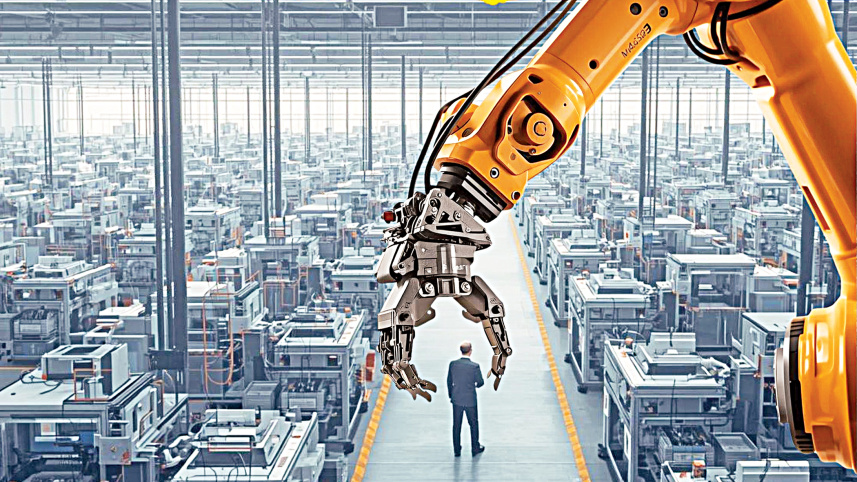
Fear of new technology is not new. Whether new technology will replace human beings is a question that has been haunting humankind from time immemorial. One may remember the “Luddites” in early nineteenth-century Britain - workers who went to smash new weaving machines for fear that they would replace human labour.
Such concerns have returned with the advent of artificial intelligence (AI).

Advances in computing power have led to the development of tools and applications that are so versatile that they can accomplish a lot of tasks hitherto performed by human beings. As this technology is portable, countries with the requisite infrastructure can make use of it. And that is happening at a time when the labour market of Bangladesh is already facing multiple challenges. The question naturally arises whether the challenges will now become more difficult.
Labour market woes in Bangladesh have worsened
The labour market in Bangladesh has never been without its challenges. The shortage of good jobs in the formal sector, a high degree of dependence on the informal sector, low and falling rate of women’s participation, decline in women’s jobs in the ready-made garment industry, and a high rate of open unemployment among young people are issues that are not new.
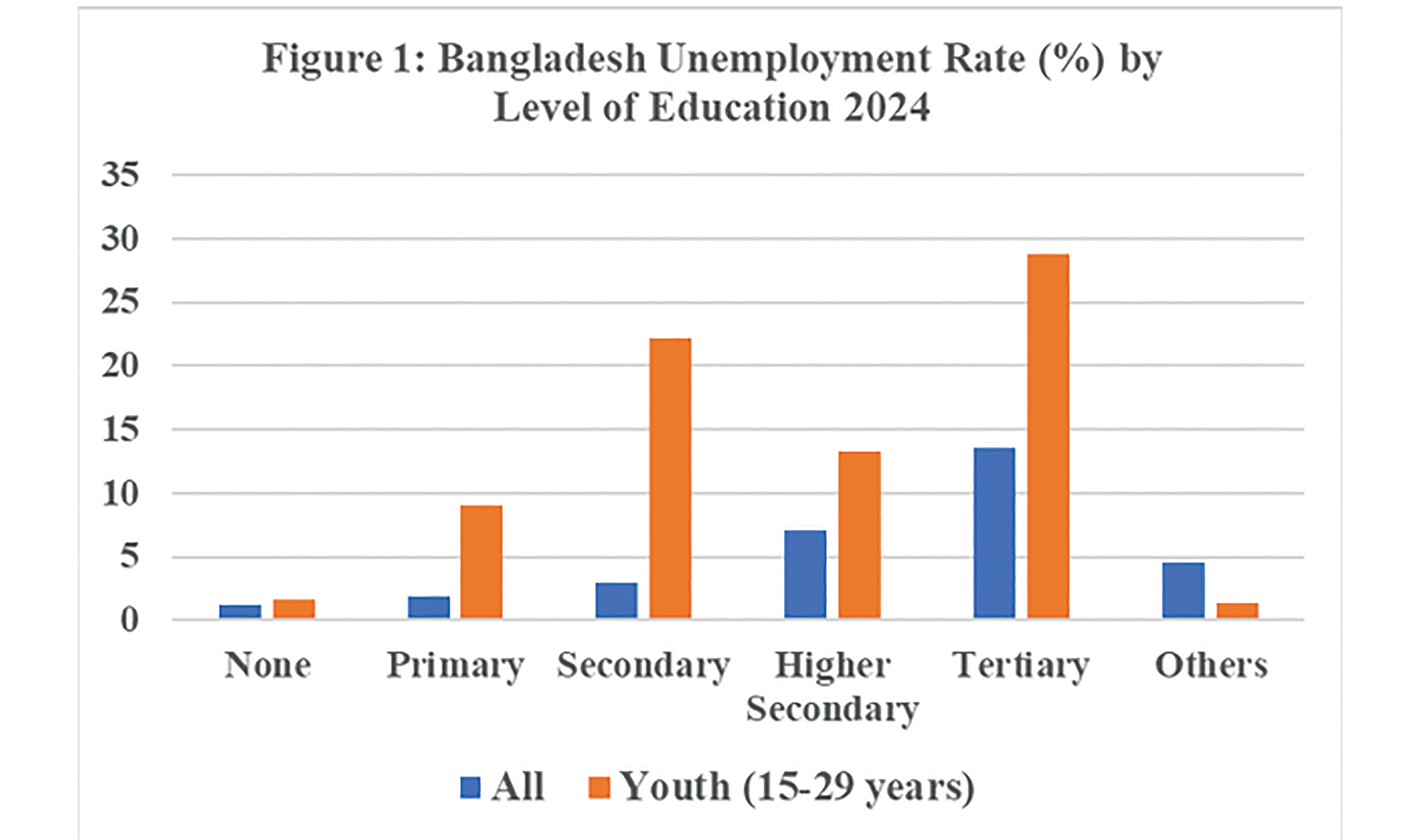
Figure 1
Source: Prepared by the author using data from Bangladesh Bureau of Statistics: Labour Force Survey 2024
Data from the Labour Force Survey of 2024 shows that labour market woes have worsened. As there has been very little growth of jobs in manufacturing in recent years, the process of structural transformation of the labour market is moving in the opposite direction. Instead of a rise in the share of manufacturing and a fall in that of agriculture, the opposite is happening.
Unemployment among the educated remains a major issue, and the rate of unemployment is the highest among those with tertiary education (Figure 1).
The advent of artificial intelligence (AI) is raising concerns
Previous experiences with technological and industrial revolutions have shown that while innovations can transform the lives of human beings, they also create challenges and raise fears about their possible adverse effects. While AI has huge potential for raising productivity, possible negative effects on employment and the need for developing new skills have emerged as important issues.
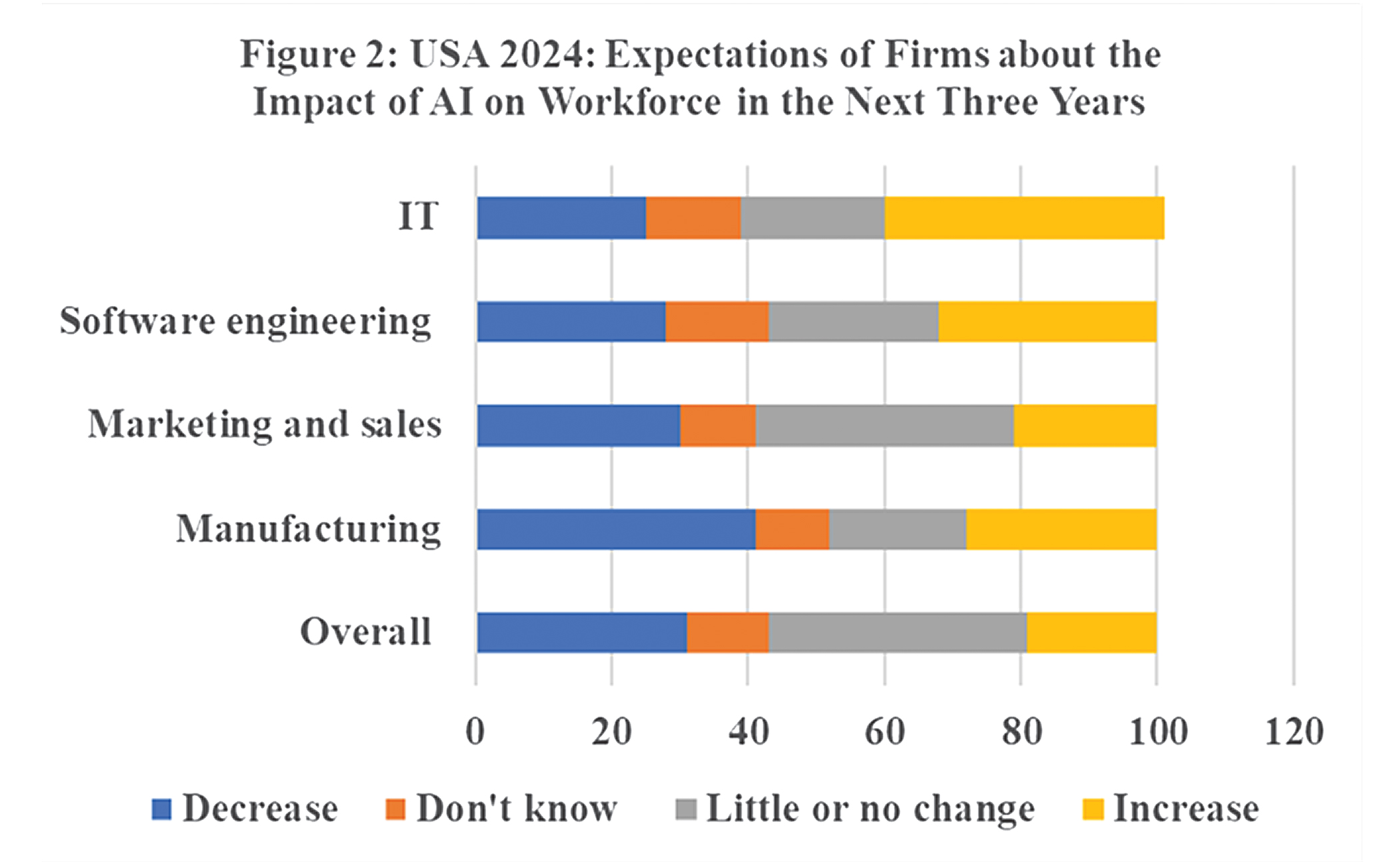
Figure 2
Source: Prepared by the author using data from Cerity Partners, McKinsey & Company Survey 2024
Which sectors are likely to make more use of AI?
Almost all sectors of the economy can use AI in some way or another; however, there are certain sectors where it can be used more easily and effectively. They include manufacturing, wholesale and retail trade, transportation, information and communication, finance, health, education, and services of various kinds.
The above list should not be taken to imply that sectors like agriculture cannot benefit from AI. For example, it can be used effectively in research and development work, in innovative and yield raising practices, and in making marketing more efficient.
Is AI going to create havoc in the labour market?
In its extreme form, the scare that often makes the rounds is that AI can replace human labour in most jobs, and widespread use of this technology may mean the end of work. However, the history of technological progress shows that while some jobs disappear, new jobs are created, and on the whole, more people get employed. Can it be different this time? Although it is too early to provide a clear answer to this question, it is possible to say a few words based on current experiences.
As very little research has been done in developing countries on the possible impact of AI on their labour markets, one may look at the situation in developed countries for some indication. In that context, data from a survey carried out in the USA in 2024 (Figure 2) may be relevant. If anything, this data does not support the doomsday scenario that is often painted. On the whole, less than a third of the enterprises covered expect AI to lead to a decrease in their workforce, and 19 per cent expect an increase. Taking into account those who say “little or no change,” one can say that over half don’t foresee a decrease in jobs.
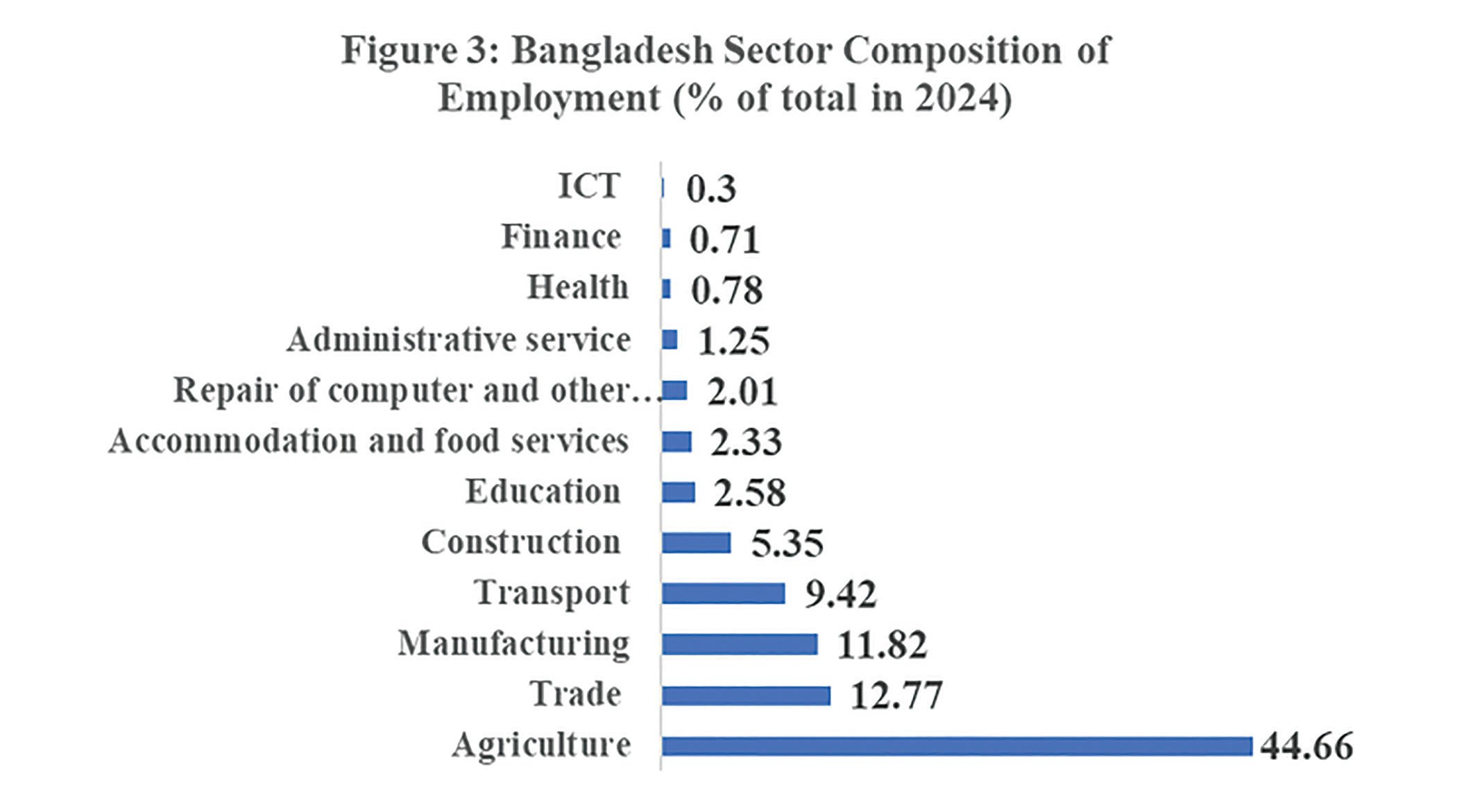
Source: Prepared by the author using data from Bangladesh Bureau of Statistics: Labour Force Survey 2024
While the scenario mentioned above varies between sectors, even in manufacturing, nearly half don’t foresee a decrease in workforce. If that is the expected impact in a developed country like the USA, can the outcome in developing countries - where the rate of adoption of the technology is likely to be much slower and limited - be one of large-scale job losses?
How is the labour market of Bangladesh going to be affected by AI
 For all latest news, follow The Daily Star's Google News channel.
 To address the above question, it would be necessary to ask whether Bangladesh is likely to see a widespread application of AI in the near future. The answer to this question, in turn, would depend on the structure of the economy and the likely speed of change in it. In that context, it is important to look at the sector composition of employment. Data presented through Figure 3 indicates that agriculture still remains the major employer in the labour market; and sectors where AI is likely to make quicker and easier inroads, e.g., manufacturing, trade, education, health, finance, etc. account for just about a third of total employment. Moreover, large proportions of the activities in some of them are in the informal segment, where the likelihood of adoption of AI is limited.
Bangladesh’s labour market already faces unemployment, informality, and weak structural transformation. Evidence from developed countries does not support widespread job destruction from AI. Bangladesh’s employment structure limits rapid AI adoption, but educated workers face new risks and opportunities. Long-term gains from AI depend on investment in skills, infrastructure, and policy readiness.
But the above should not be taken to mean that Bangladesh can or should ignore opportunities associated with AI. Productivity and competitiveness are important, and AI can contribute towards achieving these goals.
Furthermore, AI is particularly important from the point of view of the educated job-seekers because they are likely to seek jobs in the modern sectors of the economy which have good potential for its application. However, they already face high rates of unemployment; and AI opens up both opportunities and challenges for them. Those with technical competence in the field will be able to benefit from the opportunities, while those lacking in such skills will be left behind. Hence, rather than ignoring AI as irrelevant or fearing it, it is important to increase the preparedness to adopt and benefit from it.
Is Bangladesh well-prepared to embrace AI?
Preparedness to adopt and benefit from AI has at least two major dimensions - physical and social infrastructure. The former includes hardware, especially what is known as “data centres”, supply of electricity, and internet services. Social infrastructure basically refers to the level of competence of the workforce which in practical terms means qualifications in the areas of science, technology, engineering, mathematics (STEM).
Data centres are large-scale computing infrastructures that are used primarily for storing data, hosting websites, and supporting computer applications. On the hardware side, they form the key pillars of the IT sector. In terms of number, strength, and capacity of data centres, USA is the leading country of the world. And China, India, and Republic of Korea are among the top ten countries. Bangladesh does have some capacity that includes one “tier IV” and one ‘tier III” data centre run by the government, and a number of centres run by private companies. Whether they will be adequate to meet future demand is something that will depend on the speed of adoption of the technology. But given the costs involved and the size of investment needed to install a data centre of reasonable size, it may not be realistic to expect private initiative in the field - unless, of course, foreign investment can be attracted.
Preparedness of the workforce to make effective use of AI hinges critically on competence in STEM subjects; and that is a major concern. For example, in 2022, about 8,000 students graduated with engineering degrees in various fields. For reference, it may be noted that in 2018 (the year in which the graduates of 2022 may have passed HSC), about 860,000 passed the HSC examination. It is thus clear that a very small proportion of students go to study engineering and related subjects. Even if one adds other science subjects and mathematics, the proportion is unlikely to be much higher. In India, even after a decline recent years, the proportion of of undergraduate enrolment in engineering was 12% in 2021.
What strategy is needed?
In order to benefit from the potential of AI, action is needed to strengthen both physical and social infrastructure. As physical infrastructure is likely to involve big investment, the government would have to come up. The orientation of students will have to be changed towards STEM subjects; and it is better to do that from early stages. The capacity of the education system will have to be beefed up accordingly. Furthermore, the management also has to have good understanding of potential uses and possible abuses and pitfalls. What is called for is a long-term strategy focusing on both hardware and skills.
Rizwanul Islam is an economist and former Special Adviser, Employment Sector, International Labour Office, Genevaa
Comments