
Why have we failed to end migrant workers’ abuse?
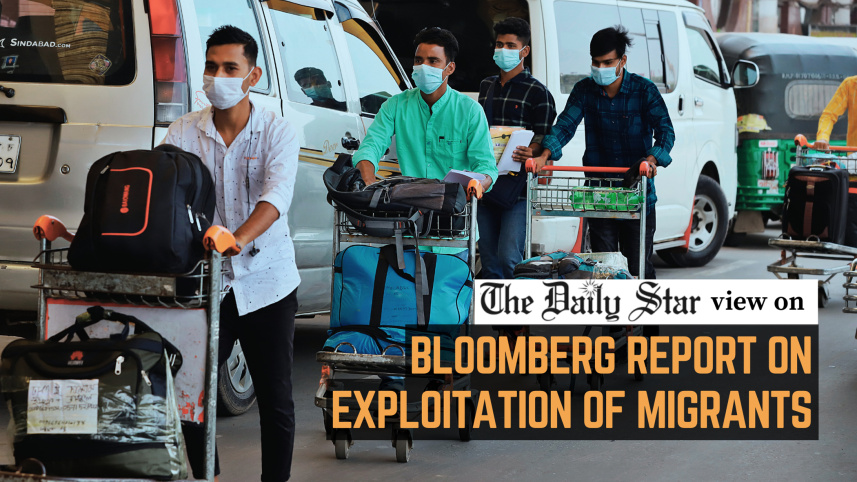
A recent Bloomberg investigation confirms what reports in The Daily Star and other media have been trying to establish: that a deliberately engineered system exists through which Bangladesh’s migrant workers are recruited, resulting in horrendous exploitations. It is a business model in which workers are charged up to $6,600 for jobs that are often nonexistent, benefitting everyone in the nexus, including recruiters, political elites, and those working the digital system. Only the worker gets the raw end of the deal, left with huge debts to pay, losing dignity, and in some cases, life itself.
The shocking case of Shofiqul Islam, a Bangladeshi migrant worker who borrowed $4,400 to get a construction job in Malaysia, only to end up dead in a derelict building outside Kuala Lumpur, is a stark example of the tragic consequences of this nefarious system. Shofiqul, like hundreds of others, reached Malaysia but found that there was no job. His employer disappeared, and he was left stranded in a building.
 For all latest news, follow The Daily Star's Google News channel.
 Over the past decade, more than 800,000 Bangladeshis went to Malaysia, and many of them have fallen into crippling debt, paying for recruitment fees that are far higher than those charged to workers from other countries. Many become victim to debt bondage, forced labour, and human trafficking. Shockingly, all this is happening under the noses of the Malaysian authorities, who seldom do anything meaningful to stop these abuses.
The recruitment process, moreover, is tightly controlled. With a small number of agencies involved, it is facilitated by the introduction of a digitised system under Bestinet, which has actually centralised the corruption. The Bloomberg investigation has identified a Bangladeshi living in Malaysia as allegedly a major player in this system and the founder of Bestinet, who has apparently used political connections in both countries to perpetuate this exploitation.
Even though these abuses were well known and internal discussions about reform had taken place, contracts were extended during the AL regime. Strangely, despite the gravity of Bloomberg’s findings, the governments of both countries did not respond to its queries. Even the current government’s inaction in ending this exploitation is disturbing. This raises the question: are the remittances that migrant workers send home more important than their rights and their lives? Why have these sinister networks not been dismantled despite all the evidence at hand? In fact, even during the interim government’s tenure, official visits of high officials on both sides and promises of solutions have not yielded any change.
There is no denying that workers need to be able to find jobs abroad and that our economy is highly dependent on the remittances they send home. But the state must put an end to this blatant exploitation by breaking the syndicates, enforcing ceilings on fees, and bringing politically connected actors and criminal brokers to book. For the next elected government, these are priority tasks—ensuring that migrant workers pay affordable recruitment fees through legitimate systems, guaranteeing their dignity and safety.
Comments