


Where teachers fear to tread

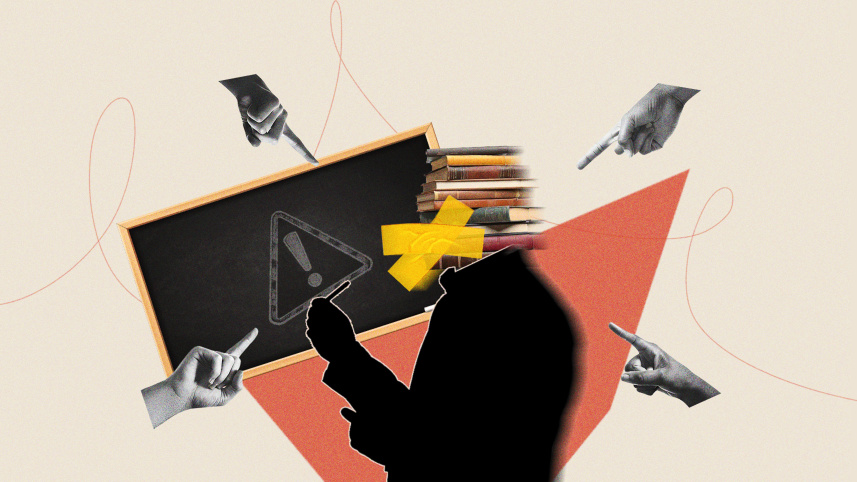
The termination of two teachers of the University of Asia Pacific (UAP), under pressure from groups of former and current students, on allegations of “Islamophobia” and being sympathisers of the ousted regime, is part of a disturbing trend. Teachers have been forced to resign, physically assaulted and mentally abused online with the administration failing to stand by them.
On December 18, Assistant Professor Layeqa Bashir and Associate Professor ASM Mohsin of the Department of Basic Sciences and Humanities at the UAP were terminated. The university administration’s reason in the notice was “the prevailing situation resulting from student protests.”

This happened without any institutional process. Instead, Prof Layeqa was first asked to resign and when she protested the move, an investigation committee was formed that invited complaints against her. Layeqa told The Daily Star that if she held anti-religion views, this would have been noted during semester evaluations. Instead, she alleged that complaints were invited from the entire student body after the committee was formed. But even before the investigation report was submitted and without giving any chance for her to respond, the university administration decided to terminate her along with Prof Mohsin.
According to reports, it all started on December 10 over Layeqa’s Facebook post where she objected to face-covering while having no issues with other aspects of purdah. This was in the context of the murder of a mother and daughter in Mohammadpur where the murderer, a domestic worker, had covered her face and worn one of the victim’s clothes to escape undetected. Layeqa had added the story at the bottom of her post.
Although the post had been set to be visible only to her friends, screenshots were leaked which led to an eruption online of demands for her termination. A week later, she apologised for any hurt feelings from her post, saying the remarks were personal and written from the standpoint of personal security following the Mohammadpur double murder. She apologised if anyone was hurt by her post and said it had no connection to her workplace. But this did not assuage the students and the protests continued, with the protesters demanding the termination of Prof Mohsin for not taking any action against Prof Layeqa. According to Prof Mohsin, he was terminated without any written complaint being made against him and with no inquiry committee formed. He was also not given any opportunity to respond.
At a press conference, one of the students demanded that teachers of other universities with the same mindset be identified and expelled. We all know how such incendiary comments can lead to dangerous situations.
What is most disturbing is that the UAP administration, instead of waiting for a full report of the investigation, announced the termination of both. Their lack of professionalism and courage to stand by their faculty members is shameful and unwarranted. Prof Layeqa told The Daily Star that verifying the identity of a student during exams or interviews, including checks for devices, was routine and lawful, referring to the viral video of her asking a student on Zoom to show her face for identification, that was also used to tag her as anti-religion.
Is this the “new Bangladesh” we are to look forward to? Where teachers can be terminated on the whims of former and current student mobs, due to allegations that have not been proven or have been made by distorting the facts? Apparently, some students objected to Prof Layeqa’s teaching about ancient customs and beliefs, which were very much a part of the subject she was teaching.
Such vicious attacks on academic freedom and freedom of speech spell disaster for universities. How will teachers teach subjects like anthropology, English literature or psychology if they are in fear that some students may interpret their lectures or comments as being anti-religion? A university is a place where ideas and views are exchanged and generated. This requires a sense of freedom that is unique and sacred. It is also the basis of debate and critical thinking. During the AL regime especially, the public universities were plagued by the violence and bullying perpetrated by the Chhatra League cadres and their cohorts. Anyone who did not bow down to them or expressed opinions against the regime and its cronies could be targeted. Private universities, however, were more or less spared of this.
Not anymore.
Now, after an uprising that promised to do away with such repression, it is back with a vengeance, only the actors are different. Groups claiming to uphold Islamic values (and some affiliated with political parties) have become emboldened and have decided to “cleanse” the universities of those they have tagged as anti-Islamic or “agents of the AL.”
There have been some who have expressed their outrage at Prof Layeqa Bashir’s arbitrary termination and expressed solidarity with her. The University Teachers’ Network has condemned the UAP’s arbitrary termination of the teachers without due process and stated that the teachers should be reinstated. A member of the network has aptly called it an assault on the academic freedom of all universities. Women’s rights organisation Naripokkho has also protested the termination of Prof Layeqa and the weaponisation of “hurting religious sentiments” to harass, torture and even kill people.
On face value, these incidents seem to be part of a widespread campaign to target anyone who does not appear to conform to certain ideologies. In the name of righteousness or safeguarding religion, certain groups—some politically affiliated—are carrying out this campaign, first by casting aspersions or even abuse on social media and then gathering enough people to create a mob and get the job done. For educational institutions, this is particularly dangerous as it aims to censor and control teachers, students, curriculum, and even campus environment.
Unless university administrations treat these cases with professionalism and fairness, these incidents will keep happening. Few teachers will want to risk termination, harassment or physical assault while trying to make students learn, which may compel them to leave out important parts of the curriculum and lead to constant self-censorship. This is a debilitating chokehold on intellectual development. Ultimately, it will be the students who will pay the price of this rabid intolerance of diverse opinions even when they are fact-based. For university education that is meant to enlighten minds through deeper knowledge and exposure to the unfamiliar and unconventional, these attacks on academic freedom will be nothing less than catastrophic.
Aasha Mehreen Amin is joint editor at The Daily Star.
Views expressed in this article are the author's own.
Follow The Daily Star Opinion on Facebook for the latest opinions, commentaries, and analyses by experts and professionals. To contribute your article or letter to The Daily Star Opinion, see our guidelines for submission.
 For all latest news, follow The Daily Star's Google News channel.
Comments