


US twin deficits, Trump’s economic gambit, and the risk of global disorder

The United States has grappled with an unsustainable economic imbalance for over two decades, characterised by persistent twin deficits in its fiscal and current account balances. This has propelled its international indebtedness to unprecedented levels, with the net international investment position reaching approximately -$26 trillion by mid-2025. A more relevant metric is that the US public indebtedness exceeded $38 trillion by the end of 2025. Compounding this vulnerability, President Donald Trump’s second term, secured in the 2024 election, promised a radical overhaul: reversing de-industrialisation through reshoring manufacturing, attracting over $20 trillion in foreign investment, and imposing reciprocal tariffs on nations like China with chronic trade surpluses against the US. However, these tariffs have backfired, unsettling financial markets and exacerbating economic volatility.
In a bold escalation, the Trump administration orchestrated a military invasion of Venezuela earlier this month, capturing President Nicolás Maduro and installing a compliant regime to exploit the country’s vast natural resources. This action aligns with the National Security Strategy (NSS) released in November 2025, which explicitly asserts US dominance in the Western Hemisphere and signals measures against Iran to safeguard Middle Eastern oil and gas supplies. These interventions risk igniting protracted military confrontations—”forever wars”—with unforeseen ramifications. Ultimately, Trump’s envisioned international economic adjustment will falter, potentially precipitating the collapse of the dollar-centric global monetary order.

The roots of the US’s economic predicament lie in its twin deficits, a phenomenon that has persisted since the early 2000s. The fiscal deficit, driven by government spending outpacing revenues, has ballooned due to factors like tax cuts, military expenditures, and pandemic-era stimulus. For instance, the federal deficit stood at $1.8 trillion in FY2025, even as revenues grew by six percent. Projections indicate it could rise to $2.6 trillion by 2034, representing over six percent of GDP. Paralleling this is the current account deficit, which measures the shortfall in trade and investment income with the rest of the world. Over the past two decades, this has averaged around three to five percent of GDP, fuelled by Americans’ consumption exceeding domestic production and leading to reliance on foreign capital inflows.
These deficits are interconnected: fiscal profligacy stimulates demand for imports, widening the current account gap. The cumulative effect has been a surge in US international indebtedness, which exposes the country to external shocks such as rising interest rates or shifts in investor confidence, which could trigger capital flight and economic instability.
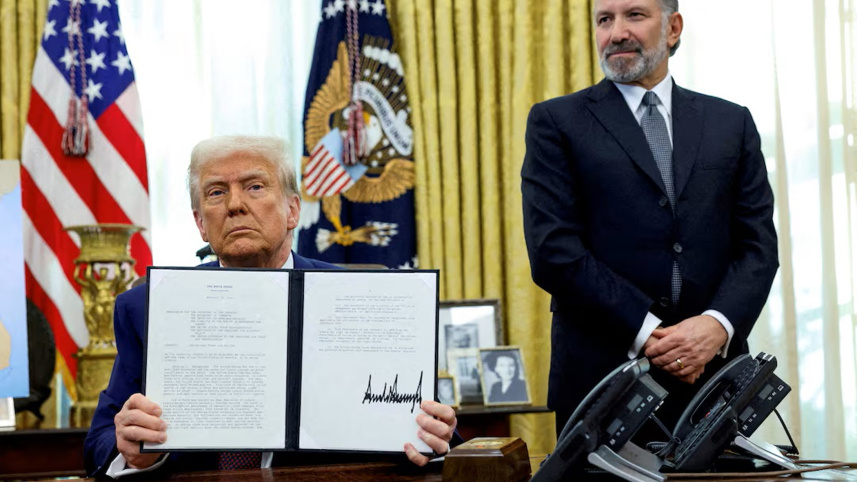
Entering his second term, President Trump campaigned on a platform to rectify these imbalances through aggressive economic nationalism. He pledged to bring factories back from overseas, particularly from China, by leveraging incentives and penalties. Additionally, Trump promised to attract massive foreign investment—over $20 trillion—to revitalise US industry. A cornerstone of this strategy was “reciprocal tariffs,” such as a proposed 60 percent tariff on Chinese goods and a 10-30 percent levy on others. These measures were framed as tools to level the playing field, protect domestic workers, and fund infrastructure without raising taxes. Trump’s vision echoed mercantilist principles, prioritising trade surpluses and industrial self-sufficiency to restore US’s economic primacy. In practice, however, implementation began with broad tariff hikes, including on European goods, under the guise of national security.
Despite these ambitions, the tariffs have backfired, destabilising US financial markets rather than fostering stability. Initial announcements triggered sharp stock market declines, with indices dropping significantly in the days following “Liberation Day”—Trump’s term for the tariff rollout. The reasons are multifaceted: tariffs raised input costs for US manufacturers, squeezing profits and prompting retaliatory measures from trading partners. Studies indicate that such policies reduce GDP by about 0.5 percent and increase unemployment, while generating revenue that falls short of expectations—already declining in early 2026. Moreover, they heightened uncertainty, deterring the very foreign investment Trump had sought. Instead of accelerating reshoring, the combination of tariffs, immigration restrictions, and spending cuts has complicated supply chains, making domestic production more expensive and less attractive. The US dollar weakened amid these disruptions, and even the Treasury market experienced volatility, eroding investor confidence. Far from correcting the twin deficits, these policies have amplified economic pressures, pushing the US towards greater isolation.
Escalating beyond economics, the Trump administration’s foreign policy has veered into militarism, as exemplified by the invasion of Venezuela. Trump declared the US “in charge” of Venezuela until a transition, framing it as a law enforcement action rather than war, despite widespread criticism for lacking congressional authorisation. This move aims to secure cheap energy resources, reducing dependence on Middle Eastern oil and bolstering domestic industry. However, it risks entangling the US in prolonged occupation, with no clear endgame amid local resistance and international condemnation.
The NSS of November 2025 provides the doctrinal backbone for such actions, openly proclaiming US enforcement of hemispheric control and readiness to act against Iran to protect Middle Eastern energy flows. Emphasising “strength as the best deterrent,” it integrates economic vitality with military leverage, criticising allies and prioritising unilateralism. Tensions with Iran have intensified, with Trump previously warning of strikes on its nuclear programme and potential closure of the Strait of Hormuz, threatening global oil supplies. A full-scale confrontation could involve US assistance to Israel, escalating into a broader regional war. These military adventures, while avoiding direct US boots on the ground where possible, contradict Trump’s aversion to endless conflicts, potentially drawing the country into quagmires reminiscent of Iraq and Afghanistan.
The consequences of this trajectory are dire. Regime changes in Venezuela and potentially Iran will likely spawn “forever” wars, draining resources and further inflating the fiscal deficit. Insurgencies, proxy battles, and humanitarian crises could persist indefinitely, diverting funds from domestic priorities and accelerating indebtedness. Trump’s international adjustment—rebalancing trade and investment—will not materialise amid retaliatory tariffs and geopolitical instability, perpetuating the twin deficits.
Most alarmingly, these strains threaten the US dollar’s hegemony. As the world’s reserve currency, the dollar underpins global finance, but mounting debt, policy unpredictability, and de-dollarisation efforts by adversaries like China and Russia could erode its dominance. Central banks are diversifying reserves, and US actions in Venezuela have heightened perceptions of American unreliability, risking a plunge in the dollar’s value and a financial tsunami. If unchecked, this could dismantle the post-World War II monetary order, ushering in multipolar chaos.
The US’s twin deficits and surging indebtedness set the stage for Trump’s bold but flawed interventions. While tariffs and military actions promise quick fixes, they instead foster volatility and conflict. The risk of forever wars will thwart economic recovery, ensuring that the international adjustment remains elusive. As the dollar’s foundation crumbles, the world may witness the end of an era, with profound implications for global stability and American prosperity.q
Dr Mizanur Rahman is professor of accountancy and public policy at the University of Dhaka. He can be reached at mizan@du.ac.bd.
Views expressed in this article are the author's own.
Follow The Daily Star Opinion on Facebook for the latest opinions, commentaries, and analyses by experts and professionals. To contribute your article or letter to The Daily Star Opinion, see our guidelines for submission.
 For all latest news, follow The Daily Star's Google News channel.
Comments