
Time to open railway tracks to private freight operators

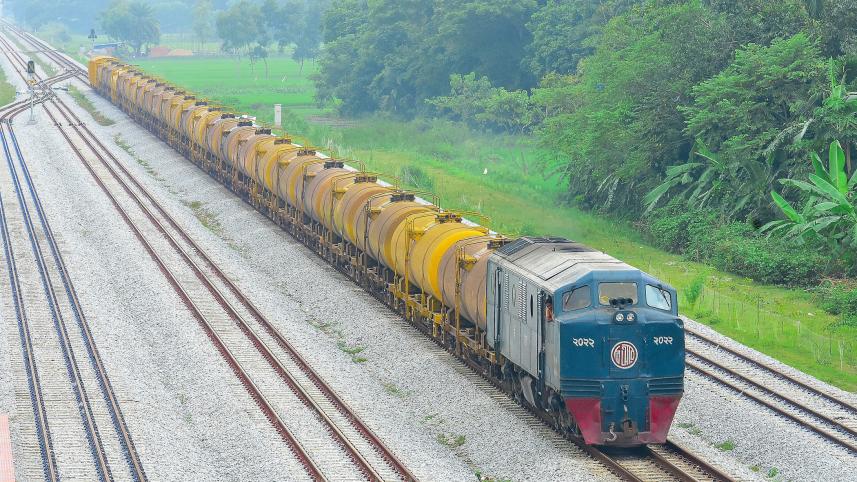
Bangladesh’s export economy now moves faster than its railways can carry it. Factories, ports and private logistics firms have modernised to meet global demand. However, rail freight remains stuck in a system designed for a smaller, slower economy. Container trains bound for Chattogram are delayed, cancelled or pushed aside for passenger services. Inland container depots (ICDs) clog up. Highways choke. Ports feel the strain.
In an earlier article, I argued that ICDs cannot become engines of export growth unless freight trains are reliable, predictable and commercially driven. That warning has only grown more urgent. Bangladesh Railway is expected to support a rapidly expanding export economy while operating under rules that prioritise passenger trains, tolerate chronic locomotive shortages and treat freight as expendable. A container train booked for tonight must not vanish because a passenger locomotive failed elsewhere or the train was politically prioritised. Yet, freight guarantees are impossible under the monopoly system, as Bangladesh Railway lacks dedicated locomotives for freights and prioritises passengers over cargo.
 For all latest news, follow The Daily Star's Google News channel.
 This is why the debate must move beyond procurement delays and management shortcomings to a deeper reform: opening Bangladesh’s railway tracks to private freight train operators.
There is no compelling reason why Bangladeshi logistics firms, exporters or foreign investors should not be allowed to run their freight trains—using their own locomotives, wagons and crews—on tracks owned and maintained by Bangladesh Railway. This would operate under transparent, regulated access agreements. The railway would retain ownership of infrastructure, control safety and manage traffic. What it would give up is its monopoly over freight operations.
This may sound radical, but globally, it is routine. India opened container train operations to private companies nearly two decades ago. Today, multiple firms run their own trains on Indian Railways’ tracks, paying access charges while investing billions in wagons, terminals and networks. Across Europe, public and private freight operators compete on national rail systems. In the United Kingdom, all freight trains are privately operated even though the tracks remain state-owned.
Russia and parts of China allow private ownership of locomotives and wagons on public corridors. Even Pakistan—once as closed as Bangladesh—now permits private freight trains in exchange for track access fees.
None of these countries privatised their railways. They separated infrastructure from operations.
That distinction matters. Bangladesh does not need to sell its tracks or stations. It needs to use them more intelligently. Allowing third-party freight operators would transform Bangladesh Railway from a cash-strapped monopoly into a network manager earning revenue from every train that runs, regardless of ownership.
The economic logic is straightforward. Bangladesh Railway struggles to procure enough locomotives for both passenger and freight services. Purchases take years. Maintenance backlogs grow. Every new passenger train further erodes freight capacity. When private operators bring their own engines, national capacity expands almost overnight—without a single taka of public investment in rolling stock, i.e., locomotives, carriages, wagons, etc.
Under this system, risk shifts from taxpayers to investors. Efficiency and innovation are rewarded. Reliability will improve even more dramatically. Private freight operators live and die by performance. A shipping line or garment exporter will not tolerate missed schedules. A private company that fails to deliver loses customers and revenue. A monopoly, particularly a government entity, does not face the same discipline.
That difference alone would turn rail freight from an unreliable afterthought into a professional logistics service.
Critics often warn that private trains would create chaos or profiteering. That happens only when regulation is weak. In every successful system, the state sets the rules: track access charges, safety standards, scheduling priorities and dispute-resolution mechanisms.
Companies compete on speed, cost and service quality—not political influence. Bangladesh already regulates airlines, ports and telecommunications. Railways do not require immunity from modern governance.
There is also a persistent fear that Bangladesh Railway would lose revenue or control. The opposite is more likely.
Instead of relying on erratic freight volumes and subsidies, the railway would earn stable income from track access, signalling, yard use and workshop services. Each additional private train would generate revenue without requiring new locomotives or staff. These funds could be reinvested in tracks, signalling and bottleneck removal, thus improving the network for both passengers and freight.
For ICDs, the impact would be decisive. Whether Kamalapur, Dhirasram, Ghorasal or future terminals, inland ports cannot function without dependable rail links. Exporters do not care who owns the locomotive. They care whether containers reach ports on time.
Under an open-access system, an ICD could contract directly with a private operator for daily—or multiple daily—block trains, backed by penalties for non-performance. Such commercial certainty is impossible under a monopoly.
There is also a broader national interest at stake. Bangladesh’s highways are increasingly clogged with container trucks, fuel tankers, and bulk cargo. Every ton shifted to rail reduces congestion, accidents, fuel consumption, and emissions. Rail is inherently more efficient for long-distance freight, yet its share keeps shrinking because service is unreliable.
Private operators would have strong incentives to capture this traffic, invest in modern wagons and build integrated rail-based supply chains.
The transition must be carefully designed. The draft Bangladesh Railway Act, allowing private ownership of rolling stock and train operations, is a promising start. But it must be backed by clear rules on access, safety, liability and pricing. Safeguards against cartelisation are essential. Regulation must be strong enough to withstand pressure from all sides.
A sensible approach would be to begin with pilot corridors—especially the Dhaka–Chattogram route, which carries most container traffic. Selected private operators could run trains under strict safety and performance conditions, while Bangladesh Railway retains full control over dispatching and network management. Results would be quickly visible, as they have been elsewhere.
The real risk lies not in reform, but in inertia. As long as freight depends on spare locomotives left over from passenger services, Bangladesh will never have a dependable rail logistics network. Exporters will continue shifting to roads. ICDs will remain underused. Public rail investments will deliver diminishing returns.
Opening railway tracks to private freight operators is not an ideological debate. It is practical. Bangladesh’s economy has outgrown a 19th-century model in which one state agency tries—and fails—to do everything. The modern world runs on networks, partnerships and regulated competition. If ICDs, ports and exporters are to thrive, they need a railway that delivers, not one that apologises.
Bangladesh has already transformed ports, power and telecommunications through public–private partnership. Rail freight should not be the last sector left behind.
Ahamedul Karim Chowdhury
is adjunct faculty at Bangladesh Maritime University and former head of the Kamalapur Inland Container Depot (ICD) and the Pangaon Inland Container Terminal under Chittagong Port Authority.
Views expressed in this article are the author's own.
Follow The Daily Star Opinion on Facebook for the latest opinions, commentaries, and analyses by experts and professionals. To contribute your article or letter to The Daily Star Opinion, see our guidelines for submission.
Comments