


A sheer waste of public resources
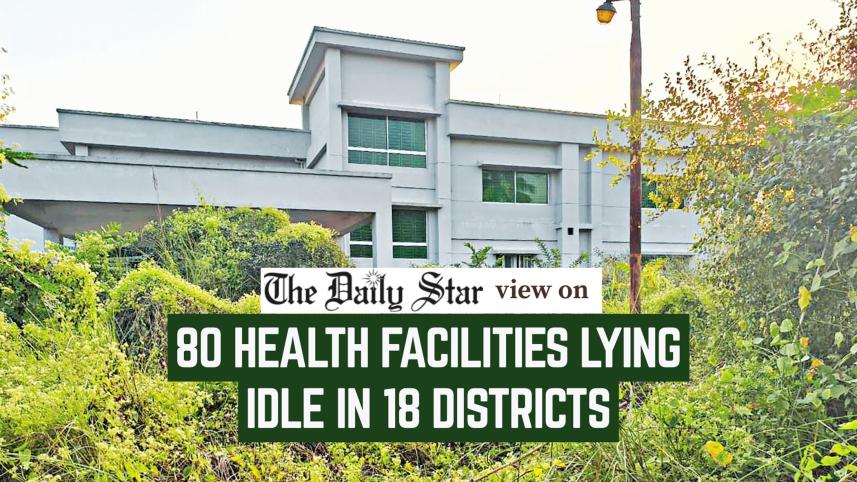
It is quite concerning that at least 80 government health facilities across 18 districts have remained non-operational for years, reflecting persistent systemic failures in healthcare governance. According to a report by this daily, of these facilities, 17 are hospitals (including four children’s hospitals), 14 are community clinics, and 12 are extensions to existing hospitals, while the rest comprise structures such as quarters for health workers. Built over years at enormous public expense, these facilities remain unused due to shortages of manpower, lack of equipment, and bureaucratic delays. As a result, basic healthcare services are being disrupted in these districts.
One such facility is the 20-bed hospital in Gazipur’s Talia village. Built at a cost of around Tk 20 crore in 2020, it remains unutilised to this day. A local family even donated two acres of land in good faith in the hope of ensuring access to medical services that never materialised. Similar situations exist in Rangpur, Madaripur, Savar, and other districts, where completed facilities continue to lie idle. Several trauma centres, meant to respond to the rising incidence of road accidents, remain non-functional, while the children’s hospitals stand empty despite paediatric wards elsewhere struggling under pressure. In some cases, facilities have remained unused for over a decade.

Health ministry documents obtained by The Daily Star show that the construction of 41 facilities was completed by 2024, while the rest were built earlier. The documents cite lack of manpower, equipment, and medicines as the main reasons for their continued non-operation. This raises a fundamental question: why were these structures built without a comprehensive operational plan? Constructing them without ensuring staff recruitment, budgetary allocation, and service readiness reflects a serious disconnect between infrastructure development and healthcare delivery. That some of the facilities were built even without feasibility studies further underscores how poor planning and weak accountability have plagued the sector. The consequences have been undoubtedly severe, as patients in rural and semi-urban areas are forced to travel long distances to already overstretched hospitals, incurring high costs and risking dangerous delays in treatment.
Decades of inefficiency, mismanagement, and corruption have thus rendered large parts of our health sector incapable of delivering essential services. Restoring order to this ailing sector requires proper planning, coordination, and accountability at every stage—something that we have, unfortunately, yet to see under the interim administration. We urge the health authorities to urgently audit all idle facilities, fast-track recruitment and staff deployment, and hold those responsible for non-functional projects to account. We also hope the next elected government will prioritise the sector and implement the reform proposals put forward by the Health Sector Reform Commission to build an efficient, accountable, and people-oriented healthcare system.
 For all latest news, follow The Daily Star's Google News channel.
Comments