


Road blockades must not become a norm
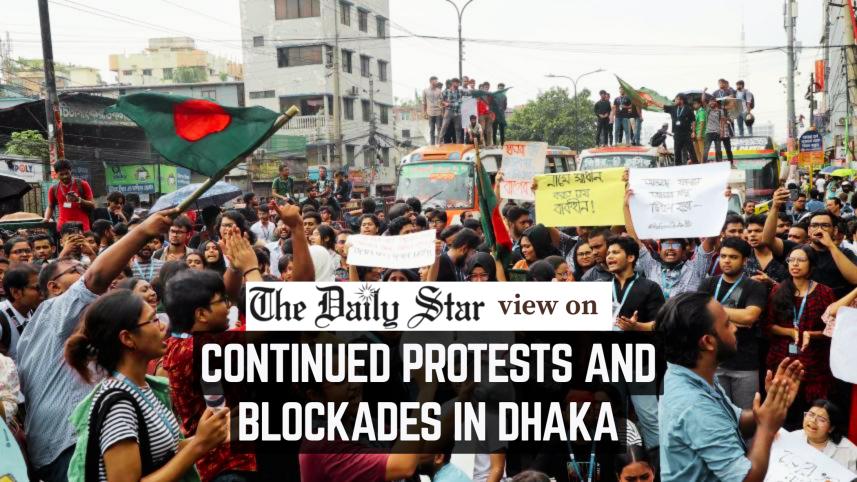
The capital city has once again been brought to a standstill by a fresh round of blockades and street protests, with key intersections repeatedly shut down over the past couple of days. Students from the seven colleges affiliated with Dhaka University blocked multiple roads demanding the promulgation of an ordinance for the proposed Dhaka Central University. At the same time, students of Tejgaon College took to the streets demanding justice for the killing of a fellow student. As vital intersections were occupied, traffic across large parts of the city was paralysed for hours at a stretch.
The consequences for the public were devastating. Buses failed to move on several routes, CNG-run auto-rickshaws were stuck in endless tailbacks, and thousands of commuters were forced to walk long distances after failing to find a ride. Parents struggled with exhausted children, hospital visits were delayed, and drivers lost precious working hours and income while sitting idle in traffic.

The crisis involving the seven colleges is not new. It dates back to 2017, when they were affiliated with Dhaka University without adequate preparation, resulting in prolonged academic and administrative complications. In that sense, the students’ grievances are understandable. However, the government has stated that a revised draft ordinance for Dhaka Central University has been sent for interministerial review and will soon be placed before the Advisory Council after legal vetting. This suggests that the process, however slow, is moving forward. Hence, resorting to blocking the roads is neither justified nor constructive.
It is also concerning that disruptive street demonstrations have become almost routine in post-uprising Bangladesh. Various groups staged protests with a wide range of demands, while the interim government was mostly unprepared to resolve these issues or handle the situations as it should have. Now that 17 months have passed since it assumed office, and with the national election less than a month away, the government must be better prepared and more decisive in dealing with such situations. We urge the government to urgently address the grievances of the protesting students, engage in dialogue where necessary, and provide clear assurances with a credible timeline for a solution. Protesters must also exercise restraint. Their right to protest must be balanced with the responsibility to safeguard public welfare.
 For all latest news, follow The Daily Star's Google News channel.
Comments