


Parties must go for real police reform
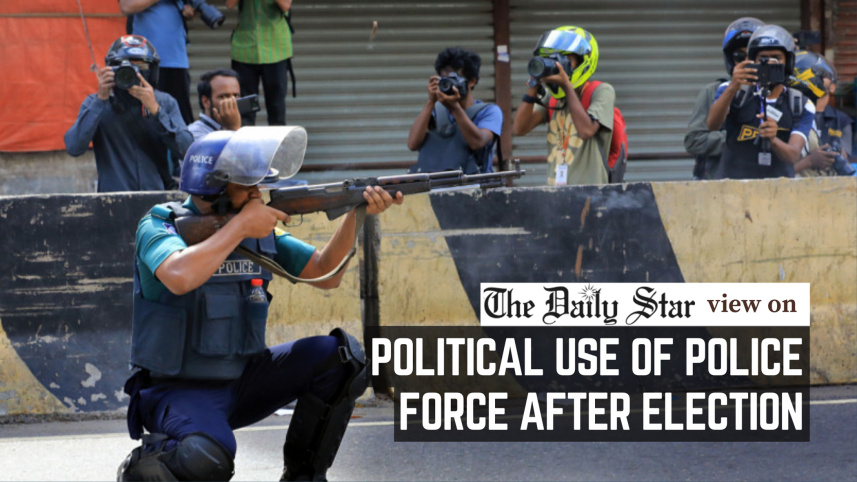
As political parties prepare to unveil their manifestos ahead of the national election scheduled for February 12, a critical opportunity has arisen for them to confront one of the country’s most persistent governance failures: the political use or abuse of the police force. Whichever party forms the next government, if it is serious about restoring public trust and ensuring law and order, the depoliticisation of law enforcement must be at the top of its agenda. Law enforcement experts and rights activists also stress that without meaningful police reform, promises of democracy, public safety, and the rule of law will ring hollow.
For decades, policing in Bangladesh has been deeply compromised by political interference. Political parties, when in power, have repeatedly been accused of treating the police as an extension of their partisan machinery. The Awami League’s 15-plus years of rule represent the most extreme manifestation of this trend. During that period, enforced disappearances, deaths from so-called gunfights, and custodial torture severely eroded public trust in the police as well as other security and intelligence agencies. The violent suppression of protesters during the 2024 mass uprising—when nearly 1,400 people were killed, according to UN estimates—only worsened police and security agencies’ public image.

People had hoped that similar human rights violations would not recur during the interim government’s tenure. However, the law and order situation over the past 17 months has been deeply unsatisfactory, marked by murders, robberies, abductions, and a surge in mob violence. In 2025 alone, at least 197 people were killed in mob attacks, up from 128 the previous year, according to Ain o Salish Kendra. Moreover, corruption within law enforcement agencies continues to exacerbate the situation.
The utmost priority for the next government, therefore, should be establishing a truly independent police reform commission. Although the interim government issued a gazette in December 2025 to establish a police commission, experts argue that the ordinance is flawed and undermines the commission’s independence. The next government must rectify these flaws through the proper procedures. An independent commission should be able to investigate complaints against police personnel impartially, both from the public and within the force, while also implementing other key recommendations of the Police Reform Commission.
 For all latest news, follow The Daily Star's Google News channel.
Comments