


New pay scale needs more scrutiny
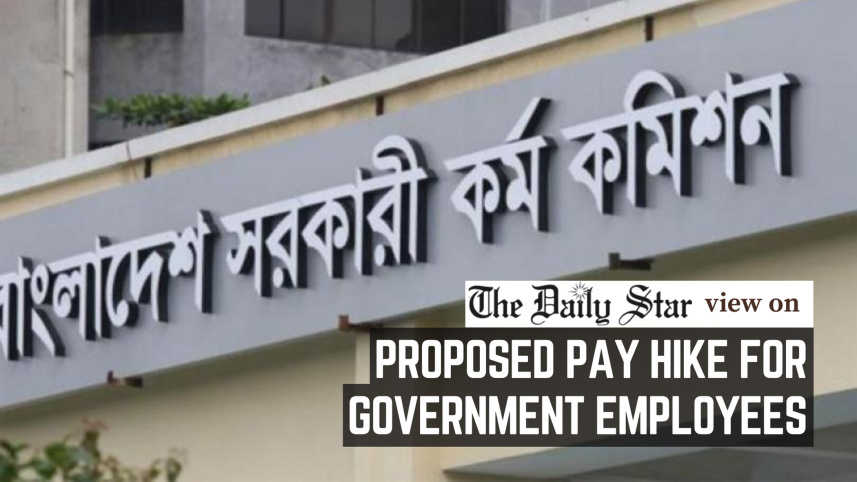
A hefty pay raise proposed for government employees may appear, at first glance, to be a matter of fairness. However, it also stands to become a fiscal landmine for the next administration. The Ninth National Pay Commission set up by the interim administration argues that a revision has been due for a decade, during which high inflation has steadily eroded real incomes. The issue here is not whether government employees deserve better pay, but how the increase is designed, financed, and how large it should be. The commission has proposed raises by up to 142 percent, at an estimated annual cost exceeding Tk 1 lakh crore. This single decision would absorb roughly a quarter of the current annual tax revenue at a time when the tax-GDP ratio is at a historic low and public debt pressures are intensifying.
The state already relies heavily on borrowing, not only to fund development spending but also to service existing debt. Adding a recurring expense of this scale would almost certainly require even more borrowing. The consequences are predictable: higher inflation, reduced space for private investment, and cuts in essential sectors such as health, education, and infrastructure. More worrying is the absence of a credible plan to finance the proposal sustainably. Without a significant expansion of the tax base and stronger revenue collection, the burden will simply be shifted forward. The next government would inherit a sharply reduced fiscal space, limiting its ability to honour its promises or respond to economic shocks.

This brings us to a deeper flaw in the commission’s approach. Pay revisions are often presented as a cure-all for inefficiency and corruption, based on the assumption that better-paid officials will perform better. History suggests otherwise. Following the last major pay hike in 2015, the tax-GDP ratio fell, and corruption, by all perceptions, showed little improvement. As Towfiqul Islam Khan, an economist, pertinently asks, where is the analysis of why this happened? And where are the reforms to ensure that higher salaries actually translate into better governance? A pay scale disconnected from accountability, productivity benchmarks, and institutional reform is simply a larger bill for the same results. Without changes in how the civil service is evaluated, promoted, and disciplined, higher pay will become a bloated expense rather than an investment in state capacity.
The political context further complicates the issue. For an interim administration at the twilight of its tenure to commit the country to such a sweeping and permanent fiscal decision is questionable. A policy of this magnitude requires democratic legitimacy and public debate. It also demands careful sequencing.
A more responsible path would be for the next elected government to examine any new pay scale. Increases should be phased and explicitly linked to performance. Revenue targets must be met before subsequent adjustments are triggered, and pay growth should be tied to measurable improvements in efficiency, service delivery, and accountability. The state cannot wish money into existence. Without discipline and reform, a well-intentioned pay hike could worsen fiscal stress.
 For all latest news, follow The Daily Star's Google News channel.
Comments