
Govt mapping plots to reduce arable land loss
lost 2% cropland in 2015‑2023

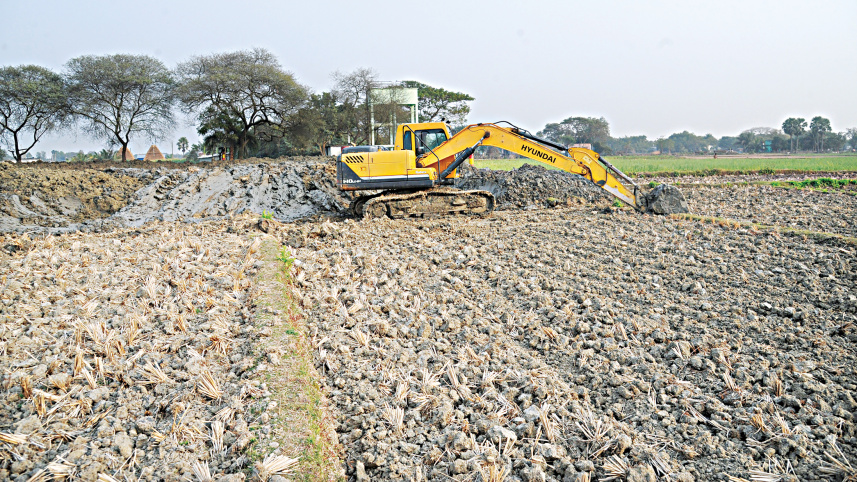
The authorities have begun classifying all the country’s land into 18 categories under a zoning model to reduce the loss of arable land caused by unplanned industrialisation and urbanisation, and to ensure national food security.
Under this zoning, a colour-coded, geo-referenced digital map is being developed, with arable lands marked green.
 For all latest news, follow The Daily Star's Google News channel.
 Officials say the system will make land-use information scientific, transparent, and easily accessible at national, district, and upazila levels.
The Land Use Control and Agricultural Land Protection Ordinance, 2026, which was issued on January 19, mentions such land classifications to ensure region-based planned land use. It says maps may be prepared either for the entire country at once or gradually, prioritising specific regions or land uses.
The maps will be updated every ten years.
Apart from arable lands, the zoning will also protect hills and forests, according to ASM Saleh Ahmed, senior secretary at the Ministry of Land.
Ahmed said that the project, which initially progressed slowly, has gained momentum. Zoning has been completed in 50 upazilas, and the target is to cover all 495 upazilas by 2027.
As the ordinance has taken effect, the government will now prepare, maintain, and regularly update the zoning maps and associated databases to protect agricultural land, he added.
The ordinance applies nationwide, except for the Chittagong Hill Tracts, including Rangamati, Bandarban, and Khagrachari.
The ordinance says research from the Soil Resource Development Institute will guide the mapping process.
According to Bangladesh Environmental Statistics 2024, released by the Bangladesh Bureau of Statistics (BBS), the country lost around 2 percent of agricultural land between 2015 and 2023. This is roughly 1,470 square kilometres.
Factors contributing to the loss include residential and industrial construction, as well as infrastructure development, according to BBS data.
The ordinance includes specific measures to protect farmland.
According to it, tobacco cultivation is banned on lands producing three or more crops per year, and will be phased out on one and two-crop lands.
Besides, commercial housing, resorts, and industrial plants are prohibited on arable land, wetlands, or water bodies. Removal of topsoil for brick kilns or other purposes is also punishable. Permits may be granted for households, places of worship, or family graveyards on private farmland.
The new law says using agricultural land for non-agricultural purposes without permission carries up to three years’ imprisonment and fines of up to Tk 10 lakh.
“These measures are intended to curb illegal land conversion and ensure the protection of agricultural land for future generations,” Ahmed said.
He added that the Central Land Allocation Committee is reviewing cases where large tracts of allocated land remain unused, while new rules under the Soil and Sand Management Act prohibit the removal of topsoil to maintain land quality.
Land and Food Adviser Ali Imam Majumder said rules to implement the ordinance are being prepared. “We hope to complete it during this government’s tenure so that the next government can implement the ordinance smoothly,” he said.
Agricultural economist Jahangir Alam Khan described the ordinance as a crucial step to slow the ongoing loss of farmland.
He said previous rules, issued in 2001 and 2012, were largely unenforced, allowing double and triple-cropped lands to be converted into fish ponds or used for brick kilns, which depleted soil and reduced crop yields.
Khan added that effective enforcement of fines and jail terms, combined with active monitoring by union council members and local agricultural officers, could significantly slow land conversion.
While the annual rate of farmland loss has declined from 0.96 percent in 1984-1996 to 0.22 percent in 2009-2019, he said the situation is still concerning.
“If properly enforced, the new ordinance could help secure food production and national food security by protecting valuable arable land,” he said.
Comments