


Govt approves EPA signing with Japan

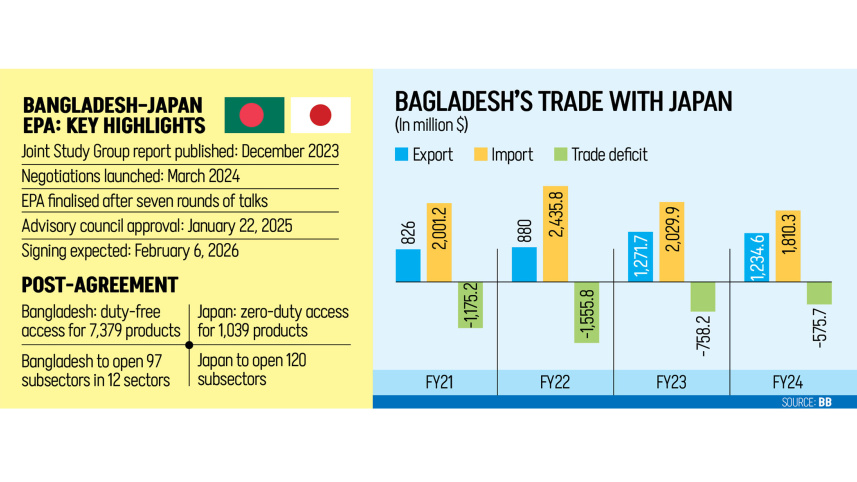
The interim government’s advisory council yesterday approved the signing of an Economic Partnership Agreement (EPA) with Japan, paving the way for duty-free market access for Bangladeshi exports to the East Asian country after LDC graduation.
Bangladesh is scheduled to graduate from LDC (least developed country) status in November this year.
 For all latest news, follow The Daily Star's Google News channel.
 Once the agreement comes into effect, Japan will allow duty-free access for 7,379 products, which are 97 percent of Bangladesh’s export basket, including the main garment items, according to a press release from the commerce ministry.
In return, Bangladesh will provide duty-free access to 1,039 Japanese products, largely in phases over 18 years.
With the advisory council’s approval, all procedural steps required for signing the agreement have been completed, Commerce Secretary Mahbubur Rahman told The Daily Star over the phone.
He said the Japanese government has also approved the final draft, and the EPA is scheduled to be signed in Tokyo on February 6. Senior officials from both countries will attend the signing ceremony.
The deal will be Bangladesh’s first full-fledged trade agreement with a major partner. So far, the country has signed only one preferential trade agreement, also with Japan, in December 2020.
Unlike a conventional tariff-focused trade deal, the EPA covers a broad range of areas, including investment, services, labour standards, regulatory cooperation and compliance issues.
Earlier, at a press conference in December last year, Japanese Foreign Minister Motegi Toshimitsu endorsed the draft during a phone conversation with Commerce Adviser Sk Bashir Uddin.
The EPA introduces single-stage transformation provisions for garments, easing rules-of-origin requirements.
The agreement also includes a chapter on trade in services. Bangladesh has agreed to open 97 sub-sectors across 12 service sectors to Japan, while Japan will open 120 sub-sectors to Bangladesh. The move is expected to facilitate greater Japanese investment and technology transfer.
Japanese investment in Bangladesh currently stands at about $500 million, a small fraction of Japan’s global outward investment.
The East Asian country remains Bangladesh’s largest export destination in Asia, with shipments currently standing at nearly $2 billion, driven largely by demand for Bangladeshi garments under Japan’s duty-free access scheme for LDCs.
Last month, Japan reaffirmed to the World Trade Organisation that it would continue duty-free market access for Bangladesh for three more years, up to 2029.
“The EPA between Bangladesh and Japan is an extremely important milestone for Bangladesh,” said Mohammad Abdur Razzaque, chairman of Research and Policy Integration for Development (RAPID).
“It sends a strong signal that Bangladesh can successfully negotiate comprehensive trade agreements with major global partners,” he added.
Bangladesh has been pursuing trade agreements with major partners to secure preferential market access after LDC graduation. Studies suggest the country could lose up to $8 billion in annual exports once LDC-related benefits expire.
At present, around 73 percent of Bangladesh’s exports depend on LDC-related trade facilities. Bangladesh is the largest beneficiary of such preferences, accounting for 67 percent of benefits extended to all 44 LDCs.
Negotiations on the EPA began in May 2024 and concluded after eight rounds, with the final round held in Tokyo in September last year.
Comments