


Climate change, agriculture and food security challenges
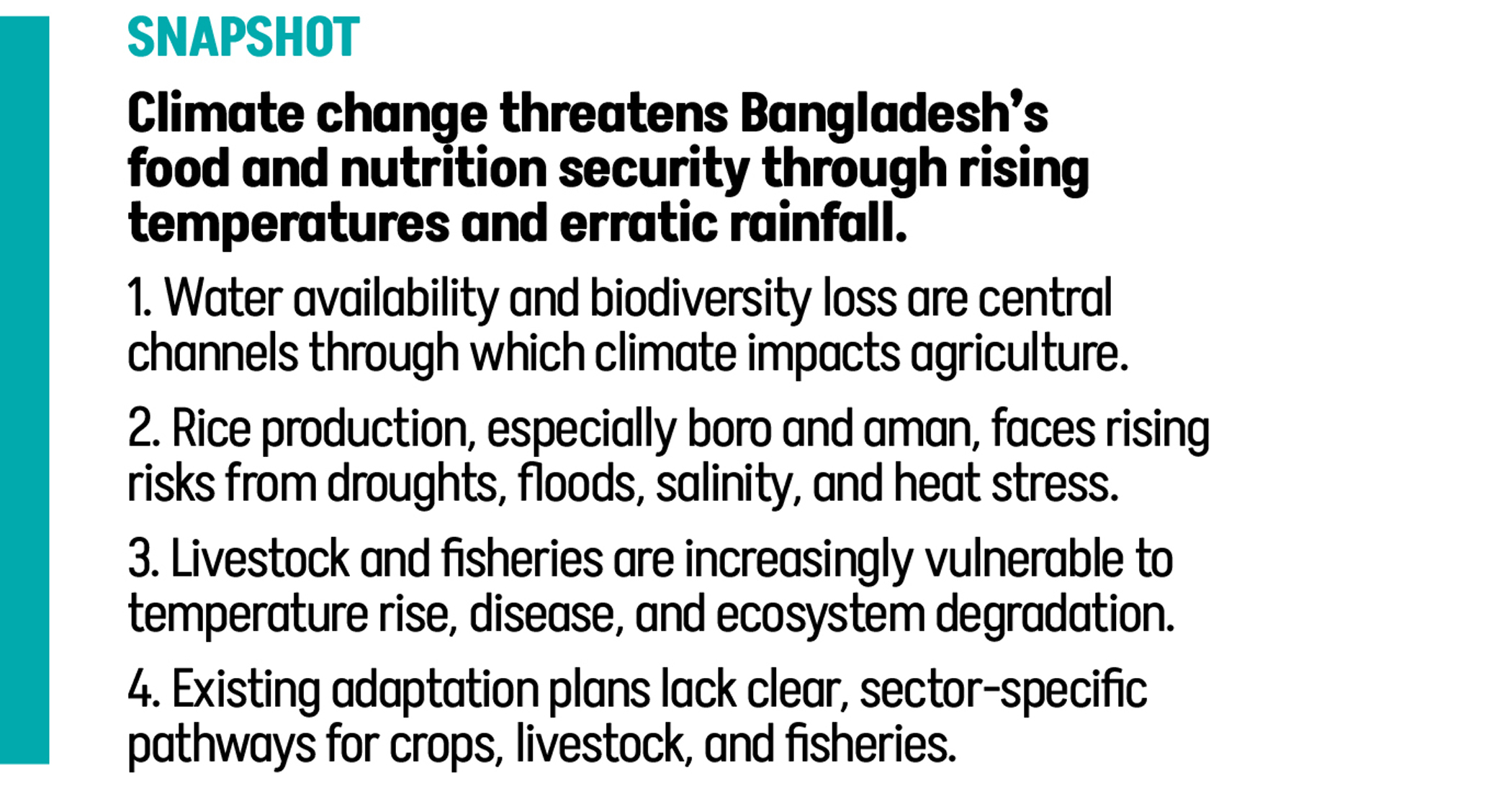
Bangladesh is one of the countries most vulnerable to climate change and its impacts. Agriculture, which is dependent on human management of natural and ecological factors is particularly vulnerable to such changes. And that in turn jeopardises food and nutrition security of people in the country. On the other hand, many of non-agricultural activities depend on agriculture. These activities thus indirectly ensure food security for those employed and earning income in the related non-agricultural sectors. This general picture of the food security and food system, has for quite some time been under threat from climate change.
Climate change and food security at risk
Climate change primarily consists of two natural phenomena, trend rise in average temperature and uncertain rainfall. Rising concentration of mainly three gases, called Greenhouse Gases (GHGs), carbon dioxide, methane and nitrous oxide, due to various human systems and actions, is the main reason for rising global temperature. The higher release and higher concentration of the three gases are mainly due to human actions and factors, such as burning of fossil fuels (coal, petroleum and its derivatives, natural gas)for industries, power generation and transport which release carbon dioxide and also various other human actions releasing methane (from deep water rice crop production, livestock enteric fermentation and improper waste management) and nitrous oxide due to unbalanced application of synthetic nitrogenous fertilizer in crop agriculture as well as other activities.
Once the average temperature rises and rainfall patterns change temporally over years and between seasons and across global and national locations, many natural processes begin to change, mostly for the worse. Two main natural resources are immediately affected: water—its availability and quality—and biodiversity. Water, in particular, is the key resource whose availability, form, and quality largely determine the first-round natural impacts of climate change.
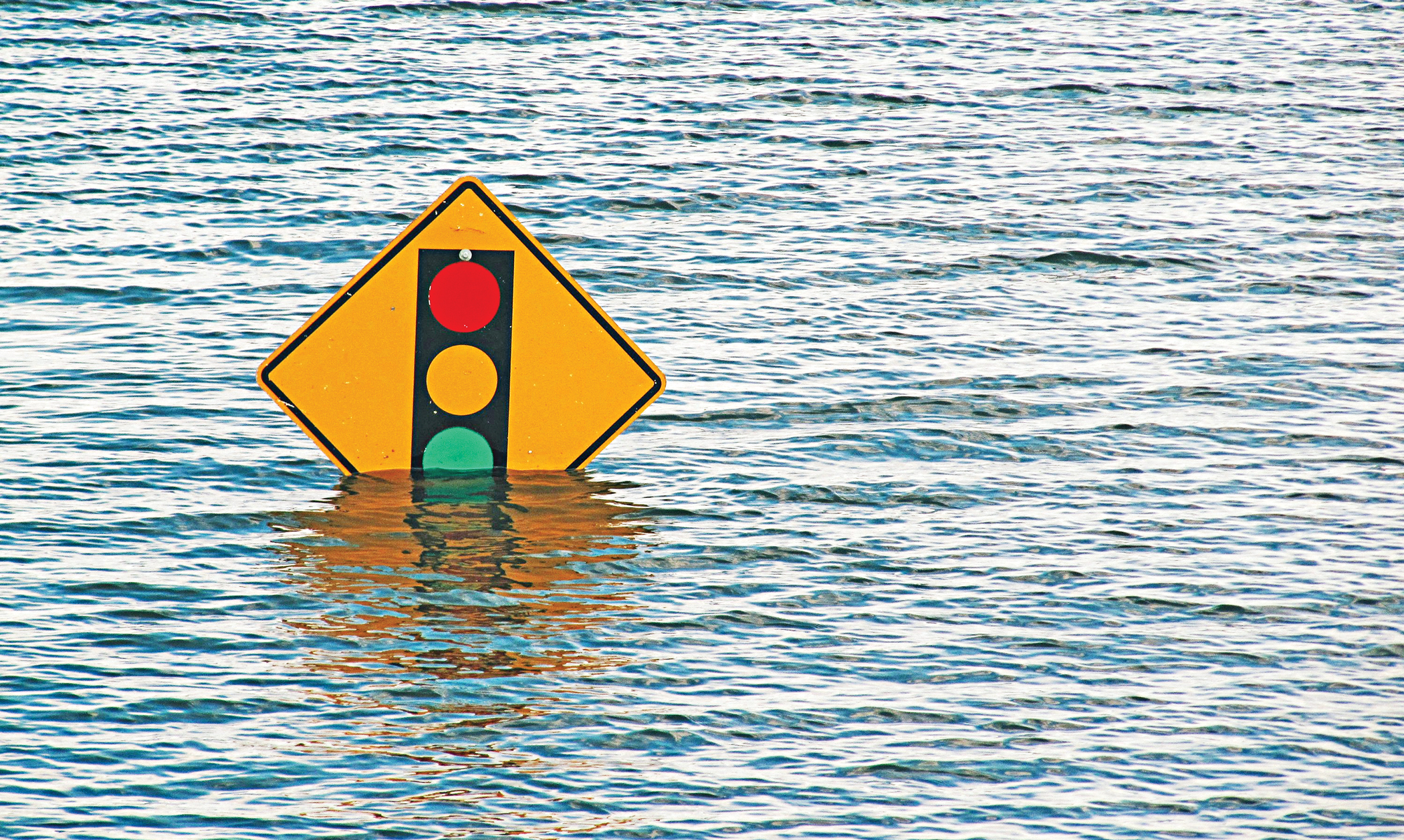
Floods (including flash floods), river erosion, drought, sea level rise and salinity, cyclones and storm surges, and landslides are all related to excess or scarcity of water, its timing and spatial occurrence, and their impacts on the economy and society. These disasters are expected to become far more frequent and intensive under climate change, with much greater adverse impacts on human systems. Biodiversity, both plant and animal, is also affected by rising temperatures and changes in water availability and quality. One clear manifestation is the warming, acidification, and deoxygenation of the Bay of Bengal, which has already led to biodiversity decline in marine fisheries and other aquatic resources.
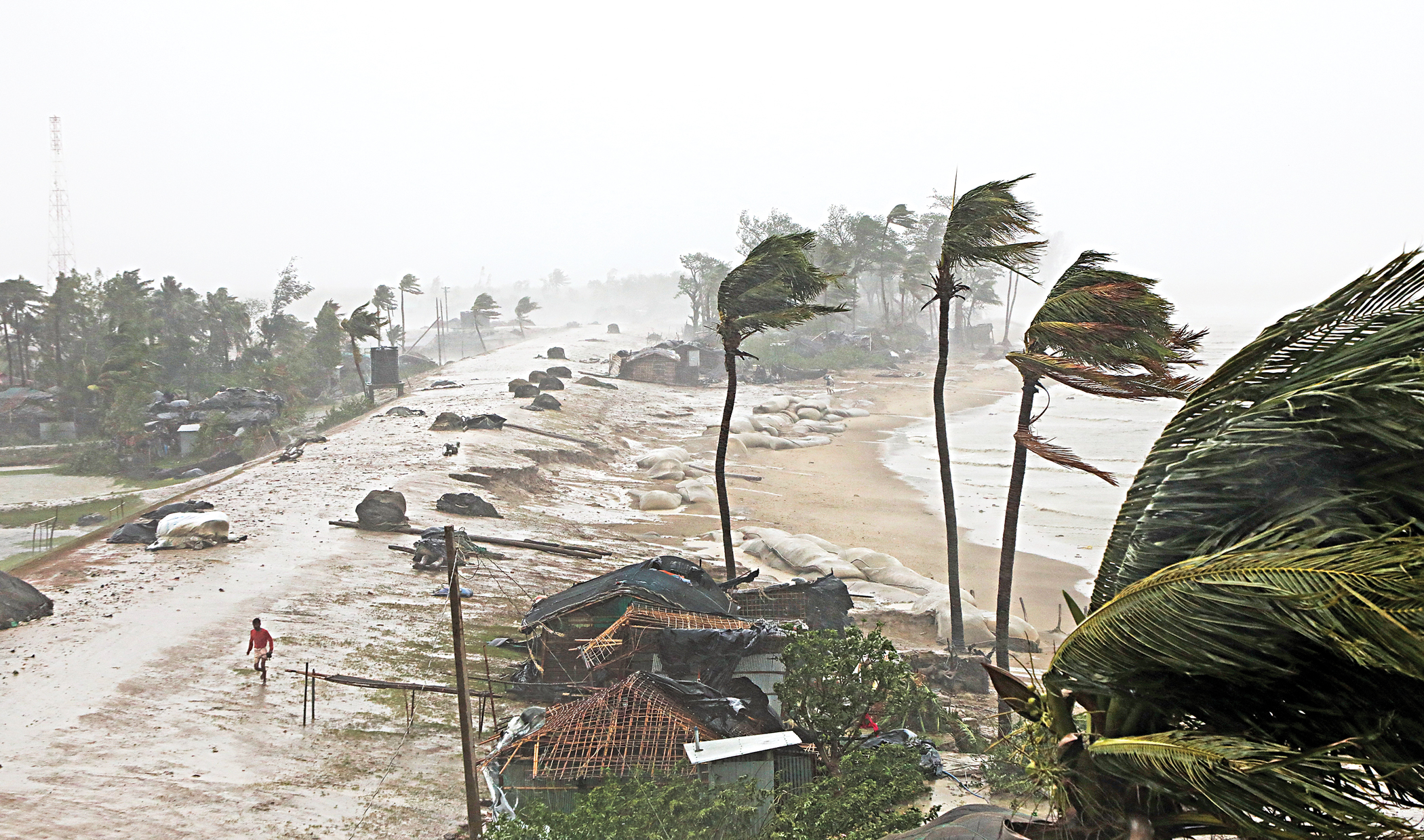
Photo: Prabir Das
Water, biodiversity, and cascading impacts
The first-round physical climate change impacts consequently affect, mostly adversely, all the human systems including agriculture, industry, power generation, health and physical infrastructure (transport and building structures). Agriculture consists of four sub-sectors, viz., crop, livestock, fisheries and forestry. We concentrate mainly on the first three.
Crop cultivation in Bangladesh is dominated by rice, the staple food, which accounts for more or less 80 per cent of total cultivable land in the country. Over 4 decades, rice output has almost tripled from (13 mn mt to around 40 mn mt during the last three years. Boro rice cultivated during mainly dry period and wholly dependent on irrigation accounts for 53-54 per cent of total rice output. Aman rice the growth period of which coincides with the rainy season but harvested in subsequent drier months accounts for around 40 per cent of total production. Aus has dwindled to insignificance and accounts for about 7-8 per cent of total rice output.
At least three types of issues have to be considered to understand the impacts of climate change on crop, particularly rice output. First, while rice is cultivated all over Bangladesh, at present only 8 districts namely Mymensingh, Rangpur, Bogra, Rajshahi, Jashore, Sylhet and Chattogram account for nearly 80 per cent of total rice output indicating primacy of N-W, central as well as the N-E districts (particularly for boro rice). Hence what happens to much of rice output availability from domestic production, food security and prices depends on what happens in these areas during the various seasons.
Given that boro rice is cultivated during the dry season, irrigation is absolutely essential for its cultivation. That means in the N-W districts where average annual rainfall is much less than in other places in the country drought, particularly prolonged drought during the rainy season is likely to make irrigation (both surface and ground water irrigation) difficult and costly. In fact, even without drought, because of the rise in average temperature due to climate change, higher evapotranspiration necessitates more frequent irrigation than usual which also raises costs of production. In case of the N-E districts, not so much drought but early and higher occurrence of flash floods, a far more likely event under climate change, can damage much of boro output before or during harvest. As 18-20 per cent of domestic boro rice output comes from Sylhet division districts, such a situation may create major food crises in the country as well as in the region. It may also be noted that as a lot of agricultural labourers from other parts of the country temporarily migrate to these N-E districts during boro harvest, their food security and livelihood will also be affected adversely if such disasters happen.
Consider now aman rice. As much of its growth period falls within the rainy season, and given that rain floods, sometime heavy ones, are common in one or other part of the country almost every year which also cause river erosion, aman area and output are likely to fall more and more over time under climate change. Furthermore, if rains fail or drought conditions prevail, this may also create problems of water shortage, particularly during the flowering period around October when rains are much less. Then again, these are the months when cyclones and storm surges including higher water salinity, particularly in the S-W districts in Khulna and Barisal divisions are likely with their occurrence and intensity to be no less under climate change over time than at present. In fact, with rising sea level these adverse impacts are likely to be more intensive. Quite obviously, such trends bode much worse situation in future for people’s livelihood including agricultural activities, because of permanent inundation of many parts in the coastal areas in general.
What awaits Bangladesh crop agriculture in terms of lower land productivity than at present over the future years (2030/2040/2050) may be summarised, according to a study, as follows:
Rice: 2.6, 4.0 and 5.3 percent;Wheat: 3.5, 5.1 and 6.4 percent;Vegetables: 2.9, 4.3 and 5.7 percent;Pulses: 4.2, 6,3 and 8.4 percent;Oilseeds: 3,1, 5.7 and 6.3 percent; andJute: 1.4, 2.2 and 3.0 percent.
At the same time, due to higher temperature, labour productivity may fall up to 11 percent over time. Declining land availability and lower land and labour productivity will mean much lower output from domestic crop agriculture significantly threatening food and nutrition security in coming years unless proper remedial measures are undertaken right from now.
Livestock, fisheries, and adaptation gaps
Focusing on livestock and poultry, heat stress causes a range of physiological and behavioural changes, including reduced feed intake, nutrient absorption, and feed conversion efficiency, lower feed availability, and diminished reproductive capacity. These effects lead to declines in milk and meat production, lower productivity in poultry and cattle, reduced wool output in sheep, and poor growth and weight loss in cattle and sheep. Public knowledge of the extent to which climate change affects livestock and poultry output in Bangladesh remains extremely limited; however, without ameliorative measures, adverse impacts are inevitable.
The other major sub-sector of agriculture which is expected to be adversely affected due to climate change impact is fisheries both inland (open capture, aquaculture) and marine fisheries. Recent information indicates that of the total output of 50 lakhs mt of fish, 30 lakh mt or 60 per cent was from aquaculture in closed water bodies, while over 14 lakhs mt or nearly 30 per cent was from open water bodies like rivers and estuaries and very extensive flood plain. Marine fisheries account for the rest mainly from territorial water, exclusive economic zone and continental shelf.
Even without climate change, fish habitats particularly inland open waters and marine systems are already under significant stress. Overfishing, degraded water quality from industrial effluents, infrastructure development across water bodies, and elite capture of fishing grounds have long contributed to this pressure. Climate change both intensifies and adds to these stressors, with rising water temperature as the common and most critical factor. Higher temperatures are likely to alter species composition as fish migrate to cooler depths or areas, especially in open capture and marine fisheries, while others may fail to survive or face eventual extinction. In aquaculture, farmers may need to adopt heat-tolerant breeds. Across all systems, warmer waters also increase the likelihood of water-borne parasites and viruses, degrading fish health and potentially compromising food safety.
In case of marine fisheries, several types of observed changes are known to have occurred in the ocean water which are rising temperature of sea water, acidification and deoxygenation. All are known to adversely impact on fish stock, changes in species and in cases outright extinction. For example, in case of the Bay of Bengal adjacent to Bangladesh coast, it has been found that while in 1971 there were reports of 475 fin fish species; this fell to 185 for fin fish and shellfish by 1993; to 98 for finfish along Naf river estuaries, and just 53 finfish by 2013 (in Ganges Meghna estuaries).
Overall fish output from all types of fisheries, is likely to decline over time unless appropriate adaptation measures are undertaken. However, for marine fisheries such adaptation at national scale is not possible unless vigorous global mitigation efforts are underway which is not the case at the moment.
Adaptation gaps and the way forward
The above discussion indicates that food and nutrition security as a whole is under extreme threat in both near and long-term future under climate change and its multifarious impacts. Question is how far we are aware of these problems and what have we done so far? As required by the United Nations Framework Convention on Climate Change (UNFCCC) of which Bangladesh is a Party, the country has prepared and submitted in 2022 its latest National Adaptation Plan (NAP: 2023-2050) covering various sectors including agriculture vulnerable to climate change and its impacts.
While this is not the place for detailed discussion on the strategy and programmes for adaptation, one good point about the NAP is its focus on water resources issues which as we have stated earlier is the key to managing many of the problems arising out of climate change including those in agriculture. Given this, however, one looks almost in vain, for clear and specific ideas about adaptation in crop, livestock and fisheries. The reasons are not far to seek as the NAP itself calls for specific data and information on the vulnerabilities that these sub-sectors face. Whatever adaptation measures have been proposed needs to be firmed up now through a clear roadmap for implementation and revising the proposals, if necessary to achieve the goals. The sooner this is done is better.
Dr M. Asaduzzaman is a former Research Director in BIDS, has a long career in research in agriculture, rural development, food safety, nutrition, environment, water resource management, renewable energy and climate change.He was Deputy Chair of the International Commission on Sustainable Agriculture and Climate Change under CGIAR and a co-recipient of the Nobel Prize given to the IPCC for his contribution as a lead author to the Second Assessment Report. He was also for some time Chair of the Consultative Group of Experts under SBI/UNFCCC
Send your articles for Slow Reads to slowreads@thedailystar.net. Check out our submission guidelines for details.