


Is Bangladesh’s industry ready for an AI revolution?
Artificial Intelligence (AI) is no longer confined to research labs or tech giants but has become a driving force in shaping global industries. It is playing a key role in market forecasting, bringing efficiency to supply chain operations and manufacturing goods. AI is currently redefining competitiveness in the industrial world.
Bangladesh’s industrial journey has been impressive. Once an agrarian economy, Bangladesh has emerged as a manufacturing and trading hub where ready-made garments, agro-processing, cement, steel, consumer goods logistics, and trading sectors play key roles. Due to growing global competition and changing consumer expectations, efficiency, precision, and adaptability are required for smooth business operations. In these areas, AI can play a transformative role.

While Bangladesh is still in the early stages of AI adoption, signs of progress are evident. In manufacturing, automation and basic data analytics are increasingly being used for quality control, inventory management, and predictive maintenance. In trading and logistics, digital platforms are improving demand forecasting and route optimisation.
In manufacturing, AI offers significant benefits, including waste reduction, improving energy efficiency, and ensuring consistent quality assurance. These factors are critical for export-oriented industries striving to meet strict global standards. For agro-based industries, AI can provide better forecasts, optimise storage, and reduce post-harvest losses. In trading and distribution, intelligent analytics stabilise supply chains, minimise price volatility, and enhance market transparency. Most importantly, AI can enable Bangladeshi firms to move up the value chain—from cost-based competition to value-driven production. This shift is essential if the country is to sustain growth beyond its low-cost labour advantages.
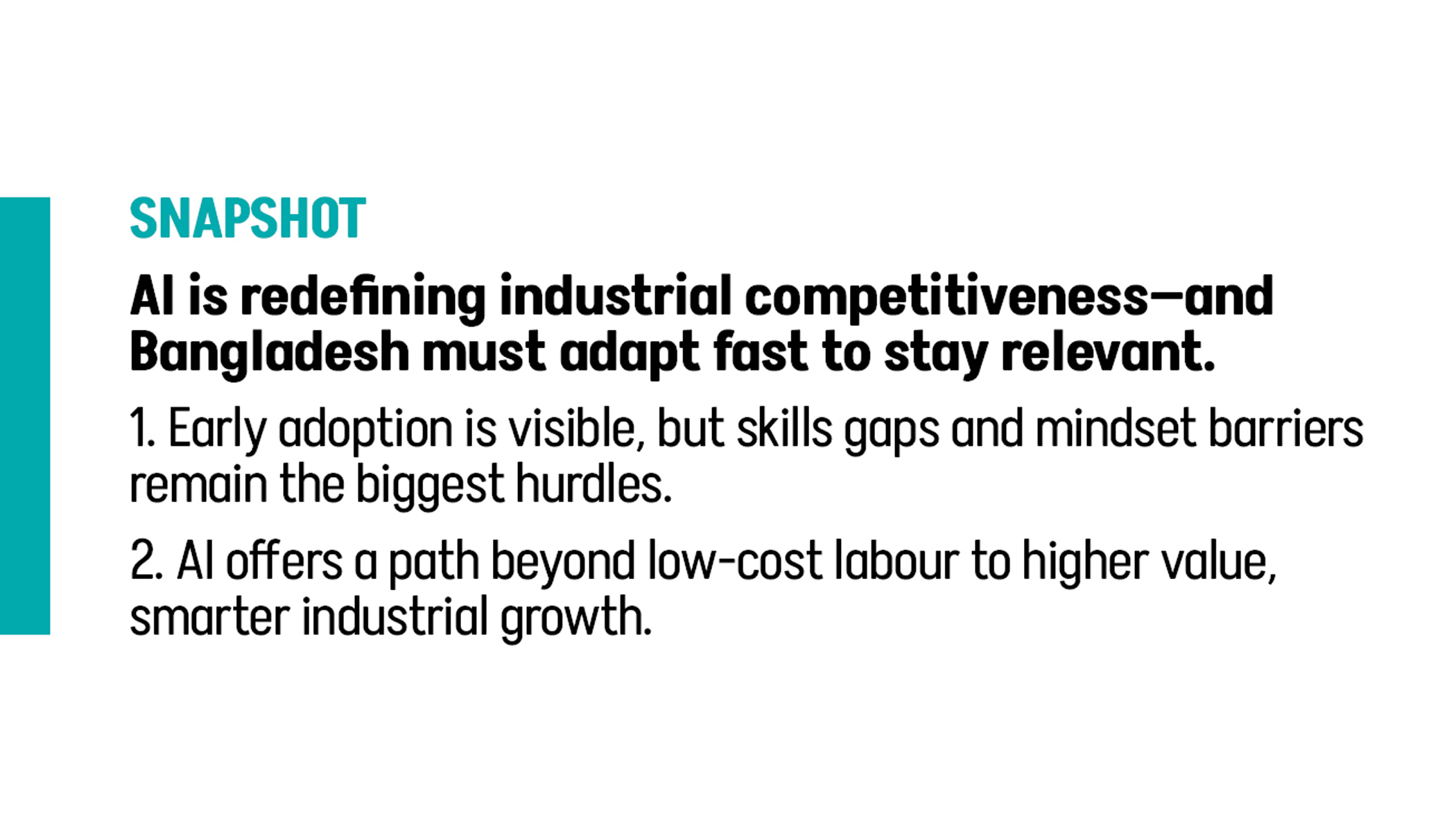
Although AI adoption is imperative for Bangladeshi industries, several barriers exist. The primary challenge is the shortage of skilled professionals. While Bangladesh has a large youthful workforce, there is a deficit of experts in AI-related fields. Industry, academia, and training institutions must collaborate to cultivate professionals in these areas.
Infrastructure is another major constraint. Mindset also matters. Many industrialists still view AI as a high-cost, high-risk investment rather than a necessity for progress. This caution is understandable, especially among small and medium-sized businesses. However, global experience shows that delayed adoption often proves more costly than early experimentation.
Large business groups in the country can play a responsible role during this transition. They can set examples for medium and small enterprises on how to integrate AI responsibly into industrial operations.
At AKIJ Resource, for example, the focus is on using technology to improve efficiency, transparency and operational discipline across business verticals. AI-driven analytics, automation, and digital monitoring systems are not ends in themselves. There are tools to support better decision-making and long-term value creation.
The responsibility of fully preparing Bangladesh’s industry for AI does not lie solely with corporates. It is a national issue. Policymakers have a key role to play in creating regulatory frameworks and data protection standards to facilitate AI adoption in industry.
Bangladesh has already demonstrated its ability to adapt. Advancements in digital financial services and e-governance are testaments to this capability. Creating an AI-ready industrial ecosystem is a continuation of this journey. Companies that adopt AI will advance, while those that lag behind will fall behind.
The global industrial environment is changing rapidly. Bangladesh must embrace AI as a core component of its industrial development. AI is not just technology. It represents judgment, leadership, and preparedness.
Sheikh Jasim Uddin is the Managing Director and CEO of AKIJ Resource Group.
 For all latest news, follow The Daily Star's Google News channel.
Comments