


Decision to Allow Public Transport: ‘Arbitrary’, may worsen the surge
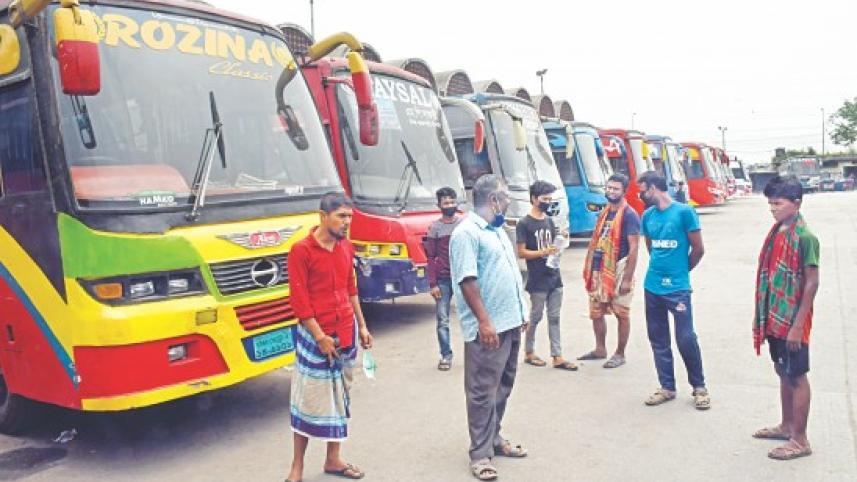
With the Delta variant of Covid spreading across the country, the government decision to allow buses to run at full capacity from tomorrow has baffled health experts.
They fear such an "arbitrary" decision based on suggestions from the law enforcement agencies may drive up virus infections, which will be evident after two weeks.

Besides, transport leaders expressed surprise at the government directive allowing only half of any transport fleet to operate, saying it would lead to rush of passengers.
According to a government circular issued on Sunday, local administrations and the law enforcement agencies will decide on the operation of public transport after discussions with transport owners and workers.
Asked about the logic behind the decision, Cabinet Secretary Khandker Anwarul Islam said, "It is based on suggestions from the law enforcement agencies."
He was speaking at a press briefing after a cabinet meeting at the Secretariat yesterday .
Anwarul mentioned that the agencies said they would sit with deputy commissioners, superintendents of police, transport owners and workers at the district level and let half of any transport fleet ply the roads at least for some days.
When told that this may increase pressure of passengers, he said it was actually aimed at reducing pressure of transports and limiting the number of inter-district buses.
On monitoring mechanism, he said, "Deputy commissioners and the law enforcement agencies will hold discussions with transport workers and find a way."
The cabinet secretary further said he had seen in Beijing that the authorities limit the number of buses on roads on a daily basis.
Hours after the briefing, Bangladesh Sarak Paribahan Malik Samity said the government decision to allow operation of only half of any transport fleet would lead to a transport crisis and subsequently increase pressure of passengers.
"It will also increase the risk of virus transmission," said the Samity in a press release.
Transport workers as well as owners will face losses because of the decision, it mentioned.
The Samity decided to withdraw the extra charges as the government will allow operation of transports at full capacity.
Earlier, the government had directed the transport owners to operate vehicles at half capacity, allowing them to charge passengers extra.
Contacted, Samity Secretary General Khondaker Enayet Ullah said the latest government decision was made without any consultations with them.
"We are requesting the government to scrap it and allow all buses to ply roads," he added.
In the past, it was seen that whenever the government relaxed the Covid restrictions, people in their thousands thronged shopping malls, markets and terminals.
Talking to this newspaper, Prof Be-Nazir Ahmed, former director (disease control) at the Directorate General of Health Services (DGHS), said, "Across the globe, governments listen to the suggestions of public health experts to tackle Covid.
"But here we are seeing that public health experts are being ignored, and non-technical persons are making decisions without any impact assessment."
 For all latest news, follow The Daily Star's Google News channel.
 Terming the government decision an illogical one, he said restrictions can be lifted if the infection rate drops below 5 percent. But it is still above 20 percent.
"We should follow scientific approach. Otherwise, we may have to pay a high price," observed Be-Nazir.
At yesterday's press briefing, the cabinet secretary said restrictions on public gatherings and recreation centres will remain in force.
Replying to a question, he said, "Public gatherings and operation of recreational centres are still not permitted."
Meanwhile, Road Transport and Bridges Minister Obaidul Quader said the strict lockdown has been relaxed for the sake of people's lives and livelihoods, but it may be re-imposed if the Covid situation worsens.
He also said both passengers and transport workers must wear facemasks and follow the health safety rules.
The minister asked Bangladesh Road Transport Authority (BRTA) to take necessary steps in this regard, reports UNB.
Comments