


Media freedom hinges on self-regulation
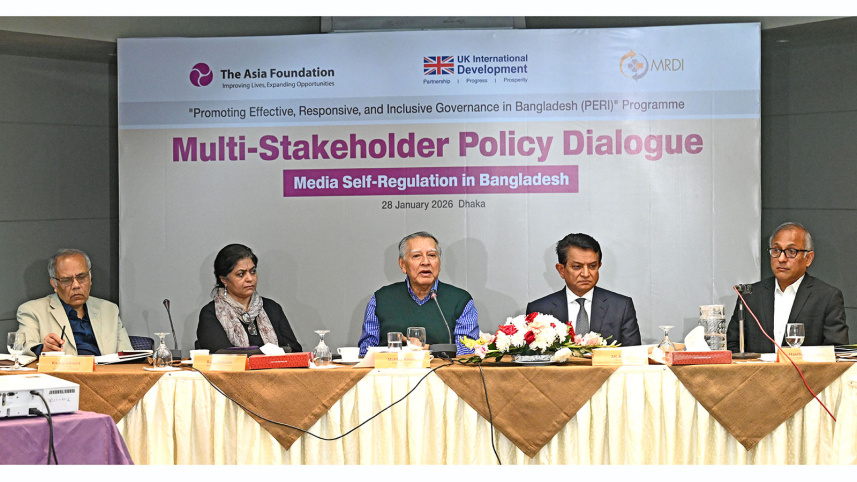
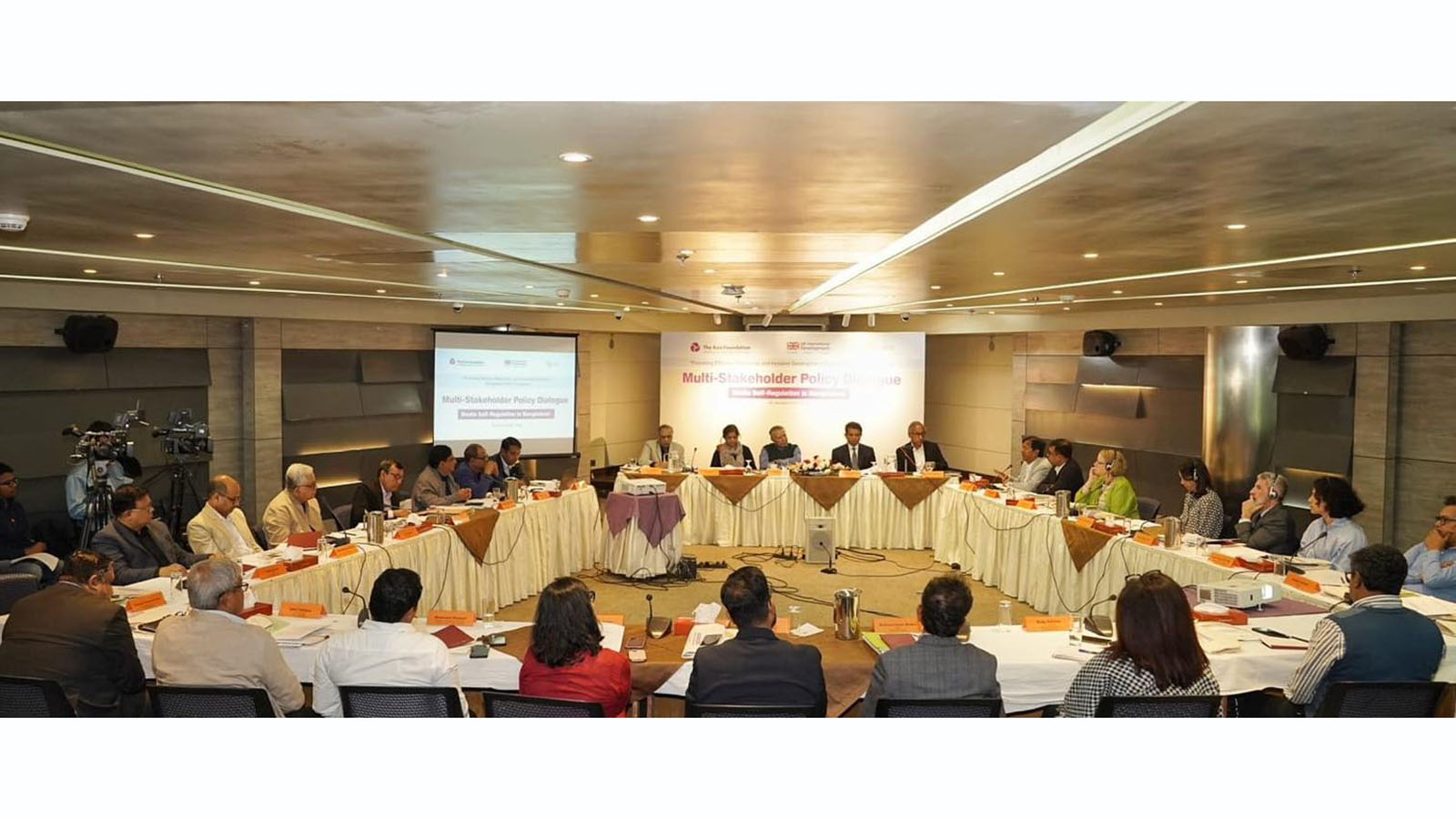
Speakers at a policy dialogue yesterday emphasised the need for self-regulation, including internal codes of conduct for both journalists and media owners, to ensure freedom and accountability of the media.
They also highlighted that strong institutions, independent editors, fair ownership, and proper internal governance are essential to protect journalists, uphold editorial independence, and rebuild public trust in Bangladesh’s media.

These remarks were made at a multi-stakeholder policy dialogue on “Media Self-Regulation in Bangladesh: The Cornerstone of an Accountable Free Press,” organised by the Media Resources Development Initiative (MRDI) in association with The Asia Foundation at Brac Centre Inn in the capital.
Mahfuz Anam, editor and publisher of The Daily Star, said he was fully in favour of self-regulation of the media, which he said depends on “strong institutions and truly independent editors”.
“The more we are self-regulated, the less government intervention there will be,” he said.
Criticising research that does not study positive examples of such institutions, he said, “Why don’t you study The Daily Star and Prothom Alo? You should also find some good examples so people understand that even in this environment, it is possible to build good institutions.”
Referring to his experience, he said, “In 35 years, we may have made mistakes, but we have never intentionally done bad journalism. We never intentionally wrote against anyone and never published anything without evidence.”
Emphasising the role of editors and owners, he said independent editors are not always on the best of terms with the owners.
“If you have an independent editor, the character of a media organisation changes immediately. An editor must be able to stand against the government and against the owner and say, ‘I will not let the government harm my staff’. We got full cooperation from our owners.
“If an editor tells the owner, ‘Fire me first, but I will not let my staff be harmed,’ a lot will change,” he said, adding that The Daily Star and Prothom Alo established the institution of the independent editor.
Giving an example, he said, “For 27 or 28 years, we have given business awards, but we have never given a business award to the owners of The Daily Star because of a conflict of interest.”
He said over 500 licensed newspapers exist in Dhaka, many without financial strength, offices, or the capacity to employ journalists, showing their purpose is different.
“If journalist unions are publicly politically divided, how do you expect readers to have faith in you?”
On self-regulation, he said, “Journalists can have personal political beliefs, but they cannot use them in their profession… Owners must also commit that they will not use media politically and must give editors freedom of operation.”
Anam also said that for self-regulation, the Editors’ Council and the Newspaper Owners Association of Bangladesh (Noab) were taking joint initiatives on separate codes of conduct for editors and owners.
Noab President AK Azad criticised the caretaker government for arrests under the anti-terrorism law.
“Police are picking up some innocent people from home and demanding huge sums of money. Those who can pay are released from the police station, and those who cannot are sent to jail under the anti-terrorism law,” he said.
“They [government] know that their term lasts only until February 12. So why are they afraid? Why have they crippled the judiciary?”
“The current caretaker government has no political agenda. Yet why are they not delivering justice, and why are innocent people being sent to jail?”
Speaking about state-sponsored oppression of journalists, Azad said, “Those who were in power before and those currently in power have the same character. There is no guarantee that future governments will be better.”
 For all latest news, follow The Daily Star's Google News channel.
 The Noab president said ethical journalism will not be possible if the state system is not corrected and we do not speak out against it.
Kamal Ahmed, chief of the Media Reform Commission, said that without accountability and transparency, the media can never regain the trust of readers and viewers.
He criticised the government’s plan to create separate commissions for broadcast and other media, which he said could create confusion.
“The government is rushing into its final stage. A broadcast commission is being formed while the existing licensing powers remain with BTRC. You can be certain that there will be overlaps and conflicts.
“And a media commission is planned while keeping the Press Council. Then, who will handle conflicts related to journalism, the Press Council or the media commission? This overlapping will unnecessarily increase complexity.”
On social media, he said, “… Bots and misinformation create the impression of popularity or public opinion. That is dangerous.”
Sara Hossain, honorary executive director of Bangladesh Legal Aid and Services Trust (BLAST), called for documenting past harassment of the media to understand “where we need to work more”.
“A mechanism is necessary to guide who the good and bad actors are. Those who do not comply should be held accountable,” she said.
Sajjad Sharif, executive editor of Prothom Alo, said although journalism is essential for democracy, it is challenging in our country.
“The media must follow internal rules. There is no alternative. We must adopt editorial policies, transparency, and accountability to gain the trust of readers and viewers,” he said.
SM Rezwan Ul Alam, associate professor of political science and sociology at North South University, said that if internal governance, internal communication, and internal strategic communication systems are not in place, the recommendations made by the Media Reform Commission will not be implemented.
Fahim Ahmed, CEO of Jamuna Television, said that a regulatory system will be effective only when journalists receive the minimum benefits they deserve.
MRDI Executive Director Hasibur Rahman moderated the event. Syed Samiul Basher Anik, manager of programme at MRDI, presented a policy paper on self-regulation of the media.
Among others, Rezwanul Haque, chief editor of Maasranga Television and president of the Broadcast Journalist Centre; Susan Vize, head of the office and UNESCO Representative to Bangladesh; Reaz Ahmad, editor of Dhaka Tribune; and Shahed Mohammad Ali, editor of the daily Samakal, also spoke at the event.
Comments