


Dhaka-Beijing co-op must continue: Says Yunus
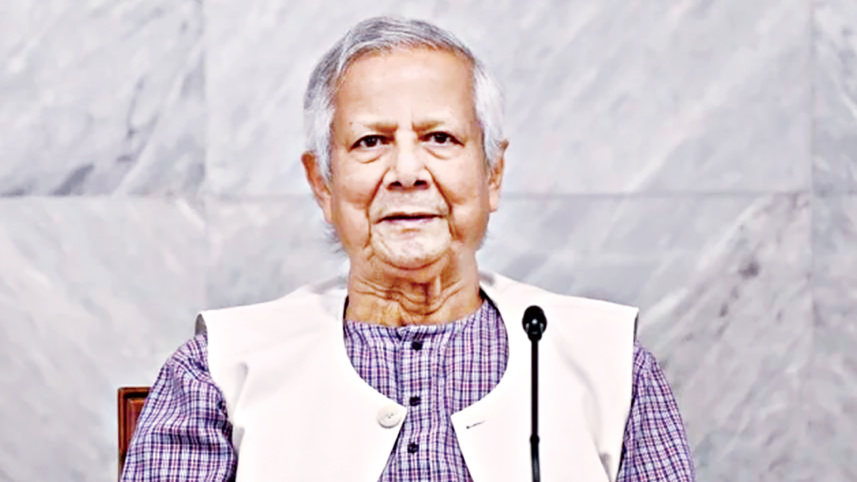
Chief Adviser Professor Muhammad Yunus has said Bangladesh-China cooperation must continue beyond his tenure.
“In a few weeks, I will be out of this office, and a new government will be formed, but the work between our two countries must go on,” he said.

The chief adviser made the remarks when a delegation from the China-Bangladesh Partnership Forum met him on Wednesday at the State Guest House Jamuna, according to the Chief Adviser’s Press Wing.
The delegation included senior Chinese academics, investors, and industry leaders from the biomedical, infrastructure, digital, and legal sectors.
Xin-yuan Fu, a leading Chinese biomedical scientist and director of the West China School of Medicine at Sichuan University, praised Professor Yunus’s vision and said he looked forward to working with Bangladeshi academics to help improve people’s lives.
Andrew Zilong Wong, senior adviser to the board of directors of Walvax Biotechnology, and Yuqing Yao, managing director of Walvax Biotech (Singapore), also expressed interest in working with Bangladesh. Walvax has exported vaccines to at least 22 countries.
The delegation informed the chief adviser that they had engaged with Bangladeshi university students on artificial intelligence and digitalisation and expressed admiration for the talent and potential of the country’s youth.
During the meeting, Yunus recalled his long-standing relationship with China, which began through the microcredit movement.
“I had the opportunity to visit remote villages in China and see how people’s lives were being transformed. Later, the Chinese government launched its own programmes inspired by these principles,” he said.
Highlighting the interim government’s priorities, the chief adviser said healthcare remains the top concern.
“Our highest priority is healthcare -- how to integrate digital technology so that doctors and patients can connect effectively, medical histories can be preserved digitally, and appointments can be accessed easily,” he said.
He also emphasised the need for social business models in the pharmaceutical sector.
“Medicines cost pennies to produce, yet are sold for dollars. We want to encourage the establishment of social business pharmaceutical companies that focus on helping people, not just profits,” he said.
He also shared his vision of establishing a “health city” in northern Bangladesh.
“During my visit to China, I proposed building a 1,000-bed international hospital in northern Bangladesh. It is a poor region but strategically located near India, Nepal, and Bhutan,” he said.
He explained that the proposed health city would include hospitals, medical colleges, research centres, vaccine production facilities, pharmaceutical industries, and medical equipment hubs.
“All health-related activities would be located in one city. People from India, Nepal, and Bhutan could also benefit by accessing quality healthcare facilities there,” he added.
The chief adviser expressed gratitude to the Chinese government for its continued support and cooperation.
 For all latest news, follow The Daily Star's Google News channel.
Comments