


API Park: The pharmaceutical lifeline still out of reach

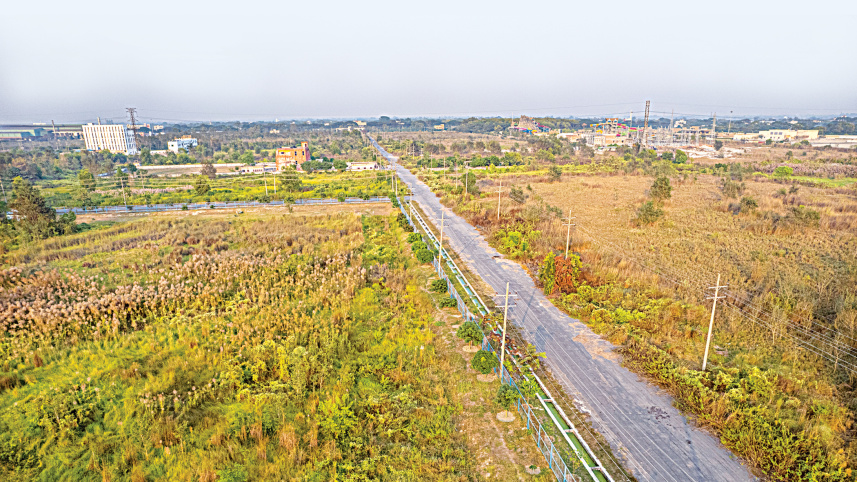
On a quiet December 11 afternoon, entering the API (active pharmaceuticals ingredients) Industrial Park in Gajaria upazila of Munshiganj, located about 50 kilometres from Dhaka city along the Dhaka-Chattogram Highway, felt oddly nostalgic, like stepping into a forgotten picnic spot.
Neatly paved roads lined with mango trees led us in, but the illusion quickly faded.
 For all latest news, follow The Daily Star's Google News channel.
 Despite 26 plots being allocated to pharmaceutical companies, only a handful of buildings stood. The rest? Overgrown jungle. Most plots remain untouched, with minimal signs of construction or industrial activity. A few scattered workers could be seen, but the park was eerily silent – far from the hub of pharmaceutical innovation it was meant to be.
For the companies who poured money into the park hoping for a brighter future, the delay has only brought frustration.
“I invested in good faith. Now I’m under serious financial pressure,” said Md Halimuzzaman, managing director of Healthcare Formulations Ltd, which invested nearly Tk 500 crore in the park and is now having to pay hefty loan instalments of Tk 20 lakh per day.
The vision behind the park was clear: reduce Bangladesh’s dependency on imported raw materials by fostering local production of API – the raw materials needed to make medicines. But nearly two decades since the project was approved, progress remains minimal. While land development and roads are largely complete, basic utilities like gas are still missing.
WHY API AND THE PARK MATTER
Bangladesh’s pharmaceutical industry, which now meets almost all domestic demand for finished medicines and exports to more than 150 countries, has long carried a structural weakness: low local production of APIs.
Currently, around 85 percent of APIs are imported, mainly from India and China.
For years, trade preferences and intellectual property flexibilities under LDC status softened the risks of import dependence. That protection is ending as Bangladesh graduates from least developed country (LDC) status later this year, which could fundamentally alter the cost structure and competitiveness of its pharmaceutical industry.
Bangladeshi firms have invested heavily in modern formulation plants, international compliance, and complex dosage forms over the past two decades.
Yet formulation alone does not ensure resilience. APIs account for a significant share of production costs. Import reliance exposes manufacturers to foreign exchange volatility, supply disruptions, and rising global prices.
After LDC graduation, local firms will also no longer freely produce patented medicines without licensing under TRIPS (Trade-Related Aspects of Intellectual Property Rights). This will increase costs and reduce margins, making domestic API production more critical than ever.
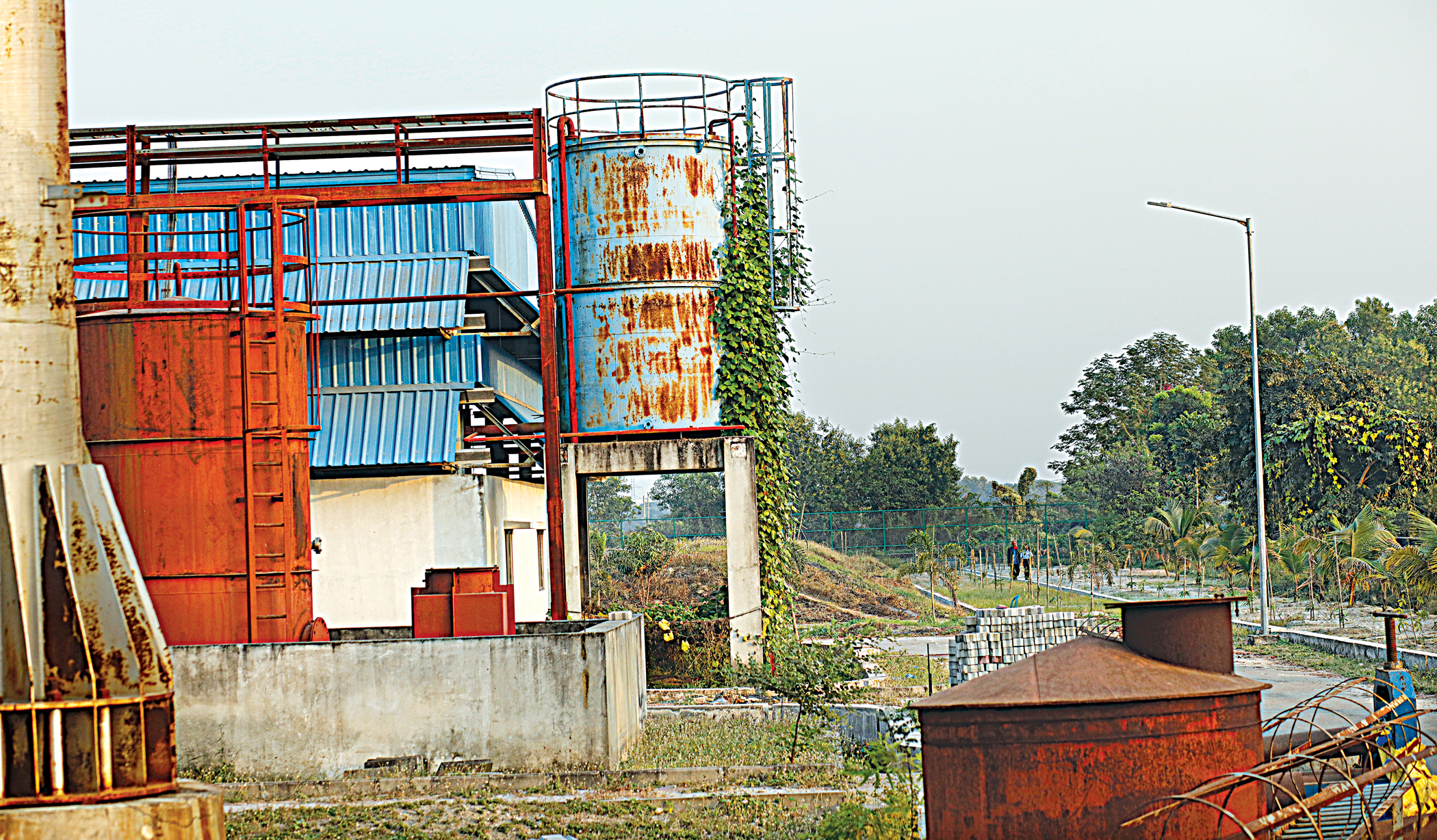
Vines grow over rusting tanks at the API Industrial Park, a symbol of the stagnation facing the project.
The state recognised the vulnerability early.
In 2008, the government approved a dedicated API Industrial Park in Gajaria, Munshiganj, to reduce import dependence and anchor backward integration. Nearly eighteen years later, the park has yet to come alive.
The API Park, spanning 200 acres, was designed to host 42 manufacturing plots with shared infrastructure: internal roads, drainage, a high-capacity electricity substation, and a central effluent treatment plant (CETP). Clustering API producers in one zone was intended to lower entry barriers, ensure environmental compliance, and make backward integration commercially viable.
More than two dozen pharmaceutical companies, including major players like Square, Beximco, Incepta, Acme, and Ibn Sina, applied for plots. Several began investing soon after allocation, borrowing from banks to construct factories and install equipment.
Despite the high ambition, the park failed to deliver. It is laid out with wide internal roads, boundary fencing and utility corridors, but most of the land remains undeveloped. Large plots stretch uninterrupted for hundreds of metres, covered in shrubs and tall grass. Power lines run along empty roads that lead nowhere.
Only a handful of buildings break the uniformity of the terrain, underscoring how little industrial activity has taken root nearly two decades after the project’s approval.
The most prominent structure in the park is the CETP, built at a cost of around Tk 80 crore. Environmental compliance is mandatory for API production, which generates hazardous chemical waste. The plant was designed to serve all factories in the park, reducing individual compliance costs and ensuring regulatory oversight.
The facility has never been used. With no factories operating, it sits idle, deteriorating in the open.
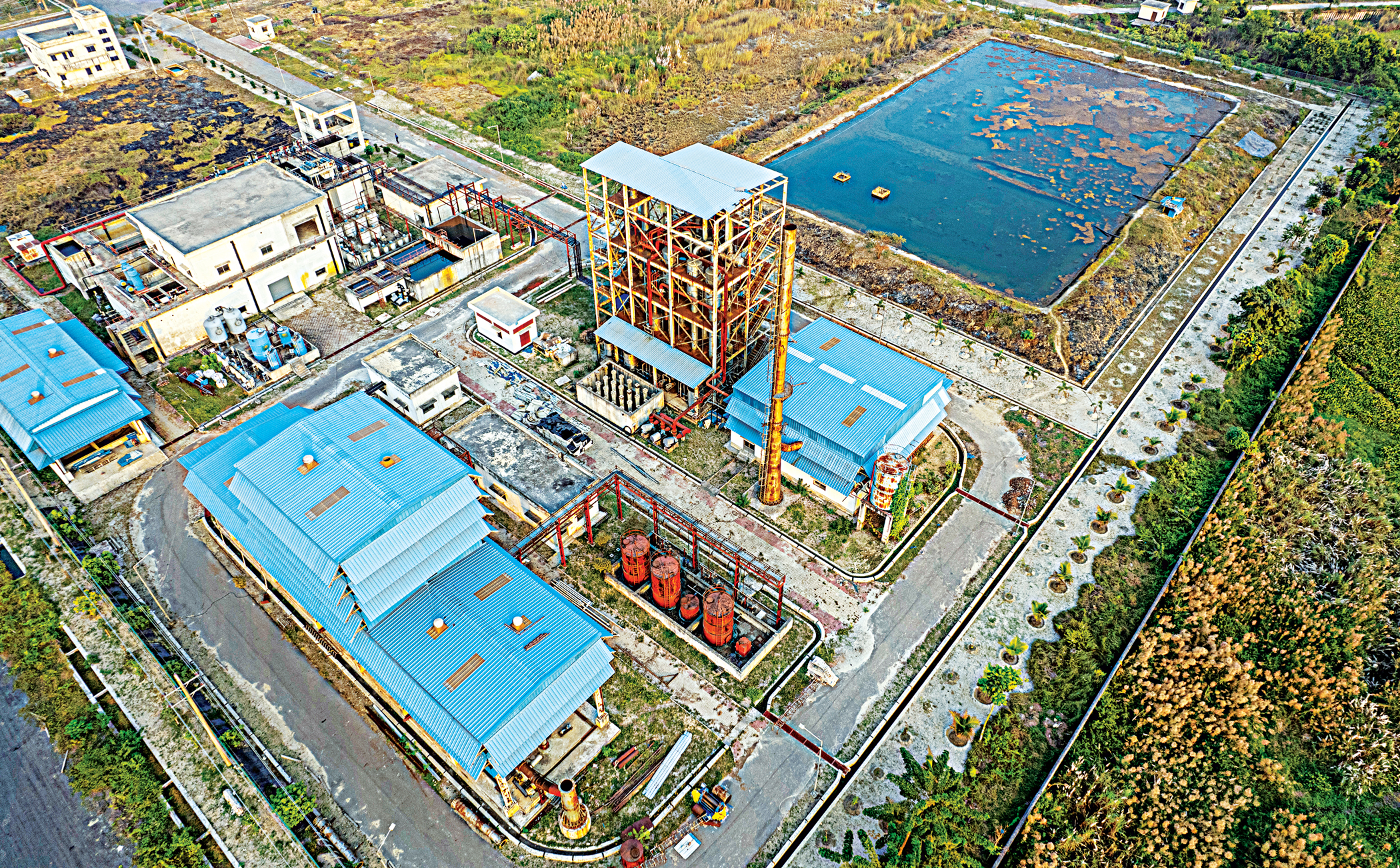
An aerial view of the park’s infrastructure, featuring the Tk 80 crore central effluent treatment plant. Designed to handle hazardous chemical waste for dozens of factories, the facility remains unused and deteriorating.
NO GAS, NO PRODUCTION
The paramount failure for the park is not having access to gas, the one utility without which API production cannot function sustainably. API manufacturing is energy- and steam-intensive. Natural gas is essential for generating steam used in chemical synthesis, distillation and purification processes. Without gas, production costs rise four to five times more.
Healthcare Formulations is among the companies most affected by the delay.
The factory has been fully constructed and equipped. But production is yet to begin due to lack of necessary utilities.
“We invested based on the expectation that utilities would be provided,” said Halimuzzaman. The company planned to start by producing 20 API molecules and add at least four new formulations every year.
Operations have not begun because there is no gas connection.
Running the factory entirely on electricity, Halimuzzaman said, is not technically feasible and would be prohibitively expensive.
Other companies face similar constraints. Several factories are partially built or fully ready but remain idle due to the lack of utilities.
Abdul Muktadir, chairman and managing director of Incepta Pharmaceuticals, said Bangladesh’s pharmaceutical growth has been real but incomplete. “We have done well in formulation, but API remains our Achilles’ heel,” he said.
“Local production is still very limited compared to national demand.”
Bangladesh currently manufactures only 10 to 15 APIs domestically, out of around 200 considered essential. Incepta produces four and is developing more.
According to Muktadir, early attempts at API production in the 1990s focused on basic compounds such as paracetamol and ampicillin but failed to scale due to low demand and shortages of skilled manpower.
A shift began after 2010, as Bangladeshi firms entered regulated export markets and saw the strategic value of backward integration. Incepta invested heavily in scientific capacity, establishing a dedicated API research and development division in 2011 that now employs more than 100 scientists.
But scaling up small-molecule API production remains constrained by energy availability. “API manufacturing is steam-intensive,” Muktadir said. “Without gas, using diesel increases costs four to five times. You cannot compete globally under those conditions.”
He said the API Park was intended to resolve this bottleneck. “Instead, what we have is land and roads, but no gas, no steam and no functioning ecosystem.”
THE OTHER CONUNDRUMS
The timing of this failure is increasingly consequential. Bangladesh’s graduation from LDC status will end the TRIPS waiver that allows local companies to produce patented medicines without licensing.
Export incentives are already being reduced, from 10 percent to 5 percent this year, with further cuts expected.
Shawkat Haider, executive director of Beximco Pharmaceuticals, said these changes will place new pressure on the industry.
“After graduation, we won’t be able to make new molecules freely, and rising API prices will increase medicine costs,” he said.
Bangladesh’s dependence on imported APIs limits its ability to absorb these shocks. “The API Park was meant to reduce this dependence.”
Some industry figures argue that Bangladesh should adopt a more selective approach to API production.
Monjurul Alam Monju, former chief executive officer of Beacon Medicare, said producing every API domestically is unrealistic, particularly for specialised treatments such as cancer, where domestic demand is limited.
“Developing APIs requires heavy investment and long-term commitment,” he said. “Countries like India and China can do this because of their large markets.”
Instead, Monju suggested focusing on a limited range of APIs with consistent local demand, supported by targeted government incentives.
However, Mustafizur Rahman, distinguished fellow at the Centre for Policy Dialogue (CPD), said API backward linkage is essential for keeping our pharmaceutical sector competitive, noting the country imports around $1.2 billion worth of APIs annually.
Rahman pointed out that Bangladesh may face immediate impacts from losing preferential trade benefits if it cannot secure an extended TRIPS waiver, which was proposed but not accepted at the WTO in December 2024. “This is a critical issue,” he stressed.
Others see the problem as deeper than infrastructure. Rauful Alam, a former principal scientist at PTC Therapeutics in the United States, said Bangladesh lacks sufficient investment in drug discovery and medicinal chemistry.
“Our pharmaceutical industry is heavily focused on formulation,” he said. “Without building capacity in organic chemistry and non-clinical research, true self-reliance will remain out of reach.”
NO TIMELINE FOR GAS SUPPLY
Officials involved in the project acknowledge the delays but cite national energy constraints.
GM Rabbani Talukder, deputy general manager of the Bangladesh Small and Cottage Industries Corporation, said core infrastructure – roads, drainage, a 20 MVA substation and gas pipelines up to plot boundaries – has been developed.
“The problem is gas supply,” he said, adding that Titas Gas and the energy ministry have cited national shortages.
Alternative solutions, including sustainable energy options on adjacent land, are being explored.
Razib Kumar Saha, deputy managing director of Titas Gas Transmission and Distribution PLC, said “There is currently no timeline for supplying gas to the API Park due to insufficient reserves.”
A proposal for a coal-based power plant exists but remains at an early stage, he added.
Comments