
ABM Habibullah redefined how Bengal’s history is read
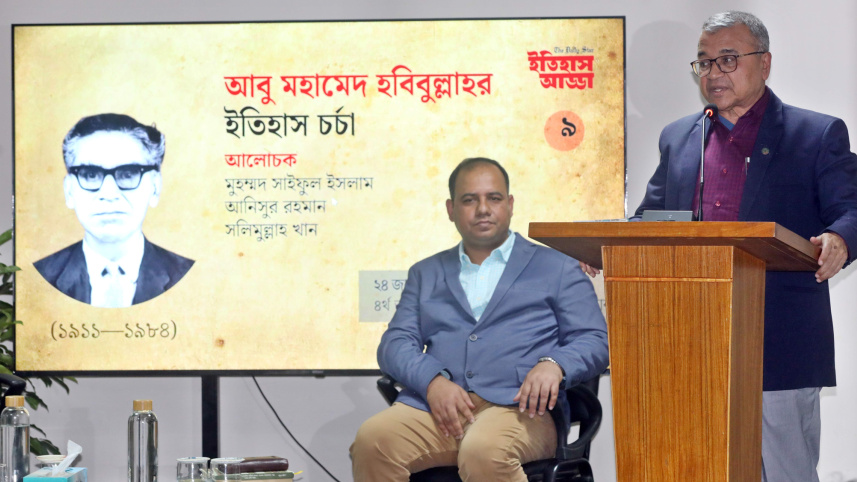
For decades, history in this region focused on dynasties, wars and imperial courts, but Professor ABM Habibullah shifted attention to trade, culture and the social lives of ordinary people in Bengal, said speakers at an event yesterday.
Academics and journalists made the remarks at the ninth episode of Itihas Adda, titled “Abu Mohamed Habibullah’r Itihas Chorcha,” held at The Daily Star Centre.
 For all latest news, follow The Daily Star's Google News channel.
 They said Habibullah’s work challenged colonial interpretations of history and traced the independent roots of Bangalee Muslim identity.
Professor Salimullah Khan described Habibullah as a lone figure in the intellectual landscape of East Bengal, noting that he stood outside the dominant historical traditions centred on Calcutta or Aligarh.
He said Habibullah’s scholarship directly countered the views of colonial-era historians, including Sir Jadunath Sarkar.
“Jadunath Sarkar believed that any significant achievement of the Muslim community in India took place only during the Mughal period,” Salimullah said.
“Habibullah Sir rejected that idea. He argued that the Turko-Afghan period, or the Sultanate era, laid the real foundation of Muslim rule and civilisation in the subcontinent,” he added.
Salimullah also explained Habibullah’s reading of Bengal’s long political independence from Delhi during the Sultanate period. According to Habibullah, Bengal remained independent for more than two centuries because of its control over maritime trade routes dominated by Arab merchants.
“As long as the Arabs controlled the Indian Ocean, Bengal maintained an independent connection with the wider world,” Salimullah said.
“When the Portuguese defeated the Arabs and took control of the sea routes, that link was broken. Bengal was then forced to look inward towards Delhi and eventually lost its sovereignty to the Mughals,” he added.
Salimullah further said Habibullah’s method could be used to question later historical interpretations, including those of historian Richard Eaton on mass conversion in Bengal.
He said Islam in Bengal evolved from an urban, merchant-based religion into a rural social force during the independent Sultanate period, driven mainly by Sufis and missionaries rather than imperial authority.
Md Anisur Rahman, a researcher and teacher at Jagannath University, described Habibullah as a professional historian who relied on original sources instead of popular narratives.
He said Habibullah had a strong command of languages and was fluent in Arabic, Persian and Urdu by family tradition, later learning Sanskrit, German and Russian.
“Unlike many scholars who depend on secondary translations, he worked directly with original texts,” Anisur said. “His Bangla translation of Al-Biruni’s Kitab-ul-Hind captures meanings that are missing even in standard English translations.”
Anisur also referred to Habibullah’s argument that Islam entered Bengal mainly through trade routes. As a result, he said, religious practice in Bengal developed a more liberal and syncretic character than in North India, where Islam was shaped by military elites.
The historian’s grandson, Somudro Haque, joined the discussion virtually from the United States and drew a parallel between his own work in aerospace engineering and his grandfather’s scholarship.
A senior principal engineer at Northrop Grumman, Somudro said he was currently designing technology for a lunar space station.
“I am designing equipment for the moon that must last 30 years, while he built a narrative of our past to last for generations,” he said, adding that he would finance the digitisation of Habibullah’s works.
The Daily Star journalist and event coordinator Shamsuddoja Sajen said Habibullah’s most enduring contribution was his focus on social and cultural history rather than the history of kings and courts.
However, he expressed concern over the current condition of institutions such as the Asiatic Society of Bangladesh and the Bangladesh Itihas Parishad, both of which the historian helped establish.
“We had hoped for a revival in historical practice after August 5, but there has been little improvement,” Sajen said.
Emran Mahfuz, another journalist of The Daily Star, conducted the programme.
Comments