


Covid risk looms large on tea workers

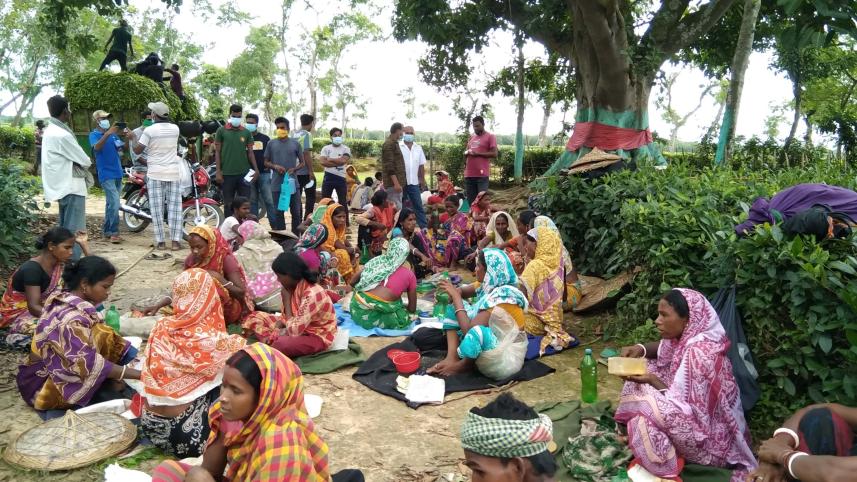
While cases of Covid-19 infection are rising every day amid the ongoing countrywide lockdown of most businesses and factories, the labour-intensive tea plantations remain open without ensuring minimal health rules.
Against crores of taka invested on various infrastructures including roads, factory buildings and luxurious housing accommodations for officials, the authorities of the tea estates so far did nothing to build even basic covered facilities where the underpaid workers can at least sit down and have their mid-day meal while maintaining social distancing.

According to a handbook published by Bangladesh Tea Board in June last year, there are 1,40,164 registered and occasional tea workers at 166 tea plantations in the country.
Daily wage of a registered tea worker in the country is between Tk 117 and Tk 120, which is the lowest in the world, said Pankaj Kanda, vice-president of Bangladesh Tea Workers' Union.
Due to their exceedingly low income, most of these marginalised people can only afford to build mud houses with thatched roof in authorised 'labour lines' -- a cramped area in a tea estate that lacks proper sanitary facilities.
If the coronavirus infects a tea worker, it will spread like a wildfire in the labour lines where an estimated five lakh workers and their family members live, Pankaj conjectured.
Kossoilla Ghatual, a worker at a tea garden in Habiganj, is the soul breadwinner of her five-member family. She said she and her family had been passing days in extreme fear after hearing the news of a worker in the labour line getting infected with Covid-19 recently.
Raju Nunia, general secretary of University Tea Students' Association and son of a tea worker, said that too little has been done to create awareness among tea workers about the deadly virus.
Preparation has been inadequate to ensure health rules including wearing face coverings, maintaining social distancing and setting up convenient hand wash outlets at the tea estates.
A sizable number of the people living in the labour lines are elderly and children, who are mostly malnourished; and if coronavirus gets a hold of them, it will be a major humanitarian disaster.
Regardless of the risks posed to such a large population, no steps have been taken to offer Covid tests at the tea estates or vaccinate the workers, Raju added.
Nipen Paul, acting general secretary of Bangladesh Tea Workers' Union, said they made repeated calls to ensure safety of tea workers by declaring paid holiday at the tea factories in line with the ongoing countrywide lockdown, but the authorities did not pay heed.
"The underpaid tea workers can't afford to lose their daily wage or spend additional money to buy face masks, hand sanitizers or soaps. But there has been no measure on part of the authorities to ensure supply of these health safety items," said Rajdew Kairi, a worker at a tea plantation in Moulvibazar.
While speaking with this correspondent, GM Shibli, chairman of Bangladesh Cha Sangshad's Sylhet branch, said all tea estates have been conducting their business in compliance with health guidelines of the government.
"We are trying to make the workers aware of the virus and offering them facemasks and soap to ensure their safety. We also ask them to maintain safe distance while working."
If they were to shut down their operations, tea leaves would be spoiled and the tea industry would incur huge losses, he said claiming, "No one has been infected by coronavirus in the tea gardens. Those who are infected came from outside."
Mohammad Nahidul Islam, deputy director of Divisional Labour Office in Sreemangal and the convener of 'crisis management committee', said inoculation were ongoing at some places, but they were short-staffed to cover the entire division.
However, despite repeated attempts, he could not provide any data on any Covid-related deaths or infections at tea estates in the region.
Brac Chairperson and economist Dr Hossain Zillur Rahman said dire consequences await a large worker population at the tea estates unless the low-income workers, who cannot afford nutritious food and proper housing, are vaccinated urgently.
 For all latest news, follow The Daily Star's Google News channel.
Comments