


Bangladesh stops dead in its tracks
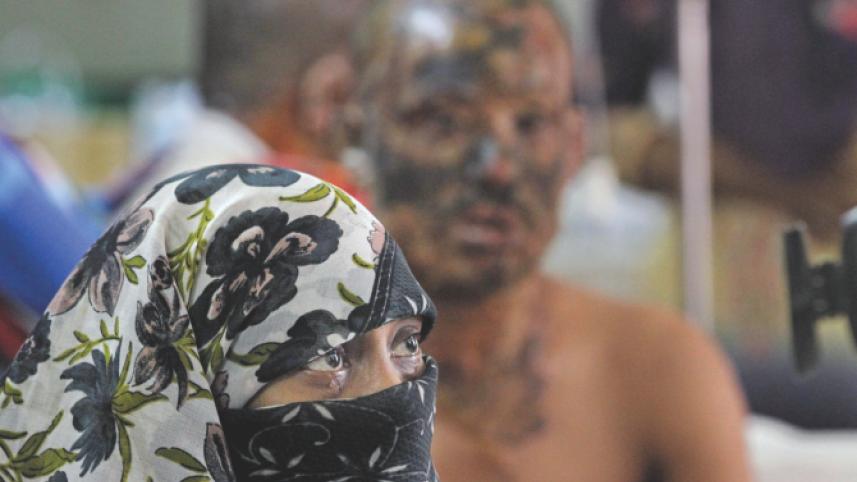
Nobody seems to be safe these days.
People are burnt alive as mindless arson attacks on public transports go unabated.

The economy continues to bleed and academic life of students is severely affected due to the ongoing political turmoil.
Yet, the battling sides -- the Awami League and the BNP -- appear nonchalant and rigid on their stances. And there is no sign of any effective move from either side to bring an end to this situation.
Thanks to their rigidity, the country has been experiencing the longest ever non-stop political agitation -- blockade -- in its history.
The previous major agitations took place in 1990 against the autocratic Ershad regime, in 1995-96 and in 2006 against the then BNP-led governments, and in 2013 against the AL-led government.
But none of those was as lengthy as the current one, and people were not so ruthlessly killed then.
The BNP-led 20-party alliance that enforced the non-stop blockade on January 6 set a record yesterday by continuing the programme for 30 consecutive days.

The record may get bigger, as BNP Chairperson Khaleda Zia already vowed to continue the blockade until the government creates a congenial atmosphere for an early parliamentary election.
The BNP-led combine has been claiming that the agitation is aimed at restoring people's democratic rights by toppling the present government formed through the one-sided January 5 national election a year ago.
The AL-led government opted to foil the agitation through administrative measures instead of looking for a political solution. But it has failed.
Opposition activists are rarely seen on streets to enforce the blockade and hartals. But they allegedly keep throwing petrol bombs at public transports, leaving people in a state of panic.
The use of excessive force and violent means has worsened the crisis, and people and businesses have been made to pay dearly.
Strengthened by shutdowns, the countrywide blockade has severely hampered people's movement, leaving them in a state of uncertainty.
Educational institutions are forced to remain closed for an indefinite period, jeopardising academic schedules at schools, colleges and universities.
All sectors, including garment, agriculture, real estate and wholesale and retail trade, suffer the brunt of the ongoing crisis.
WHAT ANALYSTS SAY
 For all latest news, follow The Daily Star's Google News channel.
 M Hafizuddin Khan, former adviser to a caretaker government, thinks the prevailing crisis should be resolved politically.
"Neither the government nor the BNP will get the desired results by using force or violent means," he told The Daily Star yesterday.
"It is a vicious circle. Violence breeds more violence. And to check escalation of violence, the government will need to use more force. But it will fuel further violence," he added.
Echoing his view, Prof Nizam Ahmed, a teacher at Chittagong University, said the solution to the current crisis lies in political means.
It is necessary to get to the bottom of the crisis and then address it to take the country out of this turmoil, said Prof Nizam, a researcher on the country's political culture and parliamentary affairs.
The present political impasse is rooted in the cancellation of the non-partisan caretaker government by the AL-led government in June 2011.
The matter couldn't be solved even in around three years due to the two sides' rigid stances on the caretaker government issue. The failure led to the holding of the one-sided parliamentary election on January 5 last year.
The crisis resurfaced prior to the first anniversary of the one-sided national polls.
The BNP sought the government's permission to hold a rally on January 5 to observe the day as "democracy killing day".
But the government denied the BNP permission. It had confined Khaleda to her Gulshan office for two weeks since January 3, and locked the party's Nayapaltan office.
On January 5 evening, an infuriated Khaleda announced a non-stop nationwide blockade.
Comments