


Bangladesh tops South Asia in air pollution


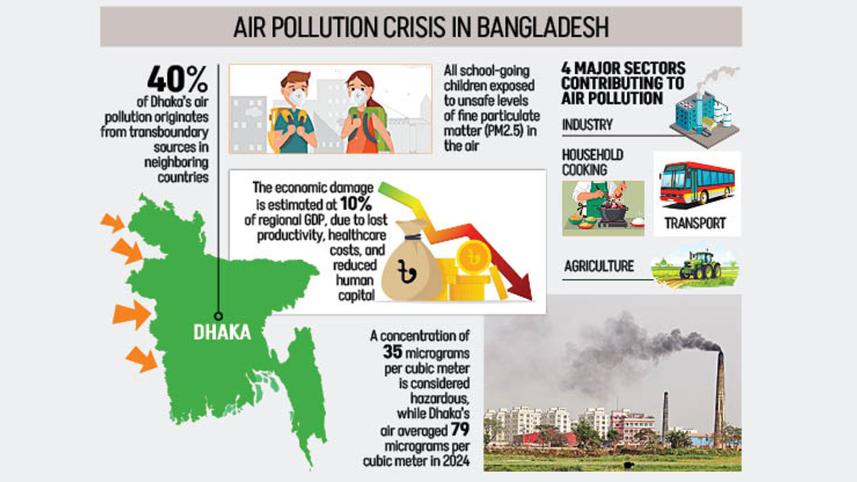
A new World Bank report has ranked Bangladesh as South Asia's worst-hit country by air pollution, with 100 percent of schoolchildren in Dhaka and nearby areas exposed to unsafe levels of fine particulate matter (PM2.5).
PM2.5 particles, which are 2.5 micrometres in diameter or smaller, are particularly harmful because of their ability to penetrate deep into the lungs and bloodstream.

The report, covering the Indo-Gangetic Plains region, said that around 40 percent of Dhaka's air pollution originates from transboundary sources in neighbouring countries.
Titled "A Breath of Change: Solutions for Cleaner Air in the Indo-Gangetic Plains and Himalayan Foothills", the report highlights the lack of systematic school closure protocols in Bangladesh during episodes of high air pollution.
"Air pollution routinely disrupts education, undermining student learning by impairing cognitive performance," it said. Even modest increases in PM2.5 are linked to learning losses equivalent to several weeks of schooling.
Following Bangladesh, Pakistan, Nepal, Bhutan, and India also face serious risks, with between 79 and 95 percent of students exposed to hazardous air.
A PM2.5 concentration of 35 micrograms per cubic meter is considered hazardous, while Dhaka's air averaged 79 micrograms per cubic meter in 2024, according to AQAir, a Swiss air monitoring firm.
While schools in India and Pakistan often close during extreme air pollution episodes, the report notes that school closures, while protective, may not significantly reduce exposure and can cause unequal learning losses.
The report identifies four major sectors contributing to air pollution in Bangladesh -- industry, household cooking, transport, and agriculture. "While industrial and household emissions dominate, regional cooperation is crucial due to transboundary pollution."
Despite Bangladesh's promotion of improved cookstoves and biogas technologies, only about 28 percent of households use clean cooking fuels such as LPG or biomass, the report said.
It said the outdated vehicle emission standards and high-sulfur fuels in Bangladesh and Pakistan further increase pollution, with vehicles often emitting several times more than cars in India or Europe.
Agricultural practices, particularly crop residue burning, are emerging as a growing source of pollution in the greater Dhaka area due to increased use of harvesters and reapers.
The report emphasises the need to eradicate open burning, reduce road and construction dust, and modernise heavy-duty vehicles to achieve an annual average PM2.5 concentration of 35 microgram per cubic meter within the next decade, a target known as "35 by 35".
Construction and demolition work in Dhaka alone generates about 1.28 million tonnes of waste annually, primarily concrete, bricks, and mortar, the report said.
In the greater Dhaka area, power plants contribute 24 percent of PM2.5, two-thirds of SO2, and 70 percent of NOx emissions, while brick kilns contribute 13 percent of PM2.5 and 25 percent of SO2, according to the report.
Thermal power plants using coal and oil remain a major source of pollution, with heavy fuel oil accounting for about 27 percent of total fuel consumption in Dhaka adjacent plants.
The report warns that air pollution in the region has reached critical levels, shortening average life expectancy by over three years and causing around one million premature deaths annually.
The economic damage is estimated at 10 percent of regional GDP, due to lost productivity, healthcare costs, and reduced human capital.
The report emphasises that the costs of implementing clean air measures are far lower than the costs of continued pollution.
The World Bank outlines a roadmap for achieving "35 by 35" through interventions in five key sectors.
 For all latest news, follow The Daily Star's Google News channel.
 The proposed plan includes scaled-up access to clean cooking fuels and appliances; modernised electrification and industrial boilers, furnaces, kilns, and power plants; increased efficiency in transportation and transition to electric vehicles; improved fuel quality; promoted sustainable management of crop residues, livestock manure, and fertiliser usage; improved waste collection, segregation, and recycling; and improved management of construction and road dust.
Protective sectors, particularly health and education, are also critical in helping communities cope while air quality remains poor.
The report concludes that with political commitment, institutional clarity, and sustained regional cooperation, the Indo-Gangetic Plains and Himalayan Foothills can achieve cleaner air, protect lives, strengthen economies, and lay the foundation for resilient, inclusive, and low-carbon growth.
Comments