


‘Marka’ : The symbols mapping decades of political legacy

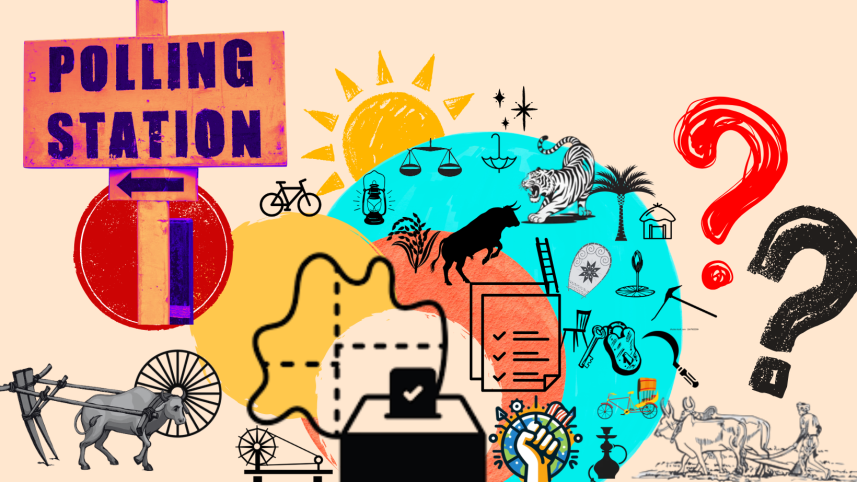
A few days ago, Dhaka’s social feeds lit up with a meme. Three men named Saiful, all vying for Dhaka-12 under different banners. The joke was obvious; the stakes behind it, less so. When names alone fail, what guides a voter’s choice? In Bangladesh, the answer is the symbol.
Traditionally in Bangladesh, voters recognise the symbols and grasp what it promises. A tiny icon on a ballot is rarely just an icon. It carries memory, allegiance, and identity long before campaign posters or promotional materials ever reach the public.

The National Citizen Party brought the issue into focus when it hesitated over adopting the “shapla koli” (waterlily bud) instead of the “shapla” it had originally sought as its symbol, prompting a series of meetings with the Election Commission.
Electoral symbols in Bangladesh are semiotic anchors, mapping decades of political life into objects instantly recognised by voters. Embedded in the textures of daily life, their meanings are layered, historically rooted, and culturally resonant. They also function as tools that can shape perception and nudge voter psychology.
The paddy sheaf (dhaner shish) tells a significant story. Fertility, sustenance, and agrarian toil are encoded in its simple lines. Its roots stretch back to Abdul Hamid Khan Bhashani’s National Awami Party and later the BNP, carrying the rhythms of rice fields, seasonal labour, and rural livelihoods. The plough (langol), historically associated with the Jatiya Party, signals authority over land, labour, and a grounded connection to agrarian life. These are not mere identifiers—they are vessels of expectation, recollection, and lived experience.
Although Awami League is disqualified in these polls, its symbol boat (nouka) is also one of the most enduring. Adopted by the United Front in 1954 and carried forward by the Awami League, it signifies journey, movement, deliverance, and leadership emerging from the riverine soil of Bengal.
The daripalla, or weighing scale, long symbolised Jamaat-e-Islami’s vision of justice and balance, embedding the party’s ideology in a simple, instantly recognisable image.
Other culturally embedded symbols extend the narrative. Lanterns (hariken) and hookahs (hukka) evoke household routines and communal gatherings. Winnowing fans (kula) and bullock carts (gorur gari) reflect labour, transport, and local economies. Huts (kure ghor) conjure domestic rhythms. Animals carry meaning too: cows (gabhi) for sustenance, horses (ghora) for strength and mobility. Each symbol ties political choice to personal and communal allegiance.
The semiotic landscape stretches further. Banyan trees (botgachh) promise shelter and continuity; rising suns (udioman surjo) embody renewal; stars (tara) guide. Roses (golap phul) and garlands (phuler mala) evoke festivity, trust, and collective memory. Household objects—spades, hand fans, lanterns—anchor voters to familiar spaces. Even ephemeral cues—the sunlight in a courtyard or the rumble of a bullock cart—accrue meaning through decades of use.
Together, the full spectrum of symbols forms a living map of Bengali society. Rural life and domestic rhythms surface in hookahs, lanterns, winnowing fans, bullock carts, huts, sickles, and spades—each reflecting everyday work, household activity, and shared experience. Household objects and tools—the chair, ladder, key, wristwatch, wall clock, candle, stick, television—signal familiarity, aspiration, and the urban gaze. Transport symbols such as bicycles and rickshaws recall mobility and circulation. Communal imagery, like the hand (panja/haat) or dove (kobutor), evokes trust, peace, and moral authority, while industrial labour finds its mark in the hammer (haturi). Each symbol turns the ballot from paper into a mirror of social life, mapping history, labour, landscape, and aspiration in a form voters instantly recognise.
Modern and aspirational symbols—televisions, computers, mobile phones, and helicopters—signal urbanity, technology, and connectivity, yet rarely carry the same emotional weight as traditional icons. Cricket bats, tiffin carriers, telescopes, or exotic animals act as mnemonic aids or branding cues, showing how contemporary culture intersects with politics without the depth of historical embedding.
These symbols do more than facilitate recognition; they perform cognitive and emotional work. In many constituencies, a voter may not read a candidate’s name but can instantly recognise the paddy sheaf, boat, plough, or hookah, linking history, livelihood, and political allegiance. Symbols also evoke nostalgia, trust, and expectation, connecting modern aspirations to political legitimacy.
Symbols are instruments of emotional consolidation and partisan identity formation. Parties extend their reach beyond ballots—through posters, jingles, banners, and chants—anchoring candidates in recollection and expectation. A familiar symbol grants instant recognition; a mismatched or unfamiliar one can unsettle voters and disrupt campaigns.
In this way, the ballot becomes a dynamic interface, where symbolic strategy, cultural memory, and political imagination converge—practical, persuasive, and poetic.
 For all latest news, follow The Daily Star's Google News channel.
Comments